

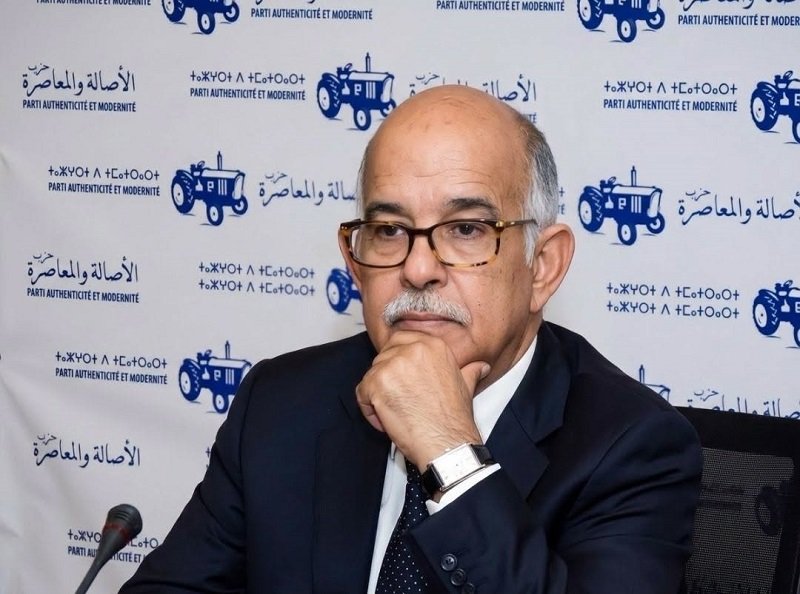
Since the announcement of the final results of the September 23 legislative elections, Morocco’s political debate has moved beyond the question of which party came first. The Party of Authenticity and Modernity (PAM) won 97 seats, ahead of the National Rally of Independents (RNI) with 66 and the Istiqlal Party with 65, while the Justice and Development Party (PJD) secured 54. A new political phase has therefore begun: the formation of the next government and the identification of the person who will lead it.
It was precisely at this point that several names began circulating across social media platforms, media outlets, among journalists and intellectuals. Mohamed Cheikh Biadillah has returned to the discussion, alongside other names, with some publications going as far as suggesting that he could be appointed Head of Government.
But the distance between a name being discussed and a name actually being chosen remains considerable.
That distinction is where the story needs to begin.
The text published by Dr. Abdelkader Al-Hafedh Brihma, under the title “Biadillah… From the Other Narrative to the Head of Government?”, starts from precisely this circulation. It presents Mohamed Cheikh Biadillah as a figure combining governmental, parliamentary and party experience, and examines whether such a profile could correspond to some of the requirements of the coming political phase. It is a political reading of the moment, not an announcement of an official decision.
What can be established independently of the speculation is that Mohamed Cheikh Biadillah is not a figure who suddenly appeared in the political conversation after the election. His institutional career goes back decades. He served as Minister of Health from 2002 to 2007, became secretary-general of the PAM in 2009, and later headed the House of Councillors. He also held administrative and territorial responsibilities before moving through government, Parliament and party leadership.
That sequence of positions helps explain why his name can re-enter the conversation at a moment when the issue is no longer simply electoral victory, but also the ability to build a parliamentary majority and manage relations between government, Parliament and opposition forces.
But past experience, by itself, does not establish what the next decision will be.
The constitutional framework is more precise. Article 47 of Morocco’s Constitution provides that the King appoints the Head of Government from the political party that comes first in the elections of members of the House of Representatives, on the basis of the election results. The first part of the equation is therefore known: PAM came first. The second part — the identity of the person who will be asked to form the government — does not automatically follow from the electoral result.
That distinction matters when reading the information now circulating. The phrase “royal appointment” does not mean that the choice is made independently of the election results. The Constitution establishes a direct relationship between those results and the party from which the Head of Government must be appointed.
It does not, however, turn a name discussed in the media into a constitutional decision.
The official portal covering the 2026 legislative elections also places the appointment of the Head of Government among the institutional steps following the announcement of the results. The constitutional process should therefore not be confused with the speculation surrounding it.
This is where the Biadillah case becomes more interesting.
The journalistic question is therefore not simply: Will Mohamed Cheikh Biadillah become the next Head of Government?
The more precise question is: Why has his name returned precisely after PAM’s electoral victory, what elements of his career make such a scenario conceivable, and what do we still have no public evidence for?
Part of the answer lies in his record.
Biadillah combines experiences that do not necessarily come together in one political career: territorial administration, government, party leadership and the presidency of Parliament’s second chamber. At a time when the next government will have to build a parliamentary majority and deal with political parties of different orientations, this experience is objectively one of the elements that could be considered when assessing a political figure.
But it does not establish that he will be chosen.
There is another factor. PAM itself is no longer the party it was when Biadillah led it. The party has gone through several generations of leadership, organizational changes and the renewal of its political cadres. In its own communications, PAM now emphasizes its evolution since its creation and the question of generational renewal within the party.
That introduces a question that appears less frequently in the current discussion: Is the next phase looking primarily for accumulated experience, or for a renewed political face? And do the two necessarily have to be treated as opposites?
The publicly available information does not allow us to answer that question on behalf of the decision-makers.
There is also Biadillah’s Sahrawi background, which features prominently in some of the analyses surrounding his name. Born in Smara, he built an important part of his political and administrative career in Morocco’s southern provinces. His political biography also records his participation, during the 1990s, in the identification process conducted under United Nations supervision.
That experience is a concrete part of his record and helps explain why some commentators connect his name to the Western Sahara dossier.
But the facts have to remain the boundary.
There is currently no publicly available evidence allowing us to state that this background would be a determining factor in any possible appointment. Turning Sahrawi origins, institutional experience and knowledge of the Sahara issue into an automatic equation leading to the head of government would be interpretation rather than verified information.
That is precisely the boundary journalism has to preserve.
The names circulating in the public debate are not limited to Mohamed Cheikh Biadillah. Other figures appear in articles and across platforms, sometimes accompanied by accounts presented as coming from political “insiders.” Yet the repetition of an assertion across several platforms does not make it independently verified, nor does it prove that a decision has been taken within the institutions.
The Soussi Media Group therefore cannot treat this type of circulation as established information simply because it is being widely repeated.
Repetition does not turn a hypothesis into a fact.
Mohamed Cheikh Biadillah has a real political and institutional record. His name can therefore legitimately be analyzed. But stating that he will become the next Head of Government requires something beyond the accumulation of experience, biography and profile: an official decision, or sufficiently solid evidence showing that he has actually become the selected figure within the constitutional process.
Until then, the story remains open.
There is a party that won 97 seats, a Constitution that establishes the framework for appointing the Head of Government, a party entering a new phase after an electoral victory, and an experienced political figure whose name has returned insistently to the public debate.
Between these elements lies a space that the currently available information cannot yet fill.
That is precisely the space that journalism must continue to watch.
The question, for now, is not whether Mohamed Cheikh Biadillah is the next Head of Government.
It is whether his name represents merely the media revival of an experienced political career, or whether it is genuinely beginning to appear among the calculations that will shape the next executive.
The answer will not come from the number of publications carrying his name.
It will come from the facts that emerge in the days ahead.


