

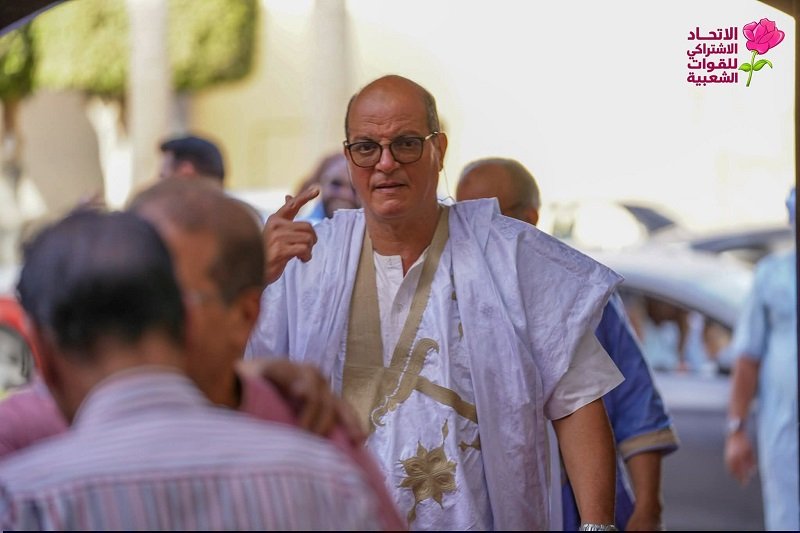
Some election texts end when the campaign ends. Others begin asking their most important questions after the ballots have been counted. Mohamed Daoudi’s article, titled “The Socialist Union I Know and the One I Do Not Know,” belongs to the second category.
Daoudi is not writing about a party he observed from a distance. He writes about a political organization in which he once held local and national responsibilities, and about a political environment in Laayoune and the southern region that he knows from direct experience.
That gives his testimony a particular weight.
The man who left the party organizationally, while insisting that he never abandoned the political school that shaped him, returned during an election campaign and says he discovered a party profoundly different from the one he had known.
This is therefore more than the story of a former party member returning to support a friend.
It is an attempt to measure the distance between a political party as a school of political thought and a political party as an electoral machine.
That is where the real substance of his argument lies.
From friendship with a candidate to a test of the party
In Daoudi’s account, everything began with the candidacy of his friend Mohamed Mouloud El Kiraa under the banner of the Socialist Union of Popular Forces.
For Daoudi, this was not simply another electoral circumstance. It brought him back, in practical terms, into a political space from which he had withdrawn organizationally many years earlier.
He explains that friendship, affection and his belief that the young candidate could bring added value to the local and national political scene convinced him to become actively involved in the campaign.
But his return is revealing.
He did not return seeking a position inside the party. He returned carrying a political memory, and that memory immediately came into contact with the party practice he encountered.
The campaign therefore became something larger than a campaign.
For Daoudi, it became a test of what the party had become.
Mohamed Daoudi is not simply defending the past
It would be easy to read his article as nostalgia for a political era that has disappeared.
That would nevertheless miss an important part of his argument.
When Daoudi invokes figures such as Abderrahim Bouabid, Abderrahmane Youssoufi, Noubir Amaoui and Mohamed Sassi, he is not merely recalling historical personalities. He is using them to define what he regards as the foundations of a political culture.
In his account, belonging to the USFP was not simply a membership card, an electoral color or a candidacy.
It represented a way of thinking about politics, a degree of independence in political choice and a particular relationship between the activist, the party and society.
That is why his final sentence — “This current Socialist Union, I do not know it; I am not part of it and it is not part of me” — carries a meaning beyond personal frustration.
He is not merely saying that he no longer recognizes certain individuals.
He is saying that he no longer recognizes the political culture that once gave the party meaning for him.
From tribe to party: the battle begins with political language
One of the most revealing passages in Daoudi’s testimony concerns the electoral discourse used during the campaign in Laayoune.
He explains that shaping the campaign message came naturally to him because he considers himself a product of the socialist political school.
He says he worked to impose a form of discourse that would move beyond broad slogans based on tribe and clan, and instead place the political party itself at the center of political mobilization.
This is not a minor detail.
For Daoudi, an election campaign is not merely about collecting votes. It is also a test of whether a political party can produce a political language of its own.
Does the candidate speak to citizens as citizens?
Or does he first address them through their family, tribal or social affiliations?
Can a political party become a framework capable of bringing together different social groups?
Or does it remain dependent on pre-existing social networks to generate electoral strength?
Daoudi’s observation therefore reaches beyond the USFP.
It touches a broader question about the relationship between political parties, candidates and social structures in constituencies where electoral politics remain closely connected to local realities.
His experience therefore raises a fundamental question:
If a political party can no longer offer a political alternative to traditional social networks, what remains of its political function?
The moment his perception changed
The decisive moment in Daoudi’s story did not take place at an electoral rally.
It took place at the party’s central headquarters in Rabat.
He says he traveled from Laayoune to Rabat on an official assignment to collect party endorsements for candidates in the region.
He expected, he explains, a relatively routine administrative procedure: submit the files, wait and collect the documents.
But a meeting with the party’s First Secretary, Driss Lachgar, changed his perception.
According to Daoudi’s account, Lachgar wanted to meet him personally and told him that he would personally handle the delivery of endorsements to a political figure belonging to another party. He also asked Daoudi to tell that person that he wanted to meet him.
Daoudi does not present the episode as a simple administrative matter.
He places it within his political history and the traditions that shaped him.
What troubled him, in his own interpretation, was therefore not merely the procedure itself. It was what he believed the episode revealed about a new way of managing the party and its candidates.
That distinction matters.
This is Mohamed Daoudi’s testimony and interpretation of what he experienced, not a judicial determination about the episode and not a general judgment on every member or official of the USFP.
The “political shop” as the language of a rupture
Perhaps the harshest expression in Daoudi’s article is his description of the current USFP as a kind of “electoral political shop”, followed by his characterization of it as a “machine of interests.”
Behind these expressions lies a deeper concern.
For Daoudi, the problem does not begin when a party loses parliamentary seats.
It begins when, in his view, the party loses the political reason why people should belong to it.
That raises a series of questions.
What makes a citizen join a political party?
Ideology?
Program?
History?
Trust?
Individuals?
Or access to an endorsement and a parliamentary seat?
If elections become the ultimate objective, what remains of the party between elections?
Daoudi does not present these questions as an academic political theory.
He makes them visible through his own experience.
That is precisely what gives his testimony its force.
The USFP after the 2026 elections
Daoudi’s article also comes at a specific electoral moment.
In the 23 September 2026 legislative elections, the Socialist Union of Popular Forces won 26 seats, behind the main parties that emerged ahead of it in the parliamentary distribution.
The final results confirmed the provisional figures announced after the vote.
USFP First Secretary Driss Lachgar acknowledged that the result represented a decline compared with previous performances and indicated that the party would need to draw lessons through its institutional structures.
It would nevertheless be excessive to turn Daoudi’s testimony into a single explanation for the electoral result.
Elections are shaped by multiple factors: candidates, campaigns, local organization, competition, participation, alliances and the broader political environment.
But his testimony introduces a question that electoral numbers alone cannot answer:
Is the problem simply electoral, or does it also concern the party’s identity, public image and relationship with society?
The message is not only directed at the USFP
A close reading of Mohamed Daoudi’s article shows that his message extends beyond the Socialist Union.
His message to political leaders is that carrying the name of a historic party does not automatically mean inheriting its symbolic capital.
His message to party officials is that the way endorsements, candidates and campaigns are managed is not merely an administrative matter. It reveals a conception of political organization.
His message to society is that reducing politics to individuals, families, networks or social affiliations risks weakening the very function of political parties.
And his message to younger generations is perhaps even more important: a party’s history cannot simply become a backdrop behind electoral platforms. It must produce a living political culture, otherwise it becomes a symbolic heritage invoked when convenient.
What does it mean to leave the party without leaving the school?
This may be the most interesting contradiction in Mohamed Daoudi’s text.
He left the organization, but says he never left the political school it represented for him.
When he returned to an electoral campaign, he therefore found himself trying to reintroduce what he regards as an authentic political discourse.
The organization remained behind him.
The political culture, however, continued to live within him.
That opens a question far larger than the USFP:
Can a political idea survive outside the organization that originally carried it?
And the reverse question is equally important:
Can a party retain its historic name when its internal political culture changes to the point that some of its former activists no longer recognize themselves in it?
There is also a generational dimension.
Is the problem that younger generations no longer know the party’s history?
Or have political parties failed to transmit that history as a living political culture rather than as symbolic heritage?
Elections end. The questions remain.
The 23 September elections redistributed parliamentary seats and opened a new political phase.
But Mohamed Daoudi’s article suggests that elections do not necessarily end with the announcement of results.
There is another, quieter contest: the contest over political identity, memory, practice and the party’s relationship with society.
A parliamentary map can change quickly.
Rebuilding political culture takes much longer.
Daoudi says he does not regret participating in his friend’s campaign. On the contrary, he believes that through that experience he defended a conception of political discourse to which he remains committed.
That is the central contradiction of his testimony.
He returned to the USFP to support a candidate and found himself questioning the party itself.
He returned for an electoral battle and emerged with a question about the meaning of political belonging.
He returned to an organization he had left many years earlier and says he encountered, in his own reading, a party whose political culture he no longer recognized.
His final sentence therefore carries the full weight of his argument:
“This current Socialist Union, I do not know it; I am not part of it and it is not part of me.”
It is not simply a personal conclusion.
It is a question addressed to the party itself.
Can the USFP still narrow the distance between its history and its present political practice? Or have the transformations of Moroccan electoral politics produced a different kind of party — one that some former activists no longer recognize as the party of their political memory?
Mohamed Daoudi leaves that question open.
And that is precisely why his testimony deserves to be read as more than a personal grievance: it is the account of a former activist who returned temporarily to the electoral field and, in doing so, attempted to measure what remains of a political school inside an organization he says he no longer recognizes.


