

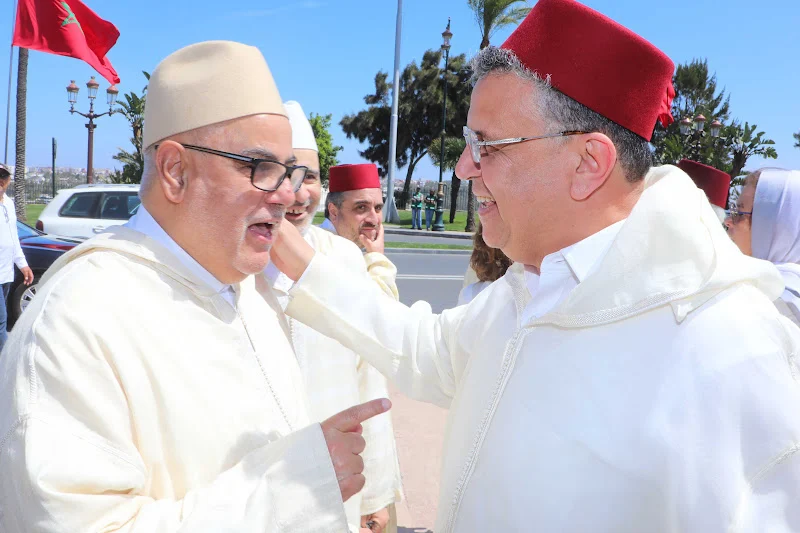
There is one sentence by Abdellatif Ouahbi, in his reading of the Authenticity and Modernity Party’s electoral result, that deserves perhaps more attention than some of his more explicitly political statements: “Within us, there is a conservative representation and a modernist representation.” At first sight, it sounds like a simple description of the ideological diversity within the PAM. Yet when placed alongside his comments about coalition-building and, more importantly, about the Justice and Development Party, the sentence takes on a different meaning.
Why did Ouahbi feel the need to explain that the PAM contains both conservative and modernist currents at a time when his party has just emerged as the largest parliamentary force, with 97 seats? The question matters. A party that has come first could simply speak about its programme, its result and its ability to build a majority. Ouahbi instead chose to describe the political composition of his own party.
The wording itself matters: “within us.” He did not say that conservatism and modernity exist somewhere in the Moroccan political landscape. He said that both are already represented inside the PAM. From there, a reading based on what could be called mafhum al-mukhalafa—a careful reading of what the wording allows one to infer without turning inference into fact—becomes possible. If the PAM considers that it already contains a conservative representation, then the PJD can no longer be presented as the sole political holder of that space.
That is precisely where the reference to the PJD becomes interesting.
Ouahbi said there were no red lines with the Justice and Development Party, provided that common ground could be found on constitutional principles, democracy, freedoms and human rights. That wording is not an announcement of a coalition. It creates a space for discussion. And the idea is not entirely new in Ouahbi’s political language: when he took over the PAM leadership in 2020, he had already argued for no red lines in alliances and expressed openness towards the PJD.
But in 2026, the electoral context gives that earlier openness a different weight.
The PAM moved from 87 seats in 2021 to 97 in 2026. The PJD rose from 13 to 54. The RNI, which had won 102 seats in 2021, now has 66, while the Istiqlal Party moved from 81 to 65. These figures do not by themselves determine the composition of a future governing majority, but they have altered the parliamentary balance. The PAM is now the largest force in the House, while the PJD has returned strongly enough to become a parliamentary actor that cannot easily be ignored.
The more revealing point lies elsewhere. The PJD returned with more seats after five years in opposition, but its political presence during that period was never limited to its numerical strength. Its MPs repeatedly raised issues involving rising prices, fuel, purchasing power and government accountability. In April 2022, for example, the PJD parliamentary group directly challenged the government over rising prices and fuel costs.
That helps explain why the 13 seats won in 2021 never told the whole story of the PJD. A parliamentary group can be numerically small and still occupy a political and media space larger than its arithmetic weight. That is relevant when looking at its return to 54 seats.
Ouahbi’s statement about the PAM’s “conservatives” can therefore be read from another angle. It is no longer simply about the party’s internal identity. It can also be understood as an attempt to redefine the boundaries between political spaces: conservatism does not belong exclusively to the PJD; modernity is not the exclusive property of the PAM either. According to Ouahbi’s formulation, both dimensions can coexist within the same political formation.
That shift in language matters because it allows the PAM to address different constituencies and political sensitivities without abandoning its own identity. But precision is essential: it does not mean that the PAM has decided to govern with the PJD. It means only that, in the party’s public discourse, the PJD is not placed behind an unbreakable political boundary.
The statements made on 24 September make clear that this opening is, for the moment, not reciprocal. Abdelilah Benkirane said that the PJD should not participate in a government led by the PAM, describing the position as a firm conviction. At the same time, Fatima Zahra Mansouri, one of the PAM’s collective leadership figures, said the party had “no red lines” in coalition discussions and that programmes and institutions would determine the possibility of agreement. She also stressed that the PJD should not be reduced to its secretary-general.
The political dialogue therefore exists more clearly in language than in an actual coalition decision. The PAM says the door is not closed; the PJD’s secretary-general says, for his part, that the party should not enter a government led by the PAM. Between those two positions lies the entire space of internal party discussions, parliamentary bargaining and institutional decisions.
Then there is the RNI. Its decline from 102 to 66 seats is significant, but it does not allow one to mechanically conclude that a new majority must be built against it. The RNI remains the second-largest parliamentary force, and the previous RNI-PAM-Istiqlal configuration still has enough seats, arithmetically, to remain a possible option. What the election has changed most clearly is the relative position of the partners: the PAM is no longer the second actor in such a configuration. It has become the first.
This is where Ouahbi’s wording becomes particularly revealing. He may not have been describing only what the PAM is; he was also defining how the party intends to present itself within a new parliamentary configuration. A party capable of speaking simultaneously to conservative and modernist sensitivities, while insisting that it has no red lines with the PJD, gives itself a wider political space for negotiations.
Still, the facts do not justify going further. Nothing in these statements establishes that a PAM-PJD coalition has been decided, nor that the RNI is destined to leave the equation. The Constitution provides a different starting point: the King appoints the Head of Government from the party that comes first in the elections to the House of Representatives, taking the results into account. The construction of the parliamentary majority comes afterward.
As for how the political system “thinks” about its balances, there are observable institutional mechanisms: the electoral system, constituency structures, local and national results, and the relationships among political parties. The electoral quotient reform introduced before the 2021 elections, for example, was politically contested but was found constitutional by the Constitutional Court. It therefore changed the mechanism through which votes are translated into seats, but it does not, by itself, constitute evidence that parliamentary seats were allocated in advance.
The rest belongs to journalistic interpretation.
One can observe, for example, that some political actors sometimes appear to have a remarkably precise understanding of the electoral margins in particular territories. That can be examined as a political and organisational phenomenon: local knowledge, networks, grassroots implantation and constituency-level balances. But an accurate anticipation of a number of seats, on its own, is not proof that an election result was “manufactured.”
That distinction is precisely what should be preserved when reading Ouahbi’s words. His reference to conservative and modernist representation within the PAM is not evidence of some hidden political arrangement. It is one element of the political language being used after an election that has significantly altered the parliamentary balance.
Within that language, the PJD now appears from a somewhat different angle: not simply as an external conservative force destined for opposition, but as a political formation with which the PAM says it can engage if certain political and institutional conditions are met.
Whether that possibility remains a verbal opening or eventually acquires a political form is still unresolved. For now, the two positions do not meet. Ouahbi says there are no red lines; Benkirane says the PJD should not govern under PAM leadership. Between those two statements lies precisely what the election has left open: political negotiation.


