

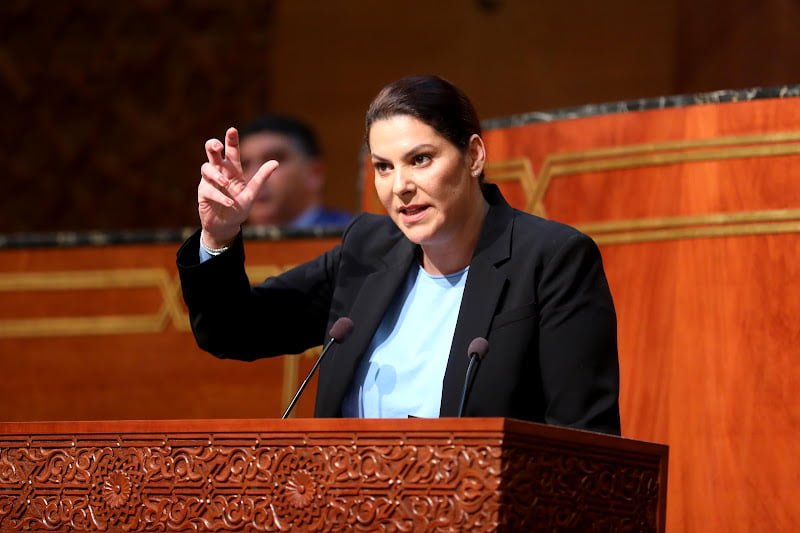
Fatima Zahra Mansouri did not present the expansion of public programmes and the growth of investment as sufficient measures of success for the new government’s term. Addressing a joint session of the two chambers of Parliament, she placed a more immediate question at the centre of government action: what tangible changes will public policies bring to employment, purchasing power, healthcare, education, housing and living conditions across the different regions of the Kingdom?
This shift towards measurable outcomes, during the joint parliamentary session held on Monday, 19 October 2026, takes on particular significance given the expectations facing the new government. The task is not simply to continue existing projects or launch additional programmes. It also involves improving the return on public spending and narrowing the gap between government decisions and the effects citizens experience in their daily lives.
Mansouri stressed the need to move from expanding social coverage to improving service quality, from measuring investment volumes to assessing their returns, and from multiplying programmes to ensuring that they complement one another. These priorities reflect an expressed intention to make the tangible impact of public policies a central criterion for evaluating government performance.
The presentation comes at the first major institutional stage for the government appointed on 16 October, following Mansouri’s designation to form the new executive on 29 September. Article 88 of the Moroccan Constitution provides for the presentation of the government programme before both chambers of Parliament, its discussion by the two chambers, and a confidence vote in the House of Representatives. The session is therefore more than an announcement of the government’s broad direction. It also establishes an initial political and programmatic basis against which the executive’s performance can be assessed over the coming years.
Purchasing Power and Public Services: Priorities Whose Results Cannot Be Deferred Indefinitely
Mansouri placed employment and purchasing power among the principal social priorities, linking them to better healthcare and education, access to housing and the reduction of regional disparities.
These issues intersect in the daily lives of Moroccan households. Employment cannot be measured solely by the number of positions created; the stability of those jobs and the income they provide also matter. Similarly, expanding health coverage does not, by itself, guarantee satisfactory access to care when service quality and the ability to obtain treatment remain uneven across regions and social groups.
By insisting that state resources should be directed towards priorities whose effects citizens can directly experience, the head of government has placed implementation under a test with several dimensions. Employment outcomes depend on the creation of sustainable economic activity. Better healthcare and education require human resources, equipment and effective management. Access to housing, meanwhile, remains dependent on household purchasing power, the supply of homes and financing conditions.
Territorial justice involves more than distributing projects among regions. It requires more equitable access to public services and economic opportunities, regardless of where people live.
A distinction nevertheless remains between announcing these priorities and specifying the means by which they will become measurable. The programme presentation identifies the direction the government intends to pursue, but it does not, on its own, establish the scale of the expected improvements or when they will materialise. A meaningful assessment will depend on quantified targets, implementation deadlines, budget allocations and indicators that make it possible to compare outcomes with commitments.
This is not merely a technical issue. Once the government identifies the return on public investment as a criterion for evaluating its performance, it will need to explain what has been achieved, what has been delayed and why the resources committed have not always produced the expected results.
A Moroccan Economy Facing Accelerating International Change
Mansouri described an international environment marked by declining stability, intensifying competition and geopolitical tensions affecting trade and energy routes. She also referred to protectionist policies encouraging the relocation of production chains, alongside the changes in occupations and sources of added value driven by digitalisation and industrial progress.
Climate pressures on water resources, agriculture and food security add another dimension to these challenges.
These developments are closely connected to the social priorities presented to Parliament. Disruptions to trade and energy supplies can increase production costs and prices. Industrial transformation changes the conditions under which countries compete for investment and employment. Water availability remains a decisive factor for agricultural activity and the economic balance of rural areas.
Economic policy must therefore contend with growth exposed to external shocks, rather than focus solely on achieving favourable indicators under a particular set of circumstances.
The head of government highlighted several of Morocco’s advantages: its proximity to European markets, its African reach, its Atlantic position, institutional stability, developed infrastructure and existing industrial base. Together, these factors can strengthen the Kingdom’s appeal to investors, support exports and expand its presence in emerging economic sectors.
Turning these advantages into real economic opportunities, however, depends on the competitiveness of businesses, skills development, innovation and the practical conditions required for production and exports.
Geography gives Morocco an advantage, but it does not determine the outcome of international competition for investment. Nor does the arrival of new industrial projects automatically guarantee a broad improvement in employment or a wider distribution of economic benefits.
Assessment must also consider the links between new investments and local businesses, the value added generated within the country, the types of jobs created and the extent to which projects facilitate the transfer of expertise and technology.
By calling on the government and economic and social stakeholders to transform the Kingdom’s assets into opportunities for growth and wealth creation, Mansouri presented this ambition as a shared responsibility. That distribution of responsibility does not diminish the state’s central role in creating favourable investment conditions, simplifying procedures, developing infrastructure and services, and strengthening competitiveness while maintaining a balance between economic growth and social justice.
The Moroccan Sahara: Sovereignty and Development as Part of the Same Direction
On the national question, Mansouri reaffirmed the central importance of territorial integrity. She linked continued defence of the Kingdom’s sovereignty and interests to efforts to mobilise international support for Morocco’s autonomy initiative under Moroccan sovereignty, alongside an acceleration of development in the southern provinces.
She also referred to developments associated with a United Nations Security Council resolution, describing them as an important stage in the evolution of the issue. Assessing the diplomatic significance of any resolution, however, requires examining its official text and precise provisions, while distinguishing what it establishes from the political conclusions that may be drawn from it. Describing a development as an important milestone is not, by itself, sufficient to determine the next stages of the process or to conclude that the matter has been definitively settled.
At the level of government policy, the connection Mansouri established between defending Moroccan sovereignty and accelerating development in the southern provinces reflects an approach that treats development as part of strengthening national integration and consolidating the Kingdom’s position in its regional environment.
The southern provinces were presented as a strategic space through which Morocco can deepen its connections with Africa and the Atlantic region. This geographical dimension creates opportunities for trade, logistical connectivity and economic development.
Realising those opportunities nevertheless requires continued investment in infrastructure, better public services, expanded employment opportunities and effective participation by the populations of the Kingdom’s southern provinces in the benefits of development.
The practical challenge will be to establish what the new government’s term will add to achievements already under way, how the announced priorities will be translated into projects, resources and clear timelines, and which criteria will be used to assess their economic and social impact, including their contribution to territorial integration.
National Foundations and Foreign Policy
Mansouri placed the government programme within a framework that includes moderate Islam, constitutional, democratic, parliamentary and social monarchy, national and territorial unity, democratic choice, the preservation of cultural and linguistic diversity, respect for rights and freedoms, and equal opportunities. She also emphasised the central role of Royal Guidelines in defining the framework and priorities of government action.
The programme is therefore presented not merely as a collection of sector-specific measures, but as government action operating within the Kingdom’s constitutional and national foundations while continuing ongoing reforms and development projects.
Regarding the Palestinian question, the head of government reaffirmed Morocco’s commitment to supporting the Palestinian cause and Al-Quds Al-Sharif, as well as to a peaceful settlement based on a two-state solution, which she described as the path towards a just and lasting peace.
This position maintains the Palestinian question among the issues on which the Kingdom continues to articulate its established diplomatic principles. Assessing how those principles are implemented, however, requires looking beyond declarations to the decisions, policies and programmes actually adopted, while respecting the constitutional and institutional responsibilities of each actor.
From Programme Presentation to Parliamentary Accountability
The next stage in the constitutional process involves discussion of the government programme in both chambers of Parliament, followed by a confidence vote in the House of Representatives in accordance with Article 88 of the Constitution.
These debates will provide an opportunity to scrutinise the announced commitments, ask the government to clarify its objectives and means of implementation, and assess its ability to respond to social and economic expectations.
The executive will have to reconcile improvements in purchasing power, employment and public services with the requirements of investment, competitiveness and adaptation to international and climate-related change. These priorities must be coordinated within the limits of available public resources and through choices that determine which needs take precedence and how budget allocations are distributed.
Mansouri has outlined the direction the government intends to pursue over the next five years and identified the areas it wants to place at the centre of executive action. Whether these orientations will materially change the lives of Moroccans will depend on the measurable commitments that follow, the resources allocated to them and the observable results that Parliament and the public can monitor and use to hold those responsible to account.


