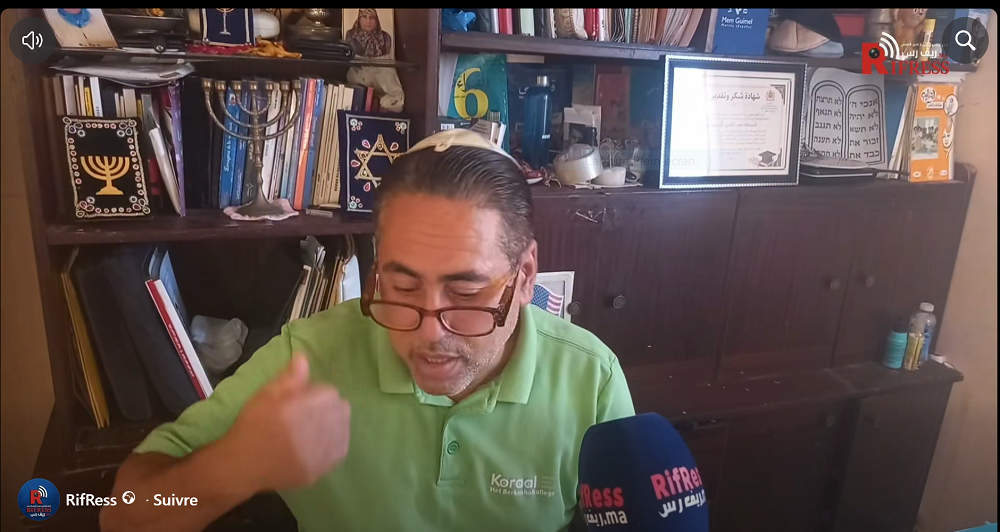
What struck public opinion most in the video released by the president of the Maimonides Association for Moroccan Jewish Heritage in Nador was not his complaint about the absence of public funding, nor even his denunciation of what he described as the repeated exclusion of his association from government support programs. The words that truly resonated were far more profound:
“Are we not Moroccans?”
This was not merely an emotional outburst in the context of an administrative dispute over financial assistance. It was an existential question that reopened one of the most sensitive debates in contemporary Morocco: what does citizenship truly mean when religious identity becomes, in the eyes of a citizen, a possible source of exclusion?
At its core, this case is not simply about a cultural association. It raises questions about Morocco’s national model itself—a model that has long presented itself, both domestically and internationally, as a unique example of coexistence between Muslims and Jews, and as a nation that constitutionally recognizes the Hebrew component as an integral part of its national identity under the 2011 Constitution.
From Public Funding to a Test of the State
On the surface, the association’s president speaks about repeated refusals of funding requests submitted to the provincial council. According to him, his organization fulfills all legal requirements, carries out cultural and educational activities, promotes Morocco’s Jewish heritage, welcomes delegations from Morocco and abroad, and contributes to objectives that are fully aligned with the Kingdom’s cultural and strategic vision.
Yet beneath this administrative complaint lies a far more fundamental demand:
the right to know why those requests were rejected.
At that moment, an administrative question becomes a constitutional one.
In a state governed by the rule of law, refusing a grant application is not, in itself, a legal anomaly if the decision is based on objective and transparent criteria. The real problem begins when decisions remain unexplained, administrative silence prevails, and citizens feel that every institutional avenue for dialogue has been closed.
Transparency does not merely protect public finances.
It also protects public confidence in institutions.
Between Facts and Interpretation
A careful distinction must nevertheless be made.
On one hand are the facts as presented by the association: repeated refusals of financial support and unanswered administrative complaints.
On the other hand are the interpretations advanced by its president, who suggests that religious, ethnic, political, or electoral considerations may lie behind those decisions, even describing them as manifestations of anti-Semitism.
From both a journalistic and legal standpoint, this distinction is essential.
These interpretations represent the association’s own assessment of its experience. They cannot be regarded as established facts unless confirmed by the competent administrative or judicial authorities through an independent investigation.
Nevertheless, the mere fact that a Moroccan association expresses such a profound feeling of exclusion deserves serious attention. Democratic societies are measured not only by objective facts, but also by the level of trust—or distrust—that exists between citizens and public institutions.
The Constitution Speaks… But Does the Administration?
Morocco’s Constitution explicitly recognizes the Hebrew tributary as one of the components of the unified Moroccan identity. This constitutional recognition remains exceptional within the Arab world.
Moreover, under the leadership of His Majesty King Mohammed VI, the preservation of Morocco’s Jewish heritage has become a strategic national policy. Synagogues, Jewish cemeteries, shrines, and historical sites have been restored, while the Kingdom has consistently promoted the Jewish dimension of Moroccan history. Royal Adviser André Azoulay has also played a prominent role in strengthening this model of coexistence and intercultural dialogue.
Against this backdrop, an uncomfortable paradox emerges when civic actors working precisely to preserve that heritage feel unable to obtain local institutional support—or even an official explanation for administrative decisions affecting them.
If the central state projects Morocco as a nation of pluralism and coexistence, local administrations are equally expected to embody those constitutional values in their daily practices.
Public policies ultimately derive their credibility not from speeches, but from their implementation on the ground.
Has Moroccan Society Changed?
Perhaps the most worrying aspect of the testimony was not the issue of financial support, but the association president’s description of an increasingly hostile social climate.
He argues that hate speech targeting Jews has become more visible on social media and suggests that this atmosphere influences the treatment of initiatives related to Morocco’s Jewish heritage.
Whether or not one agrees with this assessment, it opens a broader debate extending far beyond the city of Nador.
For centuries, Muslims and Jews lived together throughout Morocco. Jewish quarters, shared marketplaces, commercial partnerships, and human relationships formed an integral part of the country’s social fabric.
However, regional geopolitical tensions, conflicts in the Middle East, and the rapid expansion of digital platforms have increasingly blurred the distinction between legitimate criticism of Israeli government policies and hostility directed toward Jews as individuals or toward Morocco’s Jewish historical heritage.
The real challenge today is therefore to safeguard both principles simultaneously: protecting legitimate political debate while ensuring that Moroccan Jews are never stigmatized because of their religious identity.
Morocco Is Not a Monolithic Society
It is sometimes forgotten that Morocco has never been a nation built upon a single historical identity.
Although Muslims constitute the overwhelming majority of the population today, Moroccan Jews remain an inseparable component of the country’s historical memory and national identity.
In a modern constitutional state, citizenship is not measured by demographic weight.
Nor is it determined by religious affiliation.
It rests upon one fundamental principle:
equality before the law.
Rights do not derive from numbers.
They derive from citizenship.
Consequently, every legally established Moroccan association has the right to receive reasoned administrative decisions explaining why an application has been accepted or rejected.
The Message Beneath the Words
Beyond his explicit statements, the association’s president appears to be conveying a deeper message.
He is addressing not only the provincial council or the governor whom he urges to intervene.
He is, in effect, speaking to the Moroccan state itself.
His underlying question can be summarized as follows:
If Morocco officially recognizes Jewish heritage as an integral part of its national identity, who protects those working to preserve that heritage when they themselves feel marginalized?
This is no longer simply a question of financial support.
It is a question of recognition.
Recognition comes before funding.
Explanation comes before decision.
Transparency comes before trust.
What Should Happen Next?
If the association genuinely believes it has suffered unfair treatment, institutional logic requires that the competent authorities examine its complaint through the appropriate administrative channels and issue a reasoned response based upon objective legal and regulatory criteria.
If procedural shortcomings or discriminatory practices are identified, they should be corrected in accordance with the law.
Conversely, if the refusals are fully justified under existing rules, clearly explaining those reasons would help dispel suspicion and restore confidence.
A modern administration does not fear accountability.
It embraces it as one of the foundations of good governance.
Conclusion: A Test for the Moroccan Model
This case extends far beyond a disagreement between a civic association and a provincial council.
It quietly tests whether Morocco’s constitutional philosophy is capable of becoming a lived institutional reality.
When a Moroccan Jew asks,
“Are we not Moroccans?”
the answer cannot consist merely of official declarations or symbolic speeches.
It must be reflected in transparent administration, fair procedures, equal treatment, and institutions that apply the law without regard to religious affiliation or cultural identity.
For centuries, Muslims and Jews helped shape Morocco’s history together. Their faiths differed, but their belonging to the nation did not.
Preserving that legacy requires more than restoring synagogues, cemeteries, and sacred sites.
It also requires restoring confidence between citizens and their institutions, so that citizenship remains a constitutional certainty rather than a question asked before the lens of a mobile phone camera.