

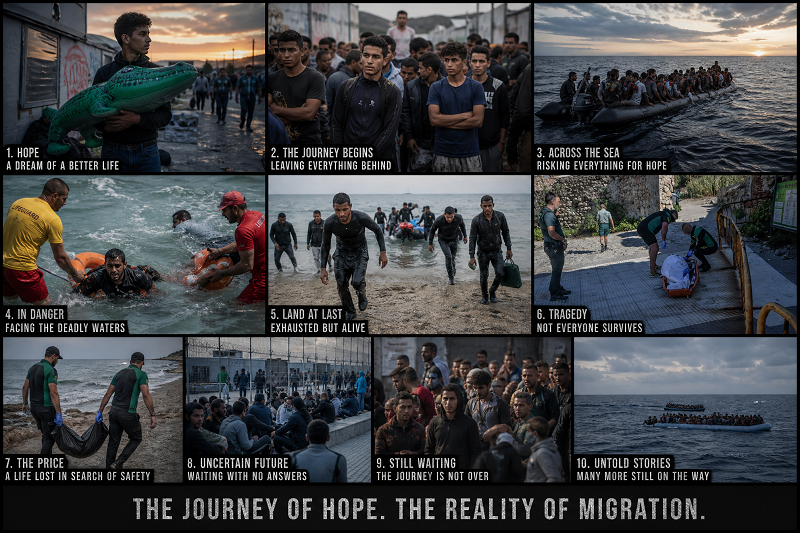
What unfolded on the beaches of Fnideq during the summer of 2025, and again in 2026, was far more than another episode of irregular migration. It was a profound social shock—one that exposed a deep transformation in the relationship between a segment of Morocco’s youth and their country, their future, and their sense of possibility. Thousands of young people, some barely in their mid-teens, entered the sea fully aware that drowning was a real possibility and that reaching Ceuta would not necessarily put an end to their hardship. Yet they chose to confront the waves rather than a reality they had come to regard as even more unforgiving.
From a distance, the picture appears deceptively simple: young Moroccans attempting to swim to Europe. A closer look, however, reveals a far more intricate story. Not everyone who entered the water was driven by poverty, just as not everyone who remained on shore was living a life of contentment. Between those two realities lies a vast landscape shaped by frustration, shrinking opportunities, fading confidence, and the growing conviction that while the world continues to move forward, their own lives have been left standing still.
This investigation does not seek convenient villains, nor does it attempt to absolve anyone of responsibility. A phenomenon of this magnitude cannot be explained by an individual decision or the shortcomings of a single institution. Rather, it is the outcome of years of accumulated economic, social and political transformations. Employment, education, regional disparities, family pressures and changing aspirations have gradually converged, until the sea came to represent, for many young people, the shortest route toward a life they believed might finally offer dignity and opportunity.
Perhaps the most striking aspect of this phenomenon is that irregular migration is no longer a clandestine undertaking carried out by small groups under the cover of darkness. It has become a public spectacle, documented in real time on smartphones, shared across social media platforms and followed anxiously by families watching events unfold from home. The question is no longer, “Who intends to leave?” It has become, “Who will dare to make the attempt first?”
For that reason, this investigation does not begin with the sea itself. It begins much earlier. It retraces the path that led northern Moroccan towns to this turning point. How did Ceuta—despite its fences, its heavy surveillance and the undeniable dangers surrounding it—come to embody hope for thousands of young Moroccans? How did Moroccan, Spanish and international media interpret this phenomenon? Did they describe the same reality, or did each construct a different narrative shaped by its own priorities?
Because this story does not begin in the water.
It begins on land, where countless young men and women gradually came to believe that the horizon—even with all its uncertainty—lay somewhere beyond the Mediterranean rather than within the country where they were born.
From Fnideq to Ceuta: The Silent Origins of a Crisis Years in the Making
At first glance, Fnideq appears to be a quiet coastal town whose economy revolves around summer tourism and small-scale commerce. Beneath that tranquil façade, however, lies a community profoundly transformed over the past few years. For decades, much of the town’s economic life revolved around its proximity to Ceuta. Before the closure of the so-called “informal cross-border trade,” thousands of families depended—directly or indirectly—on an economy that, while operating outside the formal sector, provided livelihoods for transporters, traders, café owners, landlords, artisans and countless small businesses.
When that activity came to an abrupt halt, it was not merely the movement of goods that stopped. An entire economic ecosystem collapsed. Many young people who had relied on this border economy for temporary yet regular employment suddenly found themselves without alternatives. New development projects and employment opportunities failed to emerge at the same pace as the disappearance of the old economic model, leaving behind a vacuum that many interpreted as a loss of purpose rather than simply a loss of income.
Yet attributing the phenomenon solely to unemployment would be an oversimplification. Among those who entered the sea were unemployed youths, but also students, craftsmen, casual workers and even individuals earning modest but stable incomes. What united them was not poverty alone. It was a growing conviction that their future was slipping further out of reach. At that point, migration ceased to be a strategy for improving living conditions and became an attempt to redefine an entire life.
No one wakes up one morning and decides to swim towards Ceuta. Such a decision is rarely spontaneous. It is usually the outcome of a long internal journey. For months, sometimes years, these young men and women compare their daily reality with the images constantly displayed on their mobile phones—friends who have settled in Europe, stories of apparent success, carefully curated social media posts portraying a different life across the Mediterranean. Gradually, the border ceases to be perceived as an obstacle and begins to resemble an opportunity.
This is where the real question emerges. Were these young people truly trying to reach Ceuta? Or were they, above all, trying to escape a reality in which they no longer saw a place for their own ambitions?
That question provides the key to understanding the entire phenomenon. It shifts the debate away from the act of crossing the sea itself and towards the deeper forces that persuade an increasing number of young Moroccans that risking their lives has become a more rational choice than waiting indefinitely for a future they no longer believe will arrive.
Beyond Harga: When Irregular Migration Becomes a Social Phenomenon
To understand what unfolded on the beaches of Fnideq, it is not enough to watch hundreds of young people rushing toward the sea. The more important question is why the idea of irregular migration no longer inspires the fear it once did. How did what was once an exceptional and deeply secretive decision become, for many young Moroccans, an increasingly ordinary option?
Not long ago, harga—the colloquial term for irregular migration—was a personal gamble undertaken discreetly by a handful of individuals. Today, it has evolved into a collective phenomenon. Young people move in groups, exchange information through social media, monitor sea conditions and the movements of patrol boats in real time, and encourage one another through online networks. The crossing is no longer simply an attempt to reach Europe; it has become a social event shaped by shared expectations, collective emotions and a growing belief that the risk is worth taking.
This transformation reveals something far more profound than a rise in migration attempts. Most of these young people did not initially dream of Europe. They dreamed of a stable job, vocational training, a small business, or simply the opportunity to build an independent life in their own country. But when those aspirations repeatedly collide with disappointment, the dream itself begins to change. What was once considered the last resort gradually comes to be seen as the only remaining option.
Accounts collected by Moroccan and Spanish media point to the same conclusion. Few of these young migrants describe Europe as a paradise. Instead, they speak of it as a place where starting over still seems possible. That distinction matters. It suggests that the driving force behind the phenomenon is not merely the attraction of Europe, but the growing perception that opportunities at home are steadily disappearing.
In this context, the border ceases to be a geographical line. It becomes a psychological boundary separating two visions of the future: one perceived as blocked, the other as uncertain but still open to possibility.
The central question, therefore, is no longer: “Why do these young people want to leave?” A more fundamental question must be asked: “Why have so many of them stopped believing that their future can be built in the country where they were born?”
It is precisely from this perspective that the media’s treatment of the phenomenon deserves closer examination. While the events themselves were the same, Moroccan, Spanish and international media often told remarkably different stories, each reflecting its own priorities, concerns and understanding of what was unfolding on the shores of the Mediterranean.
The Moroccan Press: Reporting the Event While Searching for Its Meaning
As the waves of young people attempting to swim to Ceuta became increasingly frequent, Morocco’s media quickly turned the phenomenon into headline news. Newspapers, news websites and television channels were filled with images of teenagers and young adults running towards the sea, rescue operations unfolding along the coast, security forces intervening to prevent departures, and anguished families waiting for news of missing relatives. The event dominated the news cycle. Yet beneath the flood of reports, one essential question often remained unanswered: what had driven so many young people to see the sea as their only escape?
Broadly speaking, the Moroccan media’s coverage followed three distinct paths. The first focused on reporting events as they unfolded, prioritising immediacy over interpretation. The second highlighted the efforts of the Moroccan authorities to secure the coastline, prevent loss of life and manage an exceptionally sensitive security situation. The third—less prominent but considerably more analytical—sought to place the phenomenon within a wider social and economic context, linking it to unemployment, the transformation of northern Morocco’s border economy, widening social inequalities and the growing sense of uncertainty experienced by many young people.
Looking back, another pattern becomes apparent. Each new wave of departures was often treated as an isolated incident rather than as another chapter in a continuing social crisis. Every summer brought familiar scenes: young people entering the sea, rescue teams searching for survivors, grieving families awaiting news, emergency services working around the clock and, eventually, the gradual disappearance of the story from the headlines—until the next wave emerged.
Some investigative journalists, however, chose a different approach. Instead of relying exclusively on official statements, they travelled to the neighbourhoods from which many of these young migrants came. They spoke with parents, teachers, neighbours and local community leaders. Their reporting revealed a reality that daily news coverage frequently overlooked: irregular migration had ceased to be an individual ambition. In many households, it had become an almost permanent subject of conversation. Parents feared losing their children to the sea, yet many also admitted they struggled to offer convincing alternatives capable of persuading them to stay.
The media also documented the increasingly influential role of social media. Before each attempted crossing, online platforms filled with messages, rumours, videos and claims about favourable sea conditions, alleged gaps in border surveillance or successful arrivals in Ceuta. Some of this information was accurate; much of it was exaggerated or entirely false. Nevertheless, its constant circulation created a powerful psychological momentum, encouraging new departures with every story of apparent success.
Viewed from today’s perspective, one criticism can reasonably be made of much of the national media coverage. Too often, attention centred on the event rather than the phenomenon, on its immediate consequences rather than its underlying causes. Yet the real challenge extended far beyond the management of a recurring migration episode. It raised a far more difficult question: how can a society create the conditions in which its young people no longer feel compelled to search for their future beyond the sea?
It is precisely at this point that the Spanish narrative begins to diverge. While part of the Moroccan press attempted to understand why young people were leaving, much of the Spanish media concentrated on what happened once they reached Europe’s external border. The same reality was unfolding before both countries—but each was telling a very different story.
When the Story Crossed the Strait: How the Spanish Press Framed the Crisis
If much of the Moroccan press sought to answer why so many young people were willing to risk their lives to reach Ceuta, the Spanish media largely focused on how they managed to arrive. The difference may appear subtle, but it reflects two fundamentally different ways of understanding the same phenomenon. On one side stood a narrative centred on the social roots of migration; on the other, one shaped primarily by concerns over border security and the management of Europe’s external frontier.
Spanish newspapers regularly carried headlines about the “arrival of migrants,” the “pressure on Ceuta,” the growing number of unaccompanied minors and the mobilisation of the Guardia Civil. In this narrative, Ceuta was portrayed not merely as a Spanish city, but as one of the European Union’s most sensitive border outposts, where every new wave of arrivals revived debates over reception capacity, migration policy and the distribution of responsibilities between Madrid and Brussels.
Yet the Spanish media did not speak with a single voice.
One current of reporting adopted a predominantly security-oriented perspective. Coverage focused on the number of arrivals, the saturation of reception centres, the financial burden of caring for unaccompanied minors and the logistical challenges facing local and national authorities. In this framework, the young migrants appeared mainly as the visible face of a border crisis whose primary implications were administrative and political.
Alongside this approach, however, another strand of journalism attempted to look beyond the shoreline. Several Spanish newspapers and investigative outlets examined developments on the southern side of the Mediterranean, exploring the economic transformation of northern Morocco, the consequences of the closure of the informal cross-border economy, persistent youth unemployment and the widening gap between the expectations of a globally connected generation and the opportunities available within their own communities. From this perspective, the beaches of Fnideq were not simply the departure point of a migration route; they had become the visible symptom of a much deeper social unease.
Part of the Spanish press also made a conscious effort to restore the human dimension of the story. Images of exhausted teenagers shivering after being rescued from the sea, volunteers distributing blankets and hot meals, and rescue workers recounting dramatic operations reminded readers that behind every statistic stood a life, a family and a personal story. In these accounts, migrants ceased to be anonymous figures in official reports and once again became individuals with names, fears and aspirations.
Each new wave of arrivals also reignited a broader political debate. Migration was frequently interpreted through the lens of Moroccan-Spanish diplomatic relations, with commentators questioning whether fluctuations in border crossings reflected the state of cooperation between Rabat and Madrid. Ceuta was no longer viewed solely as a geographical frontier; it had become a space where humanitarian concerns, domestic politics, diplomatic negotiations and European strategic interests converged.
Comparing Moroccan and Spanish media coverage ultimately reveals that each side illuminated only part of the picture. Moroccan journalism largely examined the lives and motivations of those leaving, while Spanish reporting concentrated on the border they sought to cross and the consequences of their arrival. One explored the origins of the journey; the other dealt with its immediate impact. Together, however, these contrasting narratives offer a richer and more complete understanding of the crisis.
It is at this point that the international press enters the discussion. Viewed from London, Paris, Brussels or Washington, the crossings to Ceuta are no longer seen merely as a Moroccan or Spanish issue. They become part of a broader global conversation about migration, inequality, demographic pressures and the widening divide between the northern and southern shores of the Mediterranean.
More Than Migration: A Crisis of Confidence in the Future
A careful comparison of Moroccan, Spanish and international media coverage reveals an important paradox. Although all three reported the same events, each told a different story. Moroccan outlets largely explored the social conditions that pushed young people towards the sea. Spanish media viewed the phenomenon primarily through the lens of border management and migration control. International publications tended to place it within the wider context of Mediterranean migration and global inequality. Yet despite these differing perspectives, they all pointed—explicitly or implicitly—to the same underlying reality: the young people who entered the water were not simply chasing Europe; they were searching for a future they no longer believed they could build at home.
Reducing the phenomenon to unemployment alone, however, would be misleading. Nor can it be fully explained by the activities of smuggling networks or the influence of social media. These factors undoubtedly accelerated the process, but they did not create it. The deeper cause lies in the gradual accumulation of disappointment experienced by a generation that often finds itself caught between an education system that does not always guarantee employment, a labour market unable to absorb growing numbers of graduates, rising living costs and an increasingly difficult path towards financial independence and family life.
The phenomenon has also exposed the transformative power of digital platforms. Social media no longer merely reports migration; it actively shapes the imagination surrounding it. Videos celebrating successful crossings spread rapidly across platforms, while the stories of those intercepted at sea, forcibly returned or lost to the Mediterranean receive far less attention. The result is an incomplete narrative—one that highlights arrival while obscuring the price paid to reach it.
The economic transformation of northern Morocco also forms an essential part of this story. Ending the informal cross-border trade with Ceuta was a legitimate sovereign decision aimed at replacing an unregulated economy with a more structured and sustainable model. Yet every structural transition carries social costs. When new economic opportunities fail to emerge as quickly as old ones disappear, frustration fills the gap. For many young people, migration then ceases to represent an extraordinary gamble and begins to resemble a rational response to prolonged uncertainty.
At the same time, portraying Morocco simply as a country that drives its youth away would ignore another equally important reality. Over the past decade, the Kingdom has launched major infrastructure projects, expanded its industrial base, invested in renewable energy and positioned itself as a regional economic hub while preparing to co-host the 2030 FIFA World Cup. These initiatives reflect genuine ambition and create real opportunities. The more pressing question, however, is whether the benefits of these transformations are reaching the young people who continue to view the sea as their only horizon. Economic growth ultimately gains its meaning not from investment figures alone, but from its ability to restore confidence that tomorrow can indeed be better than today.
For that reason, treating irregular migration solely as a security issue is unlikely to provide a lasting solution. Equally, reducing it to a question of poverty or unemployment fails to capture its full complexity. At its heart lies a crisis of confidence. When young people believe they can build a meaningful future in their own country, the sea becomes nothing more than part of the landscape. When that belief fades, the same sea is transformed into what appears to be the shortest path towards hope—despite all the dangers it conceals.
The repeated attempts to swim towards Ceuta therefore reveal far more than a migration crisis. They expose one of the defining challenges facing contemporary Morocco: how to ensure that national development is measured not only by roads, ports, factories and investment, but also by the confidence of a generation that must feel it has a place within the country’s future.
Because border fences may slow the movement of people, but they cannot stop the movement of ideas. And the belief that life begins elsewhere cannot be defeated by surveillance alone. It can only be overcome by policies capable of restoring trust, expanding opportunity and convincing young Moroccans that the future they seek can be built on the shores they already call home.


