

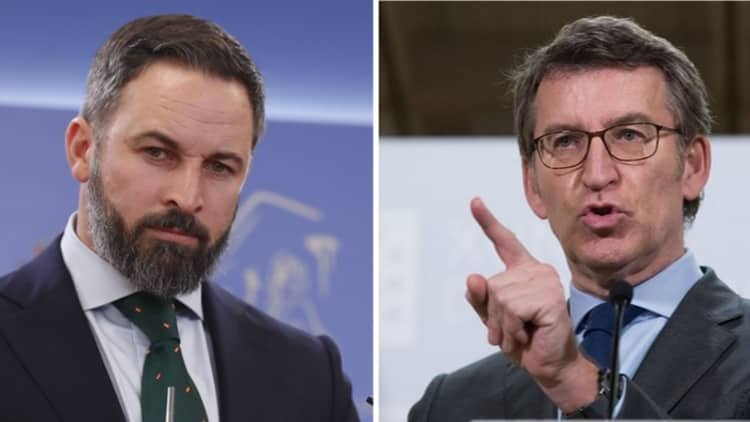
Competition between Spain’s People’s Party (PP) and the Spanish Socialist Workers’ Party (PSOE) is no longer confined to their respective positions in opinion polls. With the general election scheduled for 29 November 2026 approaching, the rapprochement between the PP and Vox has translated into practical coordination over Senate candidacies, while the Ceuta crisis and relations with Morocco have regained prominence in debates over border security, immigration and sovereignty. These developments show that Spain’s right-wing electoral calculations concern not only which party leads voting intentions, but also how votes can be converted into seats and what political conditions may shape the next parliamentary majority.
On 26 October, a Sigma Dos poll published by El Mundo put the People’s Party at 30.6% of voting intentions, compared with 26.1% for the Socialists and 19.9% for Vox. The study estimated that the PP could win between 125 and 131 seats in the Congress of Deputies, compared with 103 to 109 for the Socialists and 66 to 69 for Vox. These figures are statistical projections, not established election results.
The average published by Onda Cero radio offers a complementary picture. Based on 96 polls compiled since September 2025, its October estimate placed the PP at 31.9%, the Socialists at 26.6% and Vox at 18.8%. However, this average combines different surveys and does not represent a single poll conducted with one sample on a specific date. Figures published through 23 October also showed the PP falling from its September average of 33.2%, while Vox rose from 18.2% to 18.8%.
The gap between the PP and the Socialists is significant, but it does not settle the parliamentary equation. Spain’s electoral system does not automatically convert national vote shares into equivalent proportions of seats. Government formation depends on the actual distribution of parliamentary seats and the parties’ ability to assemble a majority in the Congress of Deputies. Vox’s growing support therefore gives it an important place in the right’s calculations, even when it does not lead voting-intention surveys.
That logic is more directly visible in the agreement announced by the PP and Vox on 26 October concerning Senate candidacies. The two parties agreed to coordinate their nominations in 23 of the 60 constituencies involved, with one party withdrawing candidates or reducing their number in selected districts so that votes could be concentrated on candidates agreed between them.
Under the arrangement, the PP will not field Senate candidates in the constituencies of Gipuzkoa, Girona and Tarragona. Vox, for its part, will withdraw from independent candidacies in Cádiz, Valencia, Castellón, Las Palmas, Santa Cruz de Tenerife and the Balearic Islands. In 14 other constituencies, Vox will field only one candidate, while the PP will retain three, with an independent candidate proposed by Vox included on some of the agreed lists.
The significance of this agreement lies in the Senate’s electoral system. In several constituencies, the voting rules allow the leading candidates to secure most of the directly elected seats. Competition between PP and Vox candidates drawing support from similar voters can therefore weaken both parties’ prospects against candidates from other political forces. By coordinating their nominations, the two parties are seeking to limit that risk and strengthen their representation in the upper chamber.
The agreement also has a political dimension beyond the mechanics of seat allocation. It follows a period in which the PP sought to maintain some political distance from Vox. Their current coordination allows them to work together in a specific part of the electoral contest. This does not mean the two parties are merging or have reached agreement on every policy. It does, however, show that electoral calculations over the distribution of seats can take precedence over publicly expressed differences.
In the Congress of Deputies, Sigma Dos projections put the PP and the Navarrese People’s Union (UPN) at a potential combined total of 128 seats, compared with 68 for Vox—196 seats for the two right-wing forces together under the estimates cited. This remains a projection, not a government agreement or a definitive allocation of political responsibilities. It nevertheless indicates the role Vox could play in negotiations if actual results were to approach those estimates.
Under these circumstances, immigration, security and national identity take on greater prominence in the competition between the two parties. Relations with Morocco can also be brought into Spain’s domestic political debate. But electoral rapprochement should not be confused with an automatic change in foreign policy: polls and party statements alone do not establish that Madrid will necessarily revise its approach towards Rabat.
The Ceuta crisis: From border management to political confrontation
The migration crisis of last July provided a new arena for this confrontation. On 30 July, Ceuta experienced an exceptional influx of migrants crossing the land and maritime borders with Morocco. Addressing Parliament on 3 September, Spanish Prime Minister Pedro Sánchez referred to approximately 70,000 irregular entries during the crisis. He said the authorities had reinforced the police and Civil Guard, mobilised the armed forces and deployed maritime and aerial surveillance resources, while continuing coordination with Moroccan authorities to return substantial numbers of people.
In his official account, Sánchez linked the development of the crisis to several factors, including the circulation of misleading information on social media about the border situation and procedures for the immediate return of migrants following a judicial ruling in July. He also acknowledged that establishing all the circumstances and determining responsibility would require further investigation. His statement did not provide conclusive evidence that Moroccan authorities had organised the wave of crossings.
This distinction is essential when examining the political accusations that followed. The scale of the arrivals shows that Spanish authorities faced an exceptional situation that placed considerable pressure on border surveillance and reception facilities. It does not, by itself, prove that the government had permanently lost control of the border or that Morocco deliberately used migration as an instrument of political pressure. Such conclusions require independent evidence, not simply the coincidence of events or statements by political parties.
The debate nevertheless moved beyond security and administrative measures. It shifted into Parliament and became a confrontation between the government and the opposition over responsibility for border management, migrant returns and the care of unaccompanied minors. The PP used the crisis to intensify its rhetoric on protecting Spanish sovereignty, while Vox advocated a more restrictive approach to immigration, including opposition to transferring minors to other parts of Spain and criticism of reception policies.
On 12 October, Spain’s public broadcaster RTVE reported on accounts of Moroccan vessels operating in the waters around Ceuta on 30 and 31 July, during the wave of crossings. Sánchez acknowledged that maritime incidents of this kind had occurred, describing them as events that could take place between neighbouring countries, while reaffirming the continuation of cooperation with Morocco. Subsequent media reports presented additional details, including allegations that vessels had entered without authorisation and switched off automatic identification systems. These details derive from Spanish media accounts and sources; their interpretations, particularly those concerning intent, should not be treated as final judicial findings.
The People’s Party used the issue to increase pressure on the government. On 16 October, its leader, Alberto Núñez Feijóo, called for what he described as a firm but calm response towards Morocco. He demanded explanations concerning the reported maritime movements and raised the need to strengthen Spain’s naval presence around Ceuta. The party also pursued an institutional route by submitting information related to the crisis to Spain’s National Court, according to the available account. However, submitting material to the judiciary does not mean that the court has endorsed the allegations or established responsibility. That depends on the contents of the file and the findings of the proceedings.
The Socialist government has defended a different approach, seeking to combine border protection with continued cooperation with Morocco on migration. In Parliament, Sánchez outlined the measures taken by his government and emphasised the role of cooperation with Moroccan authorities in carrying out returns. The opposition, meanwhile, has focused on questions about preparation for the crisis, early warnings and whether the resources deployed were adequate before the arrivals reached exceptional levels.
This disagreement cannot be resolved simply by choosing one political narrative over the other. A serious assessment of government performance requires examining what information the relevant agencies possessed before the crisis, how quickly they responded, what resources were deployed, what results were achieved and what responsibilities can be established through documents and investigations. Using the crisis to prove a general government failure or to confirm the theory of a coordinated Moroccan operation goes beyond what the published evidence supports in the absence of further proof.
Unaccompanied migrant minors: Another test of relations between Madrid and the regions
The dispute over transferring unaccompanied minors from Ceuta to other parts of Spain has acquired a parallel political and legal dimension. Following the July influx, the city faced mounting pressure on its reception and care facilities. At the same time, the central government and local and regional authorities continued to disagree over how responsibilities and costs should be distributed.
On 16 September, the PP argued that the central state should bear responsibility for dealing with minors who arrived during the crisis. It also raised the possibility of applying European rules concerning migration and returns. The government, by contrast, rejected the use of the term “invasion” as justification for bypassing established legal procedures and maintained that the status of minors is governed by specific protection rules.
The difficulty is that transferring minors involves more than easing pressure on a border city. It requires establishing each individual’s circumstances, assessing protection needs and respecting the applicable legal safeguards. Distribution across Spain also depends on the positions of regional governments, several of which are led by the PP or politically reliant on support from Vox.
In September, Le Monde reported that the dispute over redistributing migrants and minors had spread to several Spanish regions. Some regional authorities had already received groups of minors despite political objections to the allocation arrangements. These developments show that political opposition to transfers does not necessarily describe the full administrative reality: public positions can coexist with practical measures required by individual circumstances and legal obligations.
For Vox, opposition to transfers fits into a broader platform calling for tighter immigration policies and restrictions on reception. The PP, meanwhile, must balance several considerations: challenging the central government, governing the regions it controls and coordinating electoral strategies with Vox. These factors help identify areas of convergence between the two parties when the issue is the distribution of responsibilities and costs. They do not, however, establish that the parties share a common programme on every aspect of immigration.
The consequences of this debate extend beyond Ceuta. The treatment of minors, the legality of their transfer and the distinction between emergency management and the protection of rights are matters governed by Spanish and European law. They cannot be determined solely by party competition. Similarly, attributing every episode of migration pressure in the city to Morocco does not, by itself, explain all the causes of the crisis or remove the need for Spanish institutions to assess their own preparedness and decisions.
As the 29 November election approaches, these issues are becoming intertwined with calculations over seats and political negotiations. October’s polls indicate substantial electoral support for Vox alongside the PP, while the Senate agreement demonstrates that coordination between the two parties has become a practical arrangement in selected constituencies. Whether this rapprochement will extend into a broader governing agreement, and whether it will lead to a tangible change in Spain’s policy towards Morocco, cannot be established from polls or political statements alone. The answers will depend on the actual results, the conditions for building a parliamentary majority and the official decisions taken on immigration, security and bilateral cooperation.


