

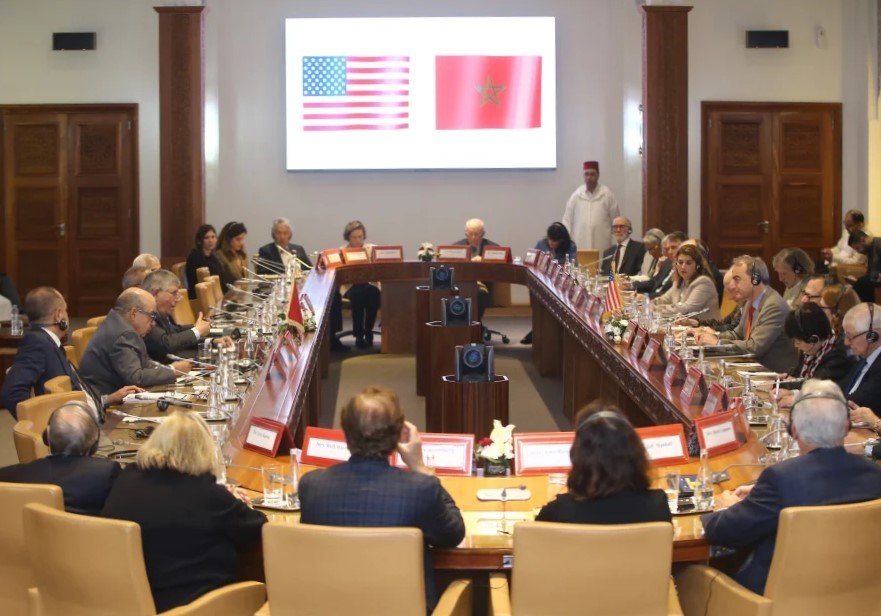
The meeting between Ahmed Touizi, Speaker of Morocco’s House of Representatives, and a delegation from the American Jewish Committee (AJC) in Rabat on Monday, October 26, 2026, went beyond the usual diplomatic expressions of friendship between Morocco and the United States. The delegation, led by Jason Isaacson, the organization’s senior official for political affairs, reaffirmed its support for Morocco’s territorial integrity as diplomatic engagement over the Moroccan Sahara continues and an important deadline approaches concerning the mandate of the United Nations Mission for the Referendum in Western Sahara, known as MINURSO.
According to the official statement issued by the House of Representatives, the discussions also covered parliamentary cooperation, economic and trade relations, and Morocco’s strategic position as a gateway to Africa. Yet the AJC’s renewed support for Morocco’s territorial integrity merits consideration beyond the protocol of the meeting, given the organization’s engagement in American political debates concerning Morocco’s position.
This position is not new. In March 2015, the American Jewish Committee expressed support for Morocco’s territorial integrity, including Moroccan sovereignty over the Sahara through a framework of local autonomy. In October 2021, the organization reiterated this position during a visit to Morocco led by Isaacson, at a time when relations among Rabat, Washington and Tel Aviv were entering a new phase following the resumption of official relations between Morocco and Israel in December 2020.
The continuity of this position becomes clearer when viewed in light of the organization’s role. Founded in 1906, the American Jewish Committee is a civil-society organization active in American political debate and engaged in international relations, religious freedom and the fight against antisemitism. Its official website identifies Isaacson as the organization’s senior official for political affairs, with extensive experience in engagement with governments and stakeholders across the Middle East, North Africa and other regions.
This does not make the AJC an agency of the United States government, nor does it give the organization’s positions the status of official American policy decisions. It does, however, help explain why engagement with the organization forms part of Morocco’s efforts to broaden support for the Kingdom among American political and civil-society circles.
Western Sahara: Political Support and the UN Calendar
The Rabat meeting took place ahead of the end of MINURSO’s mandate, which the UN Security Council extended until October 31, 2026, under Resolution 2797, adopted on October 31, 2025. According to United Nations records, the resolution received 11 votes in favor, none against and three abstentions.
The approaching deadline adds significance to diplomatic activity surrounding the issue. It does not, however, establish that the meeting with the AJC was directly coordinated with ongoing discussions at the Security Council. The parliamentary statement provides no details of technical discussions concerning a draft resolution or of specific contacts with Council members.
One point is established: Western Sahara has repeatedly featured in the AJC’s engagement with Morocco, and the organization’s delegations have reiterated their support for the Kingdom’s territorial integrity over the years. The direct impact of that support on negotiations or government positions, however, requires independent evidence that cannot be derived from the announcement of this meeting alone.
The United States remains a strategic partner of Morocco and a central actor in the diplomatic equation. In December 2020, Washington announced its recognition of Moroccan sovereignty over the Sahara. Nevertheless, the positions of civil-society organizations, even those with influence in American political circles, do not replace decisions by the US administration or deliberations at the UN Security Council.
Moroccan Identity at the Center of the Diplomatic Message
Another part of the discussions focused on Morocco’s record of religious and cultural coexistence. Touizi highlighted the Constitution’s recognition of the unity of the national identity alongside its multiple components, including its Hebrew heritage, and recalled that Moroccan Jews have historically been an integral part of Moroccan society.
This theme regularly features in Morocco’s engagement with American Jewish institutions and organizations. It is grounded in an explicit constitutional provision: the preamble to Morocco’s 2011 Constitution states that the country’s unified identity, shaped by Arab-Islamic, Amazigh and Saharan-Hassani influences, has been enriched by African, Andalusian, Hebrew and Mediterranean elements.
The issue extends beyond historical memory. Relations between the AJC and Moroccan partners have also included interfaith dialogue, cultural cooperation and initiatives to combat hatred. The organization has previously reported collaborations with Moroccan institutions and public figures as part of broader efforts to develop relations among Morocco, the United States and Israel.
Presenting Morocco’s experience of coexistence, however, does not remove the need to distinguish the symbolic value of such messaging from the practical outcomes of partnerships. Assessing the impact of these initiatives requires examining the programs actually implemented, the institutions involved, the continuity of projects and their documented results, rather than relying solely on expressions of appreciation exchanged during official meetings.
A Meeting at the Start of a New Parliamentary Term
The Speaker of the House of Representatives also noted that the visit coincided with the opening of the twelfth legislative term and the parliamentary vote on the government program presented to both chambers. The official statement additionally referred to the appointment of Fatima Zahra Mansouri as head of government, presenting these developments as part of Morocco’s institutional profile before the American delegation.
These elements reveal several dimensions of the meeting’s message: reaffirming the AJC’s position on Western Sahara, broadening Moroccan-American cooperation, presenting Morocco’s experience of religious and cultural pluralism, and explaining the country’s political and institutional developments.
Whether these messages lead to new initiatives in economic relations, parliamentary cooperation or diplomatic engagement over Western Sahara will depend on subsequent developments. The statement confirms renewed political support and identifies areas in which cooperation is sought, but it announces no new agreements or specific operational commitments.
The significance of the meeting will therefore depend on what follows. Will joint initiatives expand? Will their effects become visible in relations among the institutions and stakeholders involved? Or will the meeting remain one episode in the series of regular contacts between the American Jewish Committee and Moroccan officials? The statement does not answer these questions. The answers will depend on subsequent developments and on results that can be independently verified.


