

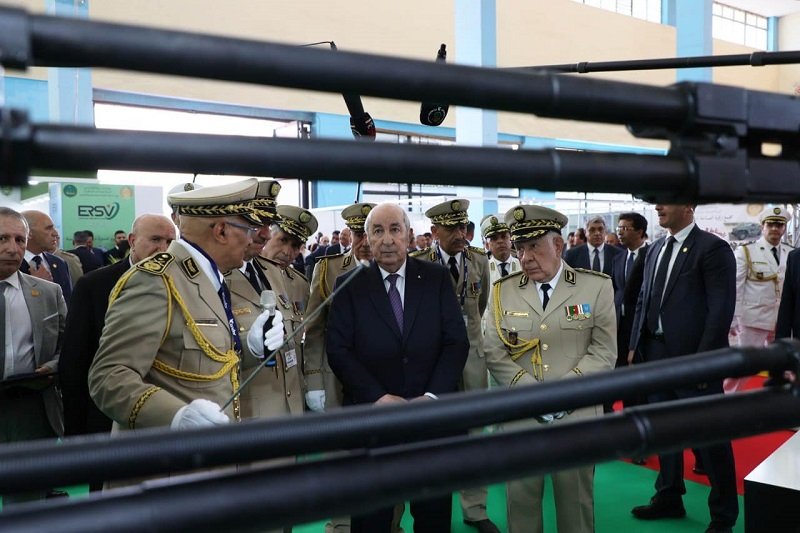
On October 25, 2026, Algeria’s Council of the Nation approved the deployment of a military detachment to Niger, with the stated objective of protecting Algerian investments, particularly oil projects linked to Sonatrach. According to Agence France-Presse, 148 of the chamber’s 174 members voted in favour during a closed session, while a vote in the People’s National Assembly was still pending when the report was published.
The detail worth examining is not simply the vote, but the nature of the mission being assigned to the army. Protecting an oil investment on another country’s territory is different from securing Algeria’s own borders, even when both tasks intersect in national-security calculations. The first may begin with guarding a facility or securing its immediate perimeter, but it can generate additional requirements: protecting supply routes, securing the movement of personnel and equipment, responding to attacks and coordinating with local forces. The boundaries between these tasks cannot be established without details about the deployment, rules of engagement and intended duration.
At present, the published information is insufficient to settle these questions. That does not mean a military commitment will inevitably expand. It means that any assessment of the risks remains incomplete while the mission’s limits, the size of the contingent and the conditions for its withdrawal remain unclear.
From Protecting Sonatrach to Testing Algeria’s Influence in the Sahel
The decision is rooted in tangible economic and security interests. Algeria is working with Niger on projects related to oil exploration, including the Kafra field in the north of the country. The two states are also seeking to strengthen cooperation in energy, security and counterterrorism. Press reports have linked the rapprochement to the Trans-Saharan Gas Pipeline project, intended to transport Nigerian gas through Niger and Algeria towards external markets.
Yet these interests are being pursued in a far from neutral environment. Relations between Algiers and Niamey experienced tensions before the two countries resumed closer engagement. Security cooperation subsequently gained momentum through official visits and the signing of a military-cooperation protocol in October. The protocol’s details have not been made sufficiently public to establish precisely what operational obligations it contains, or whether it sets an explicit ceiling on Algerian military missions abroad.
The significance of the decision lies in the convergence of several factors: economic interests that require protection, a political relationship that Algeria wants to consolidate, and a regional environment in which armed groups are difficult to contain. These considerations are plausibly part of the Algerian leadership’s calculations, but the available evidence does not establish their relative weight or prove that one is merely a cover for another.
For Algeria’s Chief of Staff, General Saïd Chengriha, the challenge extends beyond preparing a detachment and sending it to a designated location. It is a test of whether the military establishment can protect external interests without becoming entangled in expanding security commitments. It is also a test of Algeria’s ability to translate its political relationship with Niamey into a sustainable and manageable presence on the ground.
The deployment may indeed remain limited, as one member of the Council of the Nation described it in remarks reported by Algerian media. But calling a mission limited does not, by itself, establish how risky it will be. That depends on the nature of the threats, the contingent’s location, the logistical support available and the extent to which Nigerien authorities are prepared to fulfil their own security responsibilities.
Madama: The Location That Could Change the Nature of the Mission
Attention has focused on Madama, a base in Niger’s far north, near the Libyan border. Press reports have identified it as a possible destination for the Algerian detachment. However, the available official information does not establish that the location has been definitively confirmed.
Madama’s importance lies in its position within a vast desert region where movement and supply routes intersect with the borderlands of Libya, Chad and the Sahel. Instability in Libya, together with the presence of multiple armed groups and competing centres of influence, means that any military operation near this frontier requires calculations extending beyond the protection of a single oil facility.
It would nevertheless be premature to link any potential Algerian deployment at Madama to a direct confrontation with forces associated with Khalifa Haftar, or to assert that the Algerian army would necessarily become a target for particular actors. Geographic proximity does not establish the existence of a confrontation, just as the presence of multiple armed groups does not mean they will automatically act against an incoming foreign force.
The most tangible risk concerns what might be called the gradual expansion of the mission. If the facility being protected were attacked, the contingent might be required to secure a wider perimeter. If threats extended to supply routes, additional transport, reconnaissance and logistical support could become necessary. If the troops themselves came under repeated attack, questions would arise over the scope of military retaliation, its limits and Algeria’s willingness to sustain human and material losses on foreign soil.
These are scenarios, not events that have already occurred. But assessing a military decision requires more than examining the mission as initially defined. It also requires identifying the conditions under which it can end and the limits intended to prevent it from turning into a prolonged commitment.
Parliament Approves, but What Oversight Will Apply to the Mission?
Article 91 of Algeria’s Constitution, as revised in 2020, gives the president, as supreme commander of the armed forces, the authority to decide on sending units of the People’s National Army abroad, subject to approval by a two-thirds majority of the members of each parliamentary chamber. Seeking parliamentary approval is therefore not outside the constitutional framework; it is part of the procedure established by the Constitution.
A separate question concerns the quality of the information provided to parliamentarians before the vote, the nature of the deliberations available to them and the means they have to monitor implementation once the decision has been adopted.
The reported closed-door session does not, by itself, prove that parliamentary oversight was absent or that no internal deliberations took place. It does, however, limit the public’s ability to examine the detailed arguments behind the decision, unless documents or subsequent statements clarify the mission’s nature and boundaries.
The description of the vote as unanimous, used by some Algerian media outlets, also requires scrutiny. AFP reported that 148 of the chamber’s 174 members voted in favour. That figure is more precise than the general claim of unanimity.
The allocation of political and military responsibility if the mission changes is equally important. Who would decide to reinforce the contingent? Which authority would determine the rules of engagement? Is there a fixed duration or a set of withdrawal criteria? And what happens if the facilities come under attack from groups that the detachment cannot repel on its own?
These questions do not necessarily mean that the decision is wrong. They distinguish approval of the principle of deployment from oversight of how it is carried out. That distinction matters particularly when a military institution operates beyond national borders.
From the Sand War to Amgala: What the Historical Record Shows
The best-known direct military confrontation between Morocco and Algeria dates back to the Sand War of October 1963, following an escalation of the dispute over borders inherited from French colonial rule, particularly around the areas of Tindouf and Béchar. The conflict was not isolated from its international environment: both countries were operating during a period shaped by Cold War rivalries, unequal military capabilities and efforts to build alliances after independence.
A US intelligence assessment prepared in 1971 and subsequently published in the State Department’s historical archives explicitly evaluated the outcome of the confrontation, stating that Morocco had held the military advantage over Algeria in the brief border war.
The significance of that document must nevertheless be carefully defined. It is a US intelligence assessment written several years after the conflict, not a comprehensive record of every military operation. Nor does it prove that one army has enjoyed permanent superiority over the other in every circumstance. The outcome of a war fought in the early years of both states’ independence is not, by itself, a measure of their present-day military capabilities.
Some details frequently cited about Egyptian and Cuban involvement, the scale of Soviet assistance or the capture of Egyptian military personnel during the war require independent historical references for each claim. The same applies to accounts linking Egyptian pilot Hosni Mubarak to the prisoners of the conflict. Such claims should not be presented as established facts without a reliable historical source identifying his role and the circumstances of his presence in the theatre of operations.
The confrontation at Amgala in January 1976 took place in a different phase of the regional conflict. The question of Western Sahara had become a major source of tension between Morocco and Algeria, alongside Algeria’s support for the Polisario Front. Historical and military studies describe Amgala as a direct confrontation between Moroccan and Algerian forces, although it did not develop into a full-scale war between the two countries.
A US document dated February 12, 1976, contains a report by a representative of the International Committee of the Red Cross who visited 99 Algerian prisoners captured during the fighting at Amgala and held in a prison in Rabat. According to the report, nine were wounded, while the others were in good health.
The document establishes that Algerian prisoners were held following the confrontation. On its own, however, it does not reconstruct every phase of the battle or fully determine its military and political consequences. The claim that a particular individual, including Saïd Chengriha, was among the prisoners also requires an independent source establishing his identity. The number of detainees alone cannot substantiate that claim.
Amgala forms part of the troubled military memory shared by the two countries, but it does not, by itself, provide a complete explanation of Algeria’s current policy. Military institutions evolve, capabilities change and the strategic environment shifts from one decade to the next. Treating the past as a direct explanation for every present-day decision would reduce policy to a memory of rivalry while leaving current interests and circumstances out of the analysis.
From Ben Bella to Boumediene: The Military at the Centre of Power
Algeria’s military history cannot be separated from the development of political power after independence. On June 19, 1965, then-Defence Minister Houari Boumediene overthrew President Ahmed Ben Bella in a military coup. Power passed to the Revolutionary Council, which was dominated by the military establishment. Historical and academic studies identify this episode as a major turning point in the evolution of Algeria’s political system.
Relations between Ben Bella and Boumediene had deteriorated over the management of the state and control of decision-making centres before the army settled the dispute in favour of the defence minister. Since then, the military establishment has remained a central actor in Algerian politics, although the forms of its direct and indirect involvement have varied over time.
This does not mean that every state decision necessarily originates with the military alone, or that the president and civilian institutions have no role. A more accurate assessment is that military influence developed historically within a political system that cannot be understood solely through formal offices and constitutional titles.
That background matters in the current debate over Niger. The decision to deploy troops has followed a constitutional procedure involving the president and Parliament, while Chengriha remains one of the country’s leading military figures. But claims that he forced parliamentarians to approve the decision, or that he alone is the real decision-maker, require independent evidence. Neither the voting result nor the closed-door session establishes those claims.
Ben Bella’s famous declaration, “They humiliated us,” associated with the memory of the Sand War, should not be reduced to an explanation of the coup that removed him less than two years later. The conflict between the two men concerned power and control of state institutions. A single mobilising speech cannot establish the decisive cause of such a political upheaval.
Historical memory helps explain mutual sensitivities, but it does not remove the need to assess the current decision on its own evidence.
From Egypt in 1967 to the October 1973 War
The Algerian army has also participated in military deployments abroad as part of Arab support for Egypt in its conflict with Israel. In June 1967, Algeria sent aircraft and troops to support Egypt. Algerian units subsequently remained on the Egyptian front during the War of Attrition, according to US assessments published in official diplomatic archives.
During the October 1973 War, Algeria sent further reinforcements, including fighter aircraft and ground units. Assessing their contribution requires distinguishing between the timing of their arrival, the extent of their actual participation and their role in military operations. The dispatch of forces alone is not enough to demonstrate that they played a decisive role in the outcome of the conflict.
الرئيس المصري الأسبق جمال عبد الناصر في تسجيل صوتي نادر: "أنا عاوز فلوس وطيارين.. الرئيس الجزائري بو مدين قال لي لا نستطيع إعطاءك طيارين.. رحنا للاتحاد السوفييتي وإدّونا" #العربية pic.twitter.com/xVTv0XDu1e
— العربية (@AlArabiya) April 28, 2025
This history matters when considering the Niger deployment because the comparison is not simply about the Algerian army operating outside its borders. It concerns the nature of the mission and the alliance within which the deployment takes place. Supporting the armed forces of an allied state in a conventional war is different from protecting economic installations in a desert region facing multiple threats, where counterterrorism may overlap with the defence of economic interests and bilateral security cooperation.
Niger’s Shifting Sands: What Will Determine Whether the Gamble Succeeds?
Algeria faces a dilemma in Niger that cannot be reduced to a choice between sending troops and refraining from doing so. Oil interests, energy projects and cooperation with Niamey provide practical reasons to strengthen its presence. But protecting those interests through military means creates new responsibilities that require resources, a clearly defined command structure and sustained coordination with local authorities.
Neither the Sand War nor Amgala provides a basis for concluding that the Algerian army will repeat past defeats. Equally, superior equipment or operational experience cannot guarantee the success of any deployment. The decisive factors include whether the force is appropriate to the mission, whether the objectives are clear, whether it can operate in a changing security environment and whether the commitment can be brought to an end without losses or obligations exceeding the initial calculations.
The most important indicators in the coming weeks and months will be the terms of the final mandate, the actual deployment location, the size of the contingent, the planned duration of the mission, the resources allocated to it and whether Algerian authorities provide periodic assessments of its results. It will also be important to establish whether protection of the facilities remains the principal task or whether developments on the ground impose additional responsibilities.
The available evidence does not yet justify claiming that Algeria has become trapped in a military quagmire, or that Chengriha has led the army towards another defeat. The decision nevertheless creates a test: whether the Algerian command can translate political rapprochement and economic interests into a military presence with limited objectives, without allowing that presence to become an engagement that is difficult to control.
The coming developments will reveal more than the contingent’s ability to protect oil installations. They will also show how clearly the state has defined the limits of the mission, and whether it can maintain those limits as conditions on the ground change.


