

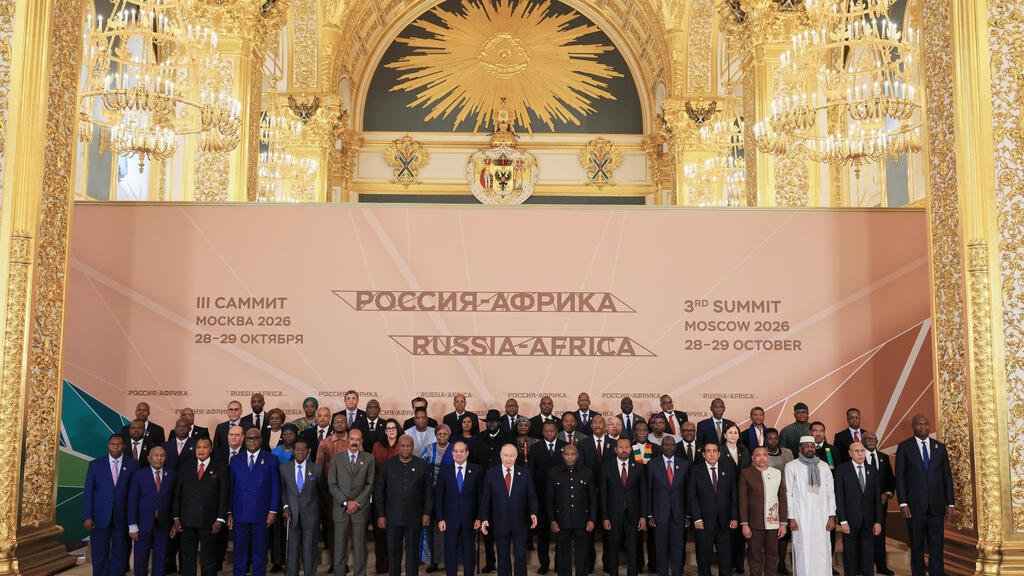
The Polisario’s absence from the third Russia–Africa Summit, held in Moscow on 28–29 October 2026, has brought renewed attention to an issue that extends beyond the list of delegations present in the conference hall: the limits of the representation that membership in the African Union can provide to the entity proclaimed by the movement when it engages with international partnerships governed by their own rules on participation, recognition and diplomatic relations.
Morocco was represented in Moscow at a senior level. King Mohammed VI designated Head of Government Fatima Zahra Mansouri to represent him at the summit, alongside Foreign Minister Nasser Bourita and Morocco’s ambassador to Moscow, Lotfi Bouchaara. According to the Moroccan Head of Government’s official communication, the summit brings together representatives of African states that are members of the United Nations. Before the summit opened, Russian presidential aide Yuri Ushakov announced that 48 of Africa’s 54 countries had confirmed their participation, including 22 represented by their heads of state.
This institutional framework is central to understanding the significance of the event. The Russia–Africa Summit is not an internal African Union meeting at which the organisation’s membership list is automatically reproduced. It is a partnership framework between Moscow and participating African countries, organised according to the arrangements established by the summit and its organisers. It is therefore necessary to distinguish the Polisario’s absence from this edition from any claim that Russia has changed its diplomatic position on the Moroccan Sahara issue. The first point can be established from the published participation information; the second cannot be inferred from the list of delegations alone.
The previous two editions provide useful context. At the 2019 summit in Sochi, the TASS news agency reported that leaders from all 54 African countries had been invited. At the 2023 summit in St Petersburg, organisers reported official delegations from 48 African countries and five regional integration organisations. For the current Moscow edition, the Kremlin again announced the participation of delegations from 48 African countries. These figures illustrate the breadth of African participation, but without detailed official attendance lists they do not establish the legal status of every absent entity or the precise reasons for its absence.
For Morocco, the significance of this distinction does not lie in declaring a definitive victory. Using UN membership as a criterion for representation gives the summit an identifiable framework and distinguishes it from a meeting based solely on African Union membership. Presenting that arrangement as proof of a definitive change in the Moroccan Sahara dispute, however, would go beyond what the available documents establish.
Beijing: Partnership criteria beyond continental membership
China offers a clearer example of the distinction between the African institution and the states participating directly in its partnership. According to the official description of the Forum on China–Africa Cooperation (FOCAC), its African membership comprises 53 countries that maintain diplomatic relations with Beijing, alongside the African Union Commission. The entity proclaimed by the Polisario does not appear on the published list.
This arrangement matters to Morocco because Beijing does not base the African composition of the forum solely on membership in the African Union. The existence of diplomatic relations with China is also a criterion for inclusion. The participation of the African Union Commission therefore does not mean that every entity belonging to the continental organisation automatically becomes an individual member of the China–Africa forum.
The evidence nevertheless needs to be interpreted carefully. The official list establishes the published membership criteria and the parties included in the forum. It does not, by itself, demonstrate that China has adopted a new decision concerning the Moroccan Sahara dispute. Similarly, the omission of an entity from a particular forum does not necessarily amount to a new political declaration about its status.
This comparison broadens the scope of Morocco’s diplomatic analysis. The task is not simply to track the number of countries recognising Moroccan sovereignty over the Sahara, but also to examine how international partnerships are structured, which entities are represented within them, and what rules distinguish the participation of continental institutions from the diplomatic representation of states.
Washington and Brussels: Recognition remains distinct from participation
At the US–Africa Leaders Summit held in Washington in December 2022, participation was subject to specific American arrangements, including requirements concerning diplomatic relations with the United States and status within the African Union. A report by the US Congressional Research Service states that the “Sahrawi Republic” was not invited because Washington did not recognise it as a sovereign state. Other countries were also absent for different reasons.
This case illustrates that an invitation to an international summit does not automatically follow from membership in a regional organisation. The host state can establish its own participation criteria according to the nature and objectives of the meeting. Exclusion from one summit, however, does not constitute a general ruling on every possible form of participation in multilateral institutions.
The European experience presents a more complex arrangement because joint organisation distributes responsibility for invitations between the two partners.
During the European Commission’s press briefing on 16 May 2025, in response to a question about the then-upcoming ministerial meeting between the European Union and the African Union, the Commission’s spokesperson explained that the meeting was jointly organised and that the African side was responsible for inviting African participants. The spokesperson also stated that the position of the European Union and its member states—namely, not recognising the entity proclaimed by the Polisario as a state—had not changed, and that its presence would not alter that position.
This episode shows that the identity of the authority issuing an invitation is not merely an administrative detail. Representatives may attend a meeting through the African institutional framework involved in organising it, without receiving a separate invitation from the European side and without their presence amounting to diplomatic recognition.
For Moroccan media coverage, this distinction deserves careful documentation. Confusing attendance with recognition risks exaggerating the Polisario’s gains. Conversely, confusing non-invitation with a diplomatic break can lead to declarations of victory that the evidence does not support.
Tokyo: When participation and non-recognition coexist
The ninth Tokyo International Conference on African Development (TICAD 9), held in Yokohama in August 2025, provides a practical example of how these arrangements can operate.
On 29 July 2025, Japanese Foreign Minister Takeshi Iwaya stated that Japan did not recognise Western Sahara as a state and that its policy of not inviting it to TICAD 9 had not changed. He also explained that the conference was jointly organised with the African Union Commission, which had previously invited representatives of the entity to earlier meetings. He added that he would not disclose the details of diplomatic consultations between the parties.
In August, representatives of the Polisario nevertheless took part in the conference, as reported by several media outlets. Japan, for its part, maintained its position of non-recognition. Moroccan media coverage also stressed that the participation had not changed Tokyo’s official position.
This sequence deserves attention because it prevents the issue from being reduced to a simplistic choice: either attendance means recognition, or absence means rejection. Representatives can participate in a conference hosted by a country that does not recognise the entity they represent if the arrangements for joint organisation allow the African partner to issue invitations.
For Moroccan diplomacy, documenting the host country’s official statements alongside identifying the authority that issued the invitation provides a more precise reading than relying solely on photographs of delegations or attendance announcements. A photograph can establish presence; it cannot, by itself, determine the status granted to a participant.
What the United Nations establishes—and what it does not
The phrase “the United Nations does not recognise the Polisario” requires legal clarification if it is not to weaken the argument.
The United Nations is not a state that grants diplomatic recognition in the same way governments do. Nor can the status of Western Sahara within the UN system be reduced to the question of recognition of the entity proclaimed by the Polisario. Since 1963, the United Nations has listed Western Sahara as a Non-Self-Governing Territory, while its final status remains the subject of a political process that has not produced a definitive settlement.
It is therefore more accurate to state that the self-proclaimed “Sahrawi Republic” is not a UN member state and that several international partners do not recognise it as a state, while specifying each country’s position. Invoking the UN status of the territory to claim that the organisation has adopted a general decision denying recognition to the entity would go beyond what the UN’s official page on Western Sahara establishes.
This clarification does not diminish the substance of Morocco’s argument. It strengthens its legal and diplomatic foundations. The defence of national interests is more robust when it relies on verifiable facts and distinguishes the respective mandates of different institutions, rather than on categorical statements that conflate their roles.
From occupied seats to measurable diplomatic gains
The Polisario’s absence from the Moscow summit, its omission from the list of African partners in FOCAC, and Japan’s stated position regarding TICAD 9 all provide evidence of the limits of the representation that African Union membership can offer outside the continental framework. These cases, however, do not belong to a single legal category and are not governed by one uniform rule. Each forum has its own arrangements, and each host state retains its own diplomatic position.
For Morocco, the significance of a diplomatic gain should be measured against what official documents establish and how stated positions translate into bilateral relations, agreements and international cooperation—not merely by whether a name appears on a list or in a group photograph.
The Moscow summit therefore provides an opportunity to examine the arrangements governing African representation in one of the major international cooperation frameworks, particularly as Morocco is represented by a delegation led by the Head of Government on behalf of King Mohammed VI.
To conclude that the Polisario’s absence signals a new turning point in Russia’s position on the Moroccan Sahara, however, would require a specific official statement, document or diplomatic decision. The published information about summit participation is not, on its own, sufficient to establish such a change.


