

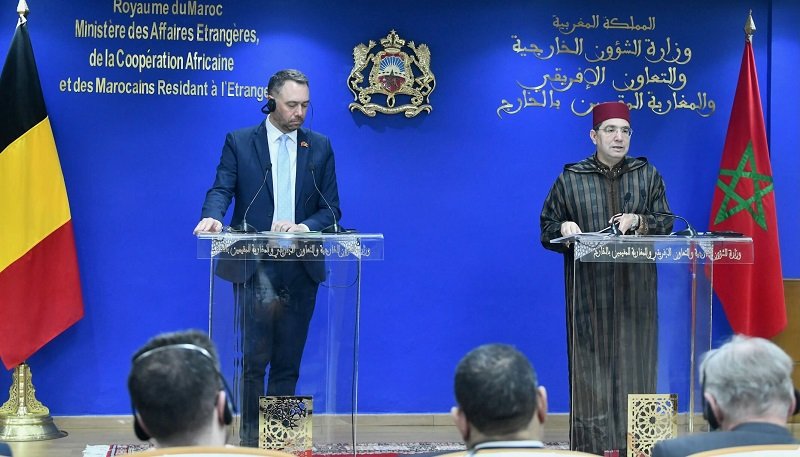
In a context marked by growing diplomatic momentum around the Sahara issue, Belgium has clearly reaffirmed its support for the autonomy initiative under Moroccan sovereignty, describing it as a “realistic and fair” approach and the most credible basis for achieving a lasting, consensual political solution in line with international law. This position builds on recent bilateral commitments and reflects continuity in Brussels’ diplomatic stance.
The statement was made in Rabat following talks between the Belgian Minister of Foreign Affairs, Maxime Prevot, and his Moroccan counterpart Nasser Bourita. The meeting took place within a structured political dialogue aimed at strengthening the strategic partnership between Belgium and Morocco while clarifying respective positions on sensitive regional issues.
A key reference point in this development is the joint declaration signed in Brussels in October 2025. That document recognizes the existential importance of the Sahara issue for Morocco and explicitly frames the territory within the sovereignty and territorial integrity of the Kingdom. It signals an effort to anchor bilateral relations on a shared political understanding and a clearly defined legal framework.
Beyond political messaging, the economic dimension plays a central role in translating this stance into practical action. The announcement that the Belgian ambassador will soon visit Rabat to prepare and support economic initiatives in the southern provinces — including facilitating Belgian business visits and organizing trade fairs and regional economic events — demonstrates a shift from diplomatic statements to operational engagement.
This linkage between diplomacy and economic cooperation reflects a pragmatic approach whereby political alignment is accompanied by tangible initiatives on the ground. By confirming that its consular coverage extends across all Moroccan territories without regional distinction, including the Sahara, Belgium also sends a clear administrative signal regarding its interpretation of the territorial framework.
From a broader analytical perspective, this evolution illustrates a wider trend among certain European partners toward a pragmatic reading of the Sahara dossier. Support for autonomy as a realistic solution, combined with deeper economic engagement, is increasingly shaping bilateral relations. In this context, the Morocco–Belgium partnership appears to be entering a phase where political convergence functions as a catalyst for structured economic cooperation and strategic alignment.


