

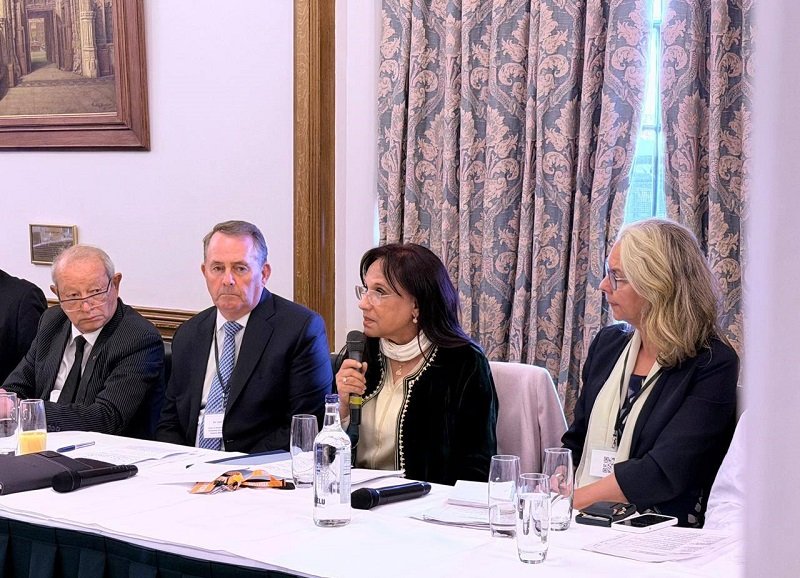
From within the halls of the House of Commons of the United Kingdom, the intervention of Amina Bouayach was far more than a technical human rights presentation. It emerged as an attempt to redraw the fragile and often contested boundaries between religion and politics in a world increasingly shaped by identity-driven tensions. The call for a new international framework to prevent the misuse of religion thus reads less as a legal proposal and more as an early warning signal in response to global distortions.
At the core of this approach lies a significant conceptual shift: moving beyond the traditional defense of freedom of religion toward the protection of individuals from the misuse of religion itself. Religion is no longer seen solely as a spiritual value, but also as a social force—capable of both cohesion and division. This explains the emphasis on establishing a precise definition of what constitutes “misuse of religion,” a notion that, while seemingly straightforward, touches on one of the most complex questions of our time: where does religious freedom end, and where does manipulation begin?
Yet the importance of this proposal is not confined to theoretical debates. Its real impact unfolds in the daily lives of citizens—particularly the Moroccan citizen. In a society where religion is deeply embedded in collective identity, any attempt to regulate or frame religious expression inevitably carries profound sensitivities. Here, individuals are not only tasked with preserving their freedom of belief but also face the subtle risk of being drawn into narratives that instrumentalize religion for political or social ends. In this sense, Bouayach’s proposal appears as an effort to protect the individual before protecting religion itself—to safeguard human consciousness from being appropriated in the name of the sacred.
What is particularly notable in the Moroccan approach, as presented in London, is its effort to reconcile two seemingly opposing imperatives: the protection of religious freedom and the firm rejection of any violent or exclusionary exploitation of religion. This balance reflects a distinct national experience, where the state promotes a model of moderate Islam while simultaneously navigating internal and transnational pressures linked to rising extremism.
Within this framework, the role of the state becomes pivotal. It is no longer merely a guarantor of freedoms but also a guardian of the religious sphere against misuse. However, this expanded role raises a fundamental dilemma: how can the state intervene to protect religion without becoming an agent of its control or normalization? This unresolved tension highlights the structural challenges that any future international framework will inevitably face.
Looking ahead, the emphasis on education and institutional structuring signals a deeper awareness: the battle against religious extremism is not solely legal—it is profoundly cultural. Extremism cannot be defeated by legal texts alone, but by fostering critical thinking that enables individuals to distinguish between genuine faith and ideological manipulation.
Ultimately, the initiative led by Amina Bouayach is part of a broader global reflection on the future relationship between religion, power, and responsibility. Yet its success will depend on its ability to move beyond international discourse and take root in the lived realities of citizens. For it is there, at the level of everyday life, that the real question emerges: not merely how to protect religion, but how to protect human beings from everything that may be done in its name.


