

In the waiting hall of an international airport, a Moroccan traveler watched a small information screen hanging above the hurried passengers. Between a delayed flight announcement and distant images of the desert, the name Smara suddenly reappeared. It was not a random news flash. It felt like a reminder that this decades-long conflict is no longer just a frozen diplomatic file inside the United Nations system, but a reflection of shifting global power configurations.
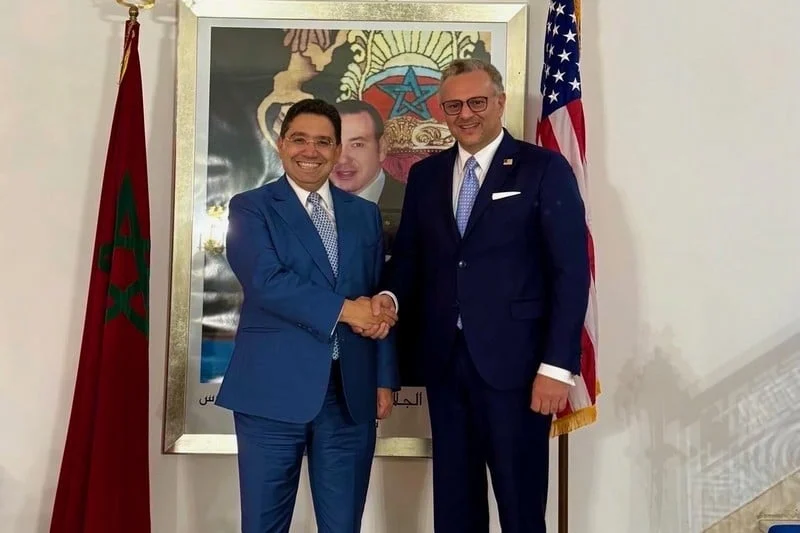
In the remarks of Massad Boulos, adviser to the U.S. President on Arab affairs, the Middle East, and Africa, the focus was not merely on describing the meetings between the parties as “positive.” It was part of a broader reading: Washington’s view that the file has reached a “significant milestone.” Behind this carefully chosen language lies a deeper reality in which regional balances are being reshaped at the intersection of security, energy, and strategic influence.
UN Security Council Resolution 2797 is not just an administrative continuation of the MINURSO mandate. It represents an attempt to politically re-energize a process that has long been stagnant. The insistence on roundtable talks bringing together Morocco, Algeria, Mauritania, and the Polisario Front reflects an international belief that the conflict can no longer be managed through inertia, but requires structured engagement among all stakeholders.
Yet beneath this diplomatic language lies a more layered reality. In recent years, Morocco has shifted from a defensive posture to a multidimensional strategy: diplomatic, economic, security-related, and military. The opening of consulates in the southern provinces, the expansion of investment flows, and the strengthening of security partnerships have collectively redefined its international positioning—from reaction to strategic initiative.
When referring to the “African Lion 2026” military exercises, the U.S. official is not merely describing routine drills. He is pointing to an evolving regional security architecture. Morocco is increasingly seen as a strategic anchor connecting the Atlantic Africa, the Sahel, and the Mediterranean, in a world where geopolitical corridors matter as much as physical borders.
At the same time, Washington maintains a calibrated balance with Algeria, described as an “important and strategic” partner. The emphasis on counterterrorism and security cooperation in the Sahel highlights another dimension of the issue: a fragile regional space shaped by armed group expansion and intensifying global competition.
The Smara attack, described as “regrettable” by the American adviser, serves as a revealing moment. In prolonged conflicts, military incidents are never isolated tactical episodes. They function as political signals capable of reshaping perceptions and influencing diplomatic trajectories. The swift international condemnation reflects the growing sensitivity surrounding the file.
The reference to an “international consensus” against destabilizing actions signals an important shift: the Sahara issue is no longer framed solely as a territorial dispute, but as a core component of regional stability and global security architecture.
Behind this evolution lies another quiet but decisive factor: economics. States increasingly read not only political maps but also energy, mineral, and logistical ones. Investments, ports, and trade routes have become variables as influential as diplomatic positions.
Thus, the Sahara is no longer merely a contested territory. It is becoming a space where security, economics, and global strategy intersect. And the deeper question may no longer be about resolving the conflict in itself, but about understanding how it continues to reshape the underlying grammar of international relations.


