

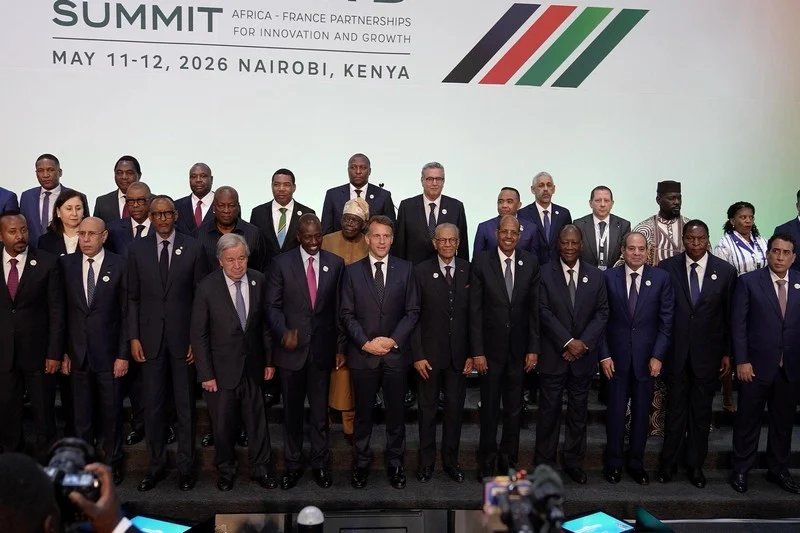
Inside a polished conference hall in Nairobi, where flags stood perfectly aligned behind official podiums and diplomatic smiles concealed hard negotiations, absence spoke louder than presence. The Polisario Front was not invited to the France-Africa Summit. And in the subtle language of modern diplomacy, exclusion can sometimes carry more weight than any public declaration. What appeared at first to be a procedural detail quickly evolved into a powerful political signal, revealing deeper shifts in Africa’s geopolitical landscape surrounding the Sahara issue.
The summit, hosted in the Kenyan capital, comes at a moment when Africa itself is redefining its priorities. Beneath discussions about trade, investment, and economic partnerships lies a broader transformation: the continent is increasingly moving toward a political logic driven by stability, infrastructure, markets, and development rather than by the ideological alignments inherited from past decades. In this changing environment, the Sahara dispute is no longer viewed solely as a historical or diplomatic conflict, but also as a question of political and economic pragmatism.
The absence of the Polisario reflects more than France’s well-known support for Morocco’s autonomy initiative, which Paris considers a serious and credible basis for resolving the conflict. It also reveals a deeper evolution taking place within several African capitals. Kenya’s decision not to invite the separatist movement appears to send a discreet yet unmistakable message: many African states are beginning to prioritize strategic balance, regional partnerships, and economic interests over old ideological reflexes.
Across the continent, governments are facing mounting internal pressures: inflation, debt, unemployment, migration challenges, and fierce international competition over African resources and markets. In this climate, prolonged regional conflicts are increasingly perceived as obstacles to growth rather than symbols of political principle. African populations are demanding infrastructure, jobs, energy, and investment—not endless diplomatic confrontations disconnected from their daily realities.
This is precisely why the Nairobi summit carries significance far beyond protocol. The Sahara issue is no longer interpreted exclusively through United Nations resolutions or the rhetoric of historical solidarity movements. It is increasingly measured through the political and economic cost of maintaining a frozen conflict. A growing number of African governments appear to believe that regional stability and economic integration now matter more than perpetuating ideological battles with diminishing practical value.
The remarks made by Salek Rahal, spokesperson for the movement “Sahrawis for Peace,” reflect this evolving perspective. By emphasizing that France recognizes only entities acknowledged by the United Nations, he highlighted a new diplomatic reality: international legitimacy today is increasingly shaped by institutions, legal recognition, and the ability to offer politically viable solutions. In a world governed by economic networks and international law, entities lacking broad recognition struggle to maintain long-term diplomatic relevance.
A similar reading emerges from the comments of Sidi Sebbaï, president of the “Sahrawi Youth for Peace,” who described the Polisario’s exclusion as evidence of a more pragmatic Africa. According to this logic, many African states now see the continent’s future less in ideological confrontation and more in development, energy security, regional connectivity, and economic integration.
Meanwhile, Algeria—supported primarily by South Africa—continues to defend the Polisario’s inclusion in African diplomatic forums. Yet the deeper question is no longer simply why Algeria maintains this position, but what it means for Algiers to find itself increasingly out of sync with evolving political trends across parts of the continent. Nairobi, in this sense, was not merely about the absence of one movement; it reflected the quiet transformation of African priorities themselves.
Africa today is no longer entirely the Africa of previous decades. Once shaped by proxy conflicts and ideological rivalries, the continent is increasingly being pushed toward a political order centered on investment corridors, trade routes, strategic partnerships, and regional stability. In this emerging geopolitical landscape, states appear more concerned with securing their place within future economic networks than sustaining endless disputes rooted in the past.
Ultimately, the message emerging from Nairobi extends far beyond the Sahara issue alone. It raises a broader question for the African continent itself: is Africa gradually turning the page on inherited conflicts in order to enter an era defined by political pragmatism and shared development? Or will some battles continue to survive, even as the rest of the world moves toward entirely different priorities?


