

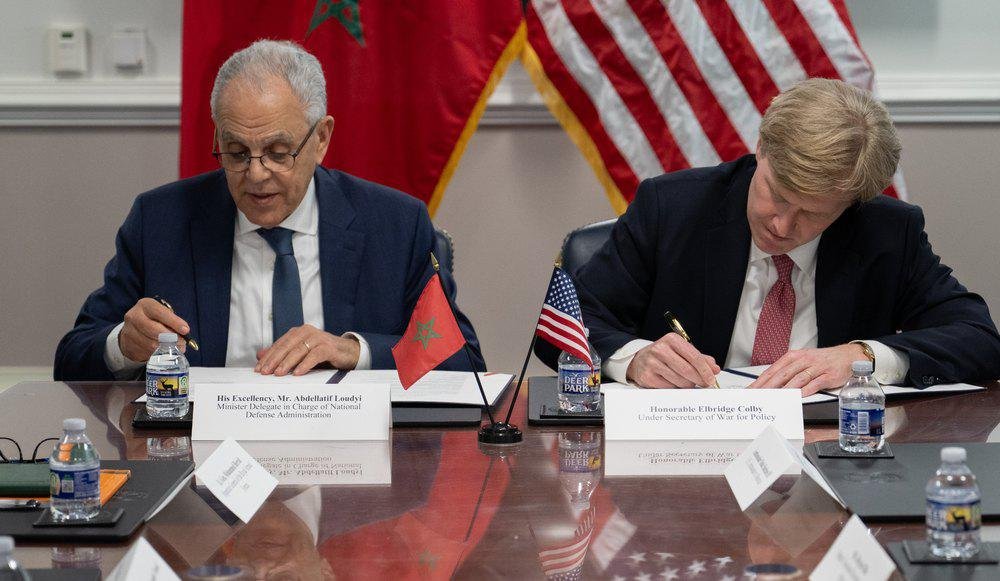
In an evening where lights are turned off early inside Moroccan middle-class homes for fear of electricity bills, and television news opens with images of aircraft carriers and strategic bombers, the world seems to be shifting from an economic logic to a “trenches” logic. While many countries complained about new U.S. restrictions on arms exports, Morocco was quietly signing a new defense roadmap with Washington, at a regional moment charged with war with Iran, tensions in the Mediterranean, and confusion within the Atlantic Alliance. This is exactly where the real question begins: is this simply ordinary military cooperation? Or is Rabat entering a new phase where its role is being redefined within the American security architecture?
It is easy to reduce what is happening to the language of official statements: “strategic partnership”, “defense cooperation”, “strengthening regional security”. But behind these words lie far deeper transformations. Moroccan-American relations are no longer simply traditional relations of friendship between an Arab country and Washington, but have become part of a broad geopolitical restructuring that truly began with the Trump administration’s recognition of Moroccan sovereignty over the Sahara in 2020, and then continued institutionally even after he left the White House.
The United States today is not only looking for an “obedient ally”, but for a “reliable geographical anchor”. And here the value of Morocco appears in the American strategic mind. The Kingdom faces the Atlantic, the Mediterranean, and Africa at the same time, controls a sensitive maritime passage near the Strait of Gibraltar, and presents itself as a stable security partner in a region marked by coups, irregular migration, and the expansion of armed groups in the African Sahel. For Washington, this is not a geographical detail, but a rare strategic asset in an age of chaos.
But the most dangerous transformation is not only in geography, but in the nature of political positioning. Morocco is no longer seen by the United States only as a Maghreb country, but as part of a broader security axis extending from the Mediterranean to the Middle East, passing through Israel and the Abraham Accords. Thus, Rabat appears, in the eyes of American decision-making centers, as a “stability platform” that can be used for multiple balances: containing Russian influence in Africa, monitoring Chinese expansion in ports and investments, countering Iranian influence, and managing security chaos south of Europe.
However, this positioning carries within it a deep contradiction. The more Morocco’s value rises in American calculations, the higher the level of tension rises in its regional environment. Algeria sees this rapprochement as a direct threat to the balance of power in the Maghreb, not only because of the Sahara, but because of a deeper question going back decades: who leads the region? Rabat or Algiers? For this reason, arms deals are no longer merely commercial contracts, but have become mutual sovereign and psychological messages. Morocco acquires advanced American, Israeli, and Turkish fighter jets and systems, while Algeria continues to move deeper into the Russian military system. The result is not only an arms race, but a gradual construction of a low-intensity “Maghreb cold war”.
The matter does not stop with Algeria. Even within Europe itself, some capitals are beginning to look with concern at Morocco’s rapid rise. Spain, which already experiences a silent tension with Rabat over migration, energy, and maritime sovereignty issues, understands that Morocco is gradually becoming a preferred American partner on the southern shore of the Mediterranean. This sometimes explains that Spanish duality: open economic cooperation with Rabat, contrasted with increasing security and strategic caution behind the scenes.
But amid all this geopolitical noise, a more sensitive question emerges within Moroccan society itself: what is the internal cost of this repositioning? Morocco, despite its diplomatic and military rise, still faces harsh socio-economic challenges: high unemployment, territorial inequalities, cost-of-living pressure, and intermittent social protests. Here appears the contradiction raised by part of public opinion: how can a country that needs massive investment in health, education, and employment enter an open regional arms race?
Then there is the popular dimension linked to Israel. While the Moroccan state sees normalization as part of a strategic repositioning serving the Sahara issue and enhancing the kingdom’s international influence, large segments of Moroccan society still consider relations with Israel a morally and socially sensitive issue. Therefore, any deeper Moroccan involvement in a U.S.–Israeli security axis could in the future create tension between state logic and street logic, especially amid the ongoing war in Gaza and rising Arab public anger.
And perhaps here lies the most important point: Washington grants Morocco an “alliance”, but does not grant it a “military alliance”. The difference between the two words may seem linguistic, but in international politics it is enormous. Morocco is a major U.S. ally outside NATO, but it does not enjoy the same defense guarantees as NATO member states. In other words, Washington may support Rabat politically and militarily, but it is not automatically obliged to enter a war in its defense if the region explodes.
And here the lessons of the Gulf resurface. The war with Iran has shown many Arab allies that partnership with the United States does not always mean direct protection or decisive intervention in times of crisis. Therefore, Rabat today seems required to manage this rise very carefully: benefiting from the American alliance without falling into a logic of overconfidence, strengthening defensive power without provoking neighbors, and turning geographical position into a diplomatic asset rather than a geopolitical burden.
In the end, the real question does not seem to be: what does Washington want from Rabat? But rather: to what extent can Morocco become a regional power without simultaneously becoming a proxy battlefield between international blocs? History teaches us that small and medium states do not always collapse because of weakness… but sometimes because of the excessive growth of their importance within great power rivalries.


