

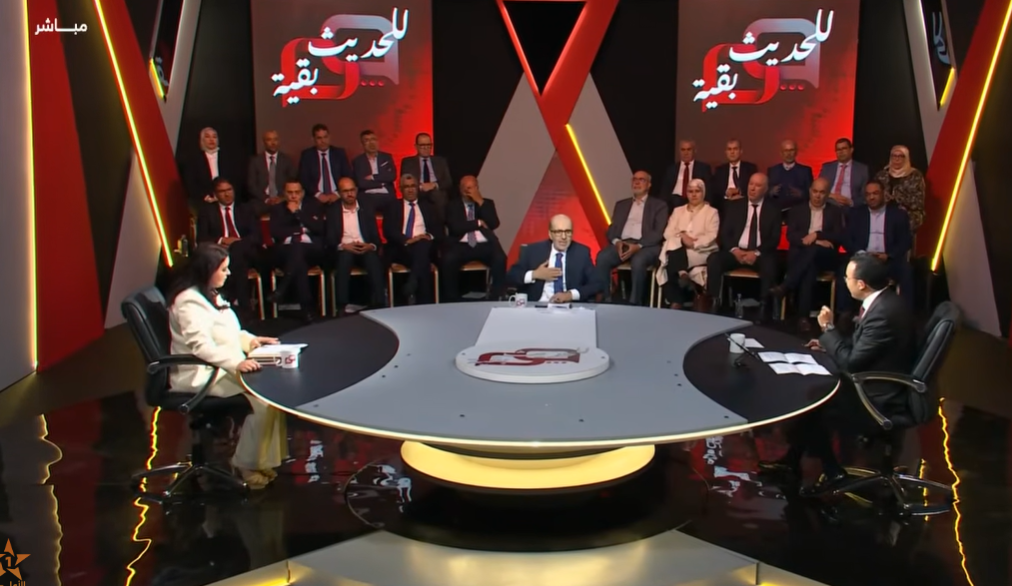
Moroccan viewers no longer watch political talk shows the way they once watched an ordinary evening broadcast. Something has changed. The citizen sitting at night in front of the public television screen now watches with a different eye: an eye that compares, measures the tone of the questions, counts interruptions, notices moments of tension, and quietly asks who is truly being pressured… and who is allowed to move comfortably through the conversation.
That is why the episode featuring Idriss Azami Al Idrissi on the program “To Be Continued” was not perceived as just another political interview. It became something larger: a mirror reflecting the growing crisis of trust between Moroccans and public media.
The timing mattered. Morocco is living through a socially tense moment marked by rising prices, declining purchasing power, mounting concerns over employment, healthcare, education, and debates surrounding social aid. In such periods, public media no longer function merely as information platforms; they become actors capable of shaping collective moods and even influencing political balances.
What captured public attention was not only Azami’s criticism of the government of Aziz Akhannouch, but the manner in which the interview itself unfolded. The repeated interruptions, the tense pacing, the constant return to sensitive issues, and the pressure placed on the guest created the impression that the program had crossed from journalistic accountability into the territory of political confrontation.
And here lies the real question: was this simply rigorous journalism applied equally to all political guests? Or did it reveal a deeper imbalance in how Morocco’s public media deals with opposition figures compared to those closer to power?
The issue is not that journalism should be soft. Serious journalism is supposed to challenge politicians, expose contradictions, and ask uncomfortable questions. The problem begins when the audience feels that such intensity is selective — that some guests are subjected to relentless pressure while others are treated with noticeable ease. At that point, the debate ceases to be purely professional and becomes unmistakably political.
This is why the name of Fayçal Laâraichi returned forcefully to public discussion. The head of Morocco’s National Radio and Television Company is no longer seen merely as an executive managing a public broadcaster, but as a symbol of a larger question: who truly defines the editorial line of Moroccan public media? Who determines the limits of criticism, the tone of questioning, and the balance between scrutiny and protection?
These questions do not emerge from nowhere. Morocco’s media landscape has changed dramatically in recent years. Social media has broken the monopoly once enjoyed by traditional television, and viewers now compare interviews, tones, and treatment across programs in real time. The public notices who is interrupted, who is given time to elaborate, who is cornered, and who appears protected.
What makes this even more sensitive is that it comes at a moment when trust in politics itself is eroding. Many Moroccans increasingly feel that political battles are no longer centered on competing social visions, but on controlling narratives, images, and public perception. In this struggle, public television becomes strategically important because it does not merely broadcast politics — it helps shape who appears strong, weak, convincing, or defensive.
During the interview, Idriss Azami attempted to present Justice and Development Party as an opposition force that exposed controversial issues ranging from import subsidies to fuel prices, social support policies, and conflicts of interest. Meanwhile, the host pushed him toward confronting the contradictions of his party’s own years in government, particularly regarding fuel price liberalization, subsidy reforms, and the Green Morocco Plan.
Yet beneath this political exchange lay a much deeper issue: can Moroccan public media still maintain equal critical distance from all political actors?
Because a public broadcaster funded by taxpayers is not just another media outlet. Citizens expect more than cold neutrality; they expect fairness in the distribution of journalistic pressure and scrutiny. The moment viewers begin to feel that a journalist has become, even indirectly, a participant in the political struggle, public media loses one of its most essential foundations: trust.
That is what gave this episode its significance. The debate moved far beyond Idriss Azami himself or even beyond the Justice and Development Party. It reopened a deeper and more uncomfortable question: who does Morocco’s public television truly belong to? The citizens who finance it? Or the political power that shapes the media landscape?
In modern politics, power no longer lies only in decision-making. It also lies in controlling images, rhythms, narratives, and impressions. Whoever shapes perception often shapes political reality itself.
For that reason, the controversy surrounding this episode goes far beyond a single television program. It reflects a broader crisis facing many public broadcasters across the Arab world: how can state-funded media convince citizens that it has not become merely the voice of power?
Moroccans may disagree about Idriss Azami, about the Justice and Development Party, or about the government of Aziz Akhannouch. But the question left hanging after the broadcast rises above parties and personalities alike: does Morocco’s public television still speak for citizens… or has it become another instrument of political authority?


