

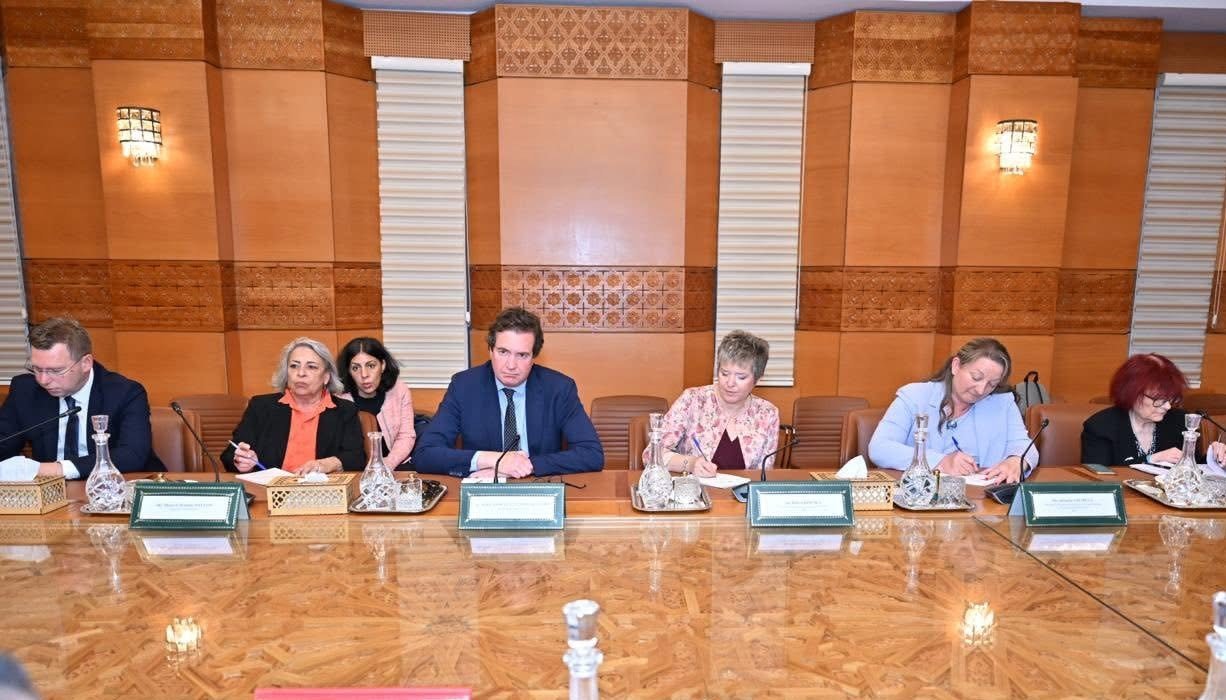
In what appears, at first glance, to be a routine diplomatic engagement, yet conceals far deeper strategic stakes, a delegation from the European People’s Party, affiliated with the Parliamentary Assembly of the Council of Europe, visited Rabat to meet Lahcen Haddad, Vice-President of the House of Councillors. Officially framed as part of strengthening parliamentary cooperation between Morocco and its European partners, the meeting in reality goes beyond institutional formalities, raising a more fundamental question about Morocco’s positioning within a complex equation: migration, regional stability, and energy transition.
The official statement highlights familiar priorities—migration, the Sahel, energy, and strategic partnership with the European Union. Yet behind these themes lies a critical question: is this a balanced dialogue based on shared responsibility, or a subtle reaffirmation of Morocco’s role as Europe’s “advanced border guardian”? When migration is framed as a shared concern, it in fact reflects asymmetrical interests: Europe seeks to limit migration flows, while Morocco is left to manage their direct consequences on its own soil.
Within this framework, the notion of “regional stability,” particularly in the Sahel, takes on a political and security dimension that goes far beyond cooperation. Morocco is portrayed as a reliable partner—but such recognition carries implicit expectations: maintaining stability, controlling borders, and contributing to the containment of regional crises. Yet a pressing question emerges: what kind of stability is being discussed, at a time when internal social and economic pressures continue to mount?
Perhaps the most sensitive issue remains European funding tied to migration and development. The European Union allocates substantial financial resources to Morocco through various programs. However, the core issue is not merely the scale of funding, but its trajectory and impact: where does this money go? How is it spent? What tangible improvements does it bring to citizens’ lives? These questions are largely absent from official narratives, yet they form the heart of the real debate.
Here lies a striking paradox: while these partnerships claim to address the root causes of migration, the underlying drivers persist—unemployment, lack of opportunity, and regional inequalities. Migration is not a random choice; it is a reflection of structural imbalances. After all, no one leaves a place where dignity and stability are assured.
Another blind spot concerns accountability mechanisms. Does the European People’s Party delegation conduct field visits? Does it assess funded projects? Does it demand measurable outcomes? Or do such meetings remain confined to political dialogue without genuine oversight?
On the Moroccan side, Lahcen Haddad emphasized parliamentary diplomacy as a tool for building trust—an approach that reflects Morocco’s ambition to position itself as a credible and influential partner. Yet for such diplomacy to move beyond rhetoric, it must be grounded in transparency, data, and measurable results.
Meanwhile, the delegation’s praise for Morocco’s “reform experience” raises its own critical question: is this an objective assessment based on concrete indicators, or part of a diplomatic language aimed at preserving strategic balance?
Ultimately, this meeting is part of a broader narrative—one that defines the complex relationship between North and South, where interests intersect but do not always align. While Europe seeks to secure its borders, Moroccan citizens seek clearer economic and social prospects.
And here lies the real challenge: can these partnerships evolve from tools of crisis management into genuine engines of development?
The answer, ultimately, will not be found in official statements—but in realities on the ground.


