

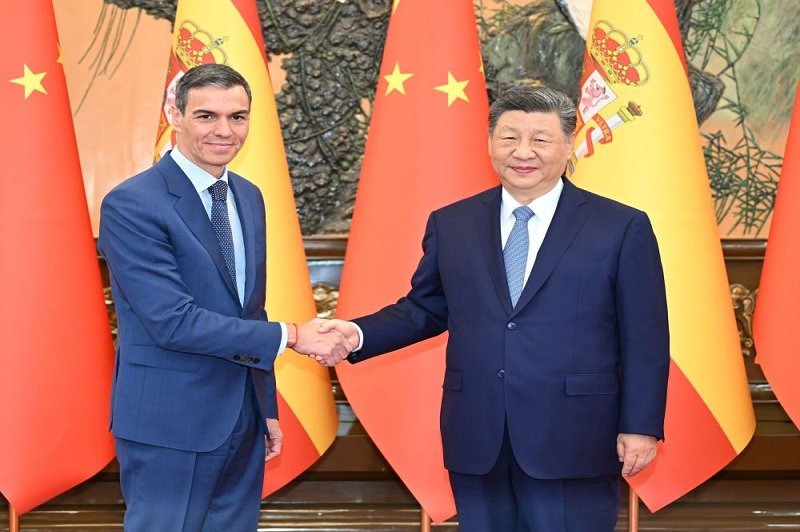
Amid the accelerating turbulence of global geopolitics, the meeting between Chinese President Xi Jinping and Spanish Prime Minister Pedro Sánchez, held at the Great Hall of the People, goes far beyond diplomatic routine. It reads as a dense political signal—almost an implicit declaration—hinting at the contours of a new international order taking shape slowly, yet with growing confidence.
🚨🔴 عاجل | تقارب صيني–إسباني
🗣️ شي جين بينغ:
"نقف مع التعددية ونرفض منطق القوة."📌 بيدرو سانشيز:
"العلاقة مع الصين تعززت… ونتجه نحو نظام عالمي متعدد الأقطاب."
🔥 رسائل تعكس تحولاً في التوازنات الدولية. pic.twitter.com/1sGgpHxIMb— Diplomatique.ma الدبلوماسية (@diplomatique_ma) April 14, 2026
From the outset, Beijing’s message was clear and loaded with meaning: “standing on the right side of history” and “opposing the law of the jungle.” These are not mere diplomatic phrases. They reflect a Chinese worldview that sees the global system drifting toward raw power politics, where international rules erode under the pressure of imposed balances. In this framing, China seeks to position itself as a guardian of “true multilateralism,” in contrast to what it views as a deviation in a global order traditionally shaped by the United States and its allies.
Yet the most striking dimension may lie in Madrid’s stance. As a member of the European Union, Spain is speaking in a tone that departs from traditional alignments, emphasizing “trust, dialogue, and stability” with China. This rhetorical shift mirrors deeper transformations within Europe, where calls for strategic autonomy from Washington are gaining traction—especially amid intensifying trade and technological tensions with Beijing.
Sánchez’s remarks about “a world growing more uncertain” reflect an emerging European awareness: the era of unipolarity is effectively over. The future appears to be moving toward a multipolar system, where multiple centers of power coexist. The key question, however, remains: will this multipolarity be structured by shared rules, or will it devolve into a fragmented order driven by competing interests?
At a deeper level, this meeting sends messages that extend well beyond the Sino-Spanish axis. It speaks to Europe as a whole—and to the broader international system. China is not merely seeking economic partnerships; it is attempting to redefine the rules of the game. Meanwhile, some European actors appear willing, cautiously, to engage with this proposition, striving to balance economic interests with geopolitical constraints.
What remains unspoken is perhaps the most critical: can Europe truly adopt an “independent pragmatic” approach toward China without colliding with its transatlantic commitments? Is Spain leading a strategic shift, or simply expressing one voice within a still-hesitant European chorus?
Ultimately, what unfolded in Beijing is more than an exchange of statements. It is a signal of a subtle struggle over who will define the rules of the next global era.
Between China’s discourse of “values” and Spain’s embrace of “pragmatism,” one question lingers:
are we witnessing the emergence of a more balanced international order… or merely a redistribution of power under new slogans?


