

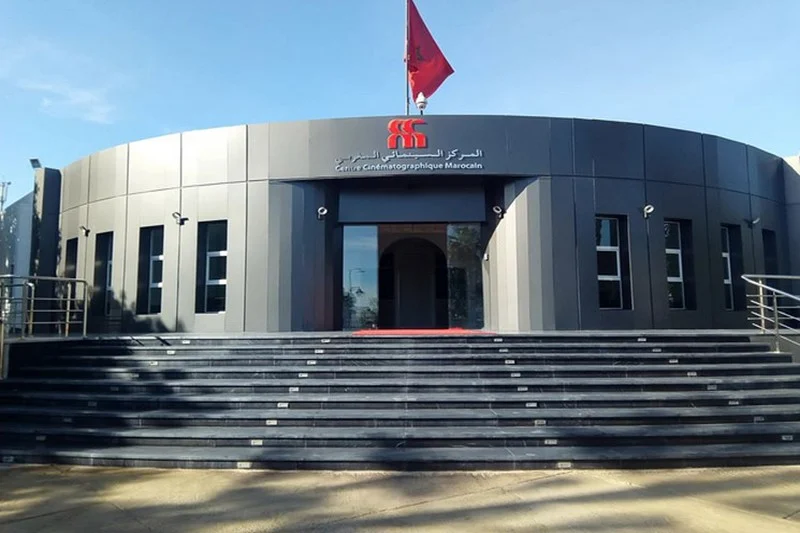
In a context where professional debates are increasingly blending with the noise of interpretations circulating on social networks, the Moroccan Cinematographic Center (CCM) has sought to clarify its position in the face of a controversy related to the financing of cinematographic works. This controversy was fueled by the circulation of an anonymous letter, attributed to unidentified circles, calling into question the decisions of the commission for support to film production.
In its statement, the CCM begins with a factual reminder that it considers essential: no official correspondence has been received regarding the allegations mentioned. Neither physical mail nor electronic message registered through institutional channels has been received on this subject. The institution thus emphasizes that it discovered the elements of the case at the same time as the general public, through press publications and reactions on social networks. This initial position immediately places the controversy within the field of non-institutionalized information, constructed outside the usual administrative channels.
Beyond a simple procedural correction, the Center seeks to place the debate within its real framework: that of a public institution that asserts it does not intervene in the dynamics of confrontation between professionals. The CCM thus rejects any interpretation that would place it at the heart of possible rivalries or “settling of scores” between actors in the film sector. Such an interpretation, according to the institution, risks diverting the very meaning of its mission, which is based on neutrality, regulatory oversight, and the strict application of public support mechanisms.
The statement also emphasizes a central point: the commission for support to film production operates as an independent body. It is composed of personalities from diverse cultural and intellectual backgrounds, reflecting the plurality of the Moroccan artistic landscape. This clarification is not merely descriptive; it aims to recall that support decisions do not stem from an individual or arbitrary logic, but from a structured collegial process, governed by defined and assumed criteria.
In this same logic of institutional transparency, the CCM highlights the control mechanisms to which the entire public aid system is subject. The system is regularly audited, notably by the General Inspectorate of Finance, in addition to other governance and control bodies. This mention reinforces the idea of a regulated institutional framework, where the management of public funds follows verification and accountability procedures, far from undocumented interpretations.
However, beyond the strictly administrative dimension of the statement, a broader underlying question emerges from the controversy: that of building trust in a sector where artistic creation, public funding, and professional competition intersect. The debate does not seem to concern only an isolated episode, but rather the overall perception of support mechanisms and the way information circulates, transforms, and becomes charged with meaning outside official frameworks.
Ultimately, the Moroccan Cinematographic Center seeks here to reaffirm an essential boundary between institutional information and interpretative readings that emerge in the digital public space. Through this clarification, it aims to consolidate the image of an institution acting within a legal framework, under control, and according to principles of fairness, while maintaining distance from positioning or confrontation dynamics within the film sector.


