

In a new development reflecting the increasing complexity of European migration policies and their intersection with broader geopolitical dynamics, the Spanish government has adopted an exceptional decree aimed at regularizing the legal status of hundreds of thousands of undocumented migrants residing in the country. However, this measure—presented as a broad legalization initiative—has introduced a notable exclusion concerning a specific group originating from the southern provinces of Morocco, classified as “stateless persons,” reigniting a multifaceted legal and political debate.
According to several Spanish media outlets, the final version of the decree, approved by the Council of Ministers, explicitly excludes individuals without recognized nationality, a legal status that applies to a number of residents from the Sahara region who have lived in Spain for many years. This exclusion effectively prevents them from benefiting from the collective regularization process, despite earlier drafts of the proposal having included them.
The same sources indicate that the initial drafts of the decree adopted a broader approach regarding eligible categories, before the final version was amended following legal recommendations from the Spanish Council of State, which argued that the status of “stateless persons” falls under a distinct legal framework separate from general irregular migration regularization mechanisms.
For its part, the Spanish government justifies this approach by pointing to the existence of alternative legal pathways through which these individuals may obtain lawful residency status, including specific protection procedures or individualized regularization mechanisms under existing legislation. Madrid maintains that this distinction does not constitute exclusion, but rather reflects differentiated legal regimes.
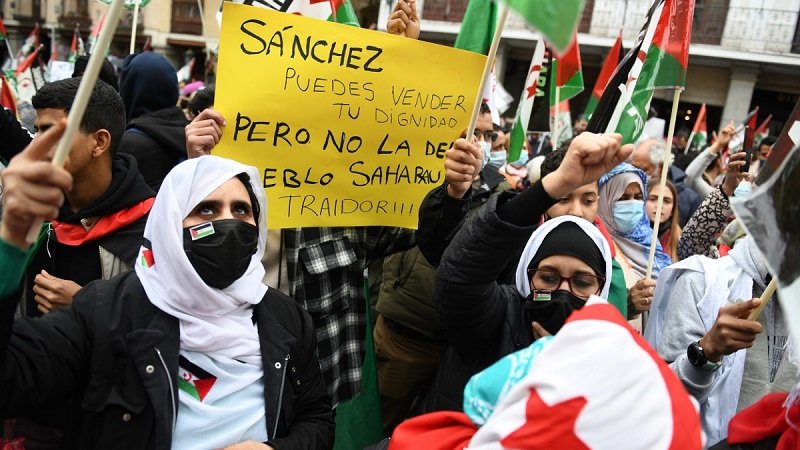
Nevertheless, this official explanation has not put an end to the controversy. Several human rights organizations, along with associations supporting the positions of the Polisario Front, argue that the decision creates a condition of heightened legal vulnerability for this group, limiting their social and professional integration opportunities despite long-term residence in Spain.
In this context, the Spanish newspaper The Objective reported that the Polisario Front has expressed its rejection of the decree, arguing that it reinforces a state of “legal limbo” for its supporters and restricts their access to employment and administrative stability.
Some associations have not ruled out challenging the measure before Spanish courts, arguing that excluding a specific group from a general regularization scheme raises questions about compliance with the principle of equality before the law. Other political interpretations suggest, in the background, that diplomatic dynamics between Madrid and Rabat may indirectly influence regulatory choices.
This development comes amid a noticeable rapprochement between Spain and Morocco, particularly following Madrid’s endorsement of Morocco’s autonomy plan as a basis for resolving the Sahara dispute. This shift has been accompanied by a gradual reconfiguration of policies concerning residents from the southern provinces, increasingly framed within Morocco’s sovereign framework.
From this perspective, Polisario supporters interpret these measures as part of Spain’s broader political alignment with Morocco’s position, arguing that they contribute to a redefinition of how the Sahara issue is being handled. Conversely, Rabat consistently reaffirms that the populations of the southern provinces are full Moroccan citizens, and that any external legal treatment must reflect this sovereign reality.
Between legal interpretation and political reading, the Spanish decree thus opens a renewed space of debate—both domestically and regionally—on one of the most sensitive and enduring issues in North Africa and the Mediterranean basin.


