

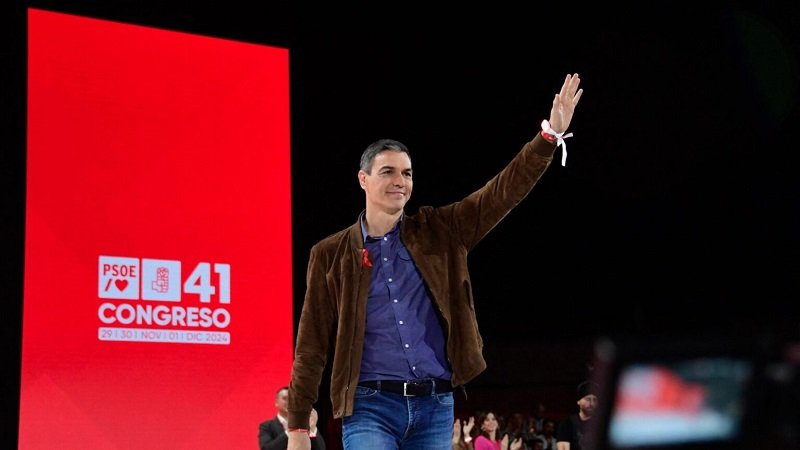
The Spanish political scene continues to take shape under an apparent stability that conceals deeper shifts in the electoral landscape. The latest data from the CIS (Centro de Investigaciones Sociológicas) confirms that Prime Minister Pedro Sánchez maintains a clear lead over his rivals, in a context marked by international tensions involving Morocco, the United States, and the Middle East, alongside Spain’s internal political dynamics.
What stands out is not only the Socialist Workers’ Party leading voting intentions with more than 36%, but also its ability to withstand political and media pressure from the right and far right. These actors have tried to turn sensitive foreign policy issues into electoral leverage, particularly Spain’s relations with Morocco, its diplomatic positioning within NATO, and its broader international alignment.
However, these issues have not translated into any significant erosion of Sánchez’s popularity. Tensions with the United States, especially regarding the use of Spanish military bases in an unstable global context, have not resulted in a major electoral backlash, contrary to opposition expectations.
Similarly, relations with Morocco remain a central topic in Spanish political debate, particularly after Madrid’s shift in support of Morocco’s autonomy plan for Western Sahara. Although this diplomatic repositioning has been strongly criticized by parts of the opposition, it has not produced a measurable electoral penalty, according to opinion surveys.
In this context, the Moroccan community living in Spain becomes a key structural factor. As one of the largest foreign communities in the country, it sits at the intersection of Spanish-Moroccan relations. Issues such as migration, labour market integration, social inclusion, and border management in Ceuta and Melilla extend far beyond electoral rhetoric and into the realm of practical governance.
The latest barometer shows the PSOE rising to 36.4%, while the People’s Party remains stable at around 23.6%. Vox declines to 14.7%, and the Sumar coalition continues to weaken. This reflects a broader shift in Spanish political priorities toward economic and social concerns, rather than ideological or foreign policy polarisation.
Overall voting intention figures place the governing bloc ahead of the combined right-wing parties, although a significant share of voters remains undecided, highlighting persistent electoral volatility.
At the leadership level, Pedro Sánchez remains the most positively rated figure, despite mixed levels of public trust. In contrast, the leader of the People’s Party struggles to broaden his support base, while the Vox leader continues to record the weakest approval ratings.
Beyond the numbers, these trends reveal a structured yet fragile political equilibrium in which foreign policy—including relations with Morocco—no longer acts as a decisive electoral fault line, but rather as one variable within a broader framework of governmental stability and political continuity.


