

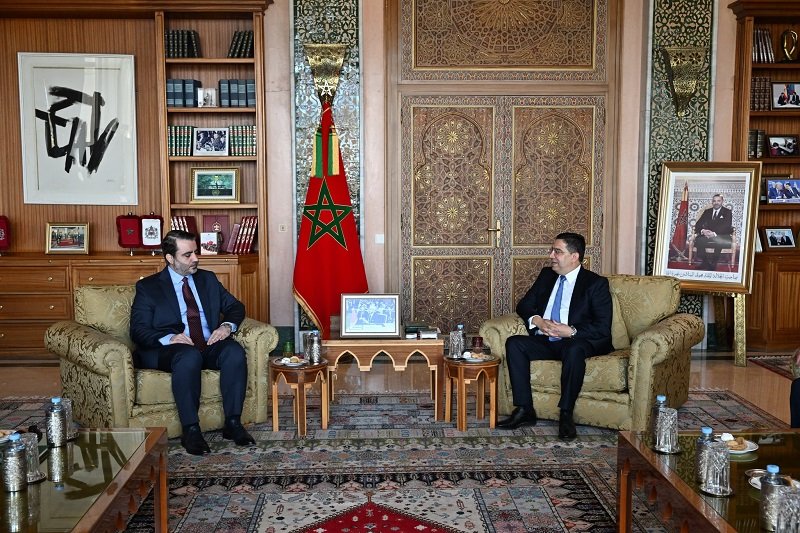
This time, it was not merely a protocol handshake between two foreign ministers, nor another diplomatic statement destined for the archives of Arab relations. When Damascus — long associated with positions opposed to Morocco on the Sahara issue — openly declares its support for Morocco’s territorial integrity and backs the autonomy initiative under Moroccan sovereignty, the significance extends far beyond conventional diplomatic language. It signals a quiet reconfiguration of balances within the Arab world itself. In politics, some shifts are measured not only by what is said, but by what their timing reveals about deeper transformations unfolding across the region.
The meeting in Rabat between Nasser Bourita and Syrian Foreign Minister Assaad Al-Chaibani cannot be separated from a broader regional context marked by rapid geopolitical repositioning after years of Arab fragmentation and political polarization. Syria, gradually emerging from regional isolation, now appears to be redefining its diplomatic priorities through a more pragmatic lens, seeking partnerships capable of providing political, economic, and strategic openings.
#Moroccan_Sahara: The Syrian Arab Republic, through its Minister of Foreign Affairs and Expatriates, Mr. Asaad Hassan Al-Shaibani, affirmed its full respect for the territorial integrity of the Kingdom of Morocco and its sovereignty over its entire territory. pic.twitter.com/eenhjsBe7d
— Moroccan Diplomacy 🇲🇦 (@Marocdiplo_EN) May 14, 2026
Within this changing landscape, Morocco is no longer perceived merely as a state located at the western edge of the Arab world. Over recent years, the Kingdom has established itself as an influential regional actor through its expanding African presence, its broad economic and security partnerships, and its growing role in mediation, stability, and regional development. For Damascus, rapprochement with Rabat represents far more than a diplomatic gesture related to the Sahara issue; it offers access to African depth and to diplomatic spaces that Syria still struggles to re-enter after years of war, sanctions, and geopolitical fragmentation.
The Syrian shift also carries powerful symbolic weight. For decades, Damascus was among the Arab capitals most closely aligned with the Polisario Front, politically supporting and hosting representatives linked to the separatist movement. Publicly affirming respect for Morocco’s sovereignty over all its territories therefore reflects a broader reassessment within Syrian foreign policy toward several sensitive regional issues. It is as though Syria is implicitly acknowledging that old ideological alignments are gradually losing relevance in favor of strategic interests and geopolitical pragmatism.
This transformation also comes amid a growing international consensus around Morocco’s autonomy proposal as a realistic and credible solution to the conflict, while separatist narratives increasingly lose momentum within international diplomatic circles. The new Syrian stance thus appears less as a temporary diplomatic gesture and more as a pragmatic reading of shifting regional and global power dynamics.
Yet beneath the calm diplomatic imagery lie deeper calculations. Syria, seeking economic reconstruction and political reintegration, understands that opening toward Morocco may facilitate its gradual return to a more balanced Arab sphere, away from the polarizations that have exhausted the region for over a decade. Meanwhile, Rabat strengthens Arab support for its territorial integrity, including from capitals historically associated with opposing positions.
The timing of Morocco’s decision to reopen its embassy in Damascus also carries strong symbolic significance. When Mohammed VI announced the move during the 2025 Arab Summit in Baghdad, it was not presented as a mere administrative step, but rather as a political signal aimed at rebuilding trust between two countries linked by a long and complex shared history. Rabat seemed to be advancing the idea that political disagreements should not permanently close the doors of dialogue.
Ultimately, however, the deeper question extends beyond Syrian-Moroccan relations alone. What this rapprochement truly reveals is the transformation of the Arab world itself. States once driven by rigid ideological alignments now appear increasingly guided by political realism, economic interests, and strategic influence.
And this is precisely where the significance of the moment lies: it is no longer simply about diplomatic support for Morocco’s Sahara position, but about the emergence of a new Arab phase in which regional balances are being rebuilt according to different rules — where strategic interests increasingly outweigh historical ideological loyalties. Because when capitals begin to change their positions, the real question is not merely who changed sides, but what kind of new Arab world is quietly taking shape behind these transformations.


