

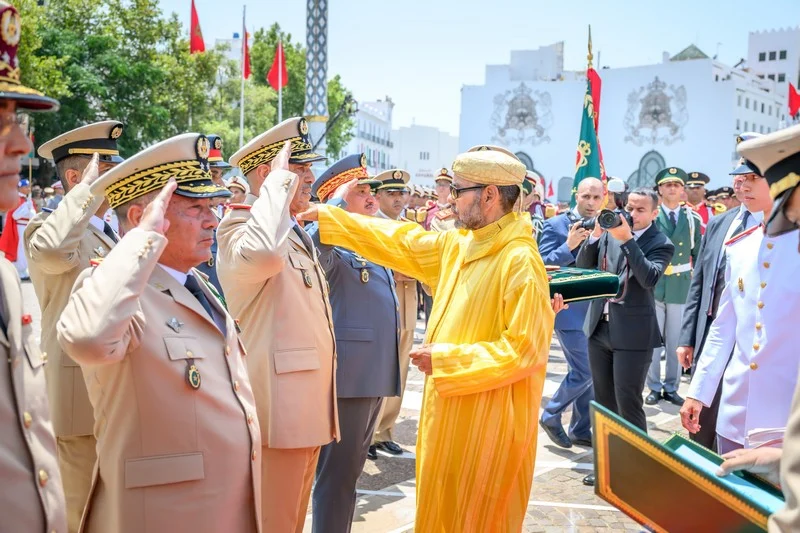
Today, the strength of nations is no longer measured solely by the number of tanks or fighter jets they possess, but by their ability to anticipate the future before it turns into a threat. In a world where geopolitical balances shift at extraordinary speed, armies are no longer judged only by troop numbers, but by their readiness to adapt to new forms of warfare, protect internal stability, and master the technologies reshaping global power dynamics. It is within this context that the speech delivered by King Mohammed VI on the 70th anniversary of the Royal Armed Forces emerges as far more than a ceremonial address; it reads as a strategic declaration about the Morocco of tomorrow.
When the monarch stated that “modernizing the Armed Forces is no longer an option, but a necessity,” he was not merely referring to the renewal of military equipment. He was outlining a profound transformation in Morocco’s military doctrine — one built around the concept of a smart military capable of confronting hybrid warfare, cyber threats, and technological conflicts that increasingly define global strategic competition.
This vision reflects a sharp awareness of both regional and international transformations. The Sahel remains shaken by insecurity, armed groups, and political instability, while North Africa is witnessing growing strategic rivalries and military competition. At the same time, cyberattacks and digital warfare have become tools capable of disrupting entire states without a single missile being launched. Through this lens, Rabat appears determined to place its military establishment within a framework of anticipation rather than mere reaction.
Perhaps the most revealing aspect of the speech was the direct emphasis on artificial intelligence, digitalization, and cybersecurity. These are no longer simple technological buzzwords; they have become central pillars of modern military doctrines. Contemporary armies increasingly rely on data systems, autonomous technologies, drones, and digital infrastructures capable of influencing geopolitical balances as much as conventional weapons. By integrating these fields into its strategic priorities, Morocco signals its intention not to remain dependent on global technological shifts, but to develop national capabilities linked to sovereignty and strategic independence.
Yet the royal vision does not reduce power to technology alone. The speech also highlighted the importance of investing in human capital through education, advanced training, and scientific qualification for military personnel. Twenty-first century armies are not built solely with sophisticated weapons, but with minds capable of understanding, managing, and innovating the tools of the future. In this sense, the military institution becomes part of a broader national modernization project centered on research, innovation, and technological advancement.
Beyond the security dimension, the speech also carried a strong social and humanitarian message. Announcements concerning the construction and renovation of military hospitals, alongside a large-scale military housing program, reflected an approach that sees the armed forces not merely as a defense apparatus, but as a social institution tied to the dignity and well-being of military personnel and their families. It was, in essence, a message of recognition toward those entrusted with safeguarding the nation.
The King also praised the role played by the Royal Armed Forces during recent floods and natural disasters that affected several regions of the Kingdom. These interventions demonstrated an army whose mission extends beyond conventional defense into humanitarian action and citizen protection during crises. Through such operations, the military emerges as a pillar of social stability and national solidarity during difficult times.
The speech also carried an important diplomatic dimension. By reaffirming Morocco’s commitment to bilateral and multilateral military cooperation, the monarch underscored the Kingdom’s ambition to strengthen its position as a reliable regional partner and a force for stability in Africa and the Mediterranean space. In an increasingly uncertain international environment, possessing a modern and professional military has also become a tool of geopolitical influence.
Underlying this broader vision is a deeper reflection on the relationship between youth, citizenship, and the state itself. Through military service, Morocco also appears to seek the reinforcement of discipline, belonging, and responsibility among younger generations living through profound social and cultural transformations. As if the strength of a nation does not begin only at its borders, but also in its ability to cultivate a shared national consciousness.
Ultimately, the anniversary speech was not simply about the military. It was about the image of a Morocco seeking to balance loyalty to its national constants and monarchical foundations with an ambitious adaptation to the strategic realities of the future. In a world shaped by technological acceleration and constant transformation, states that fail to invest in knowledge and digital sovereignty risk gradually losing their place within the global balance of power.
And behind this entire vision lies a deeper question: in the twenty-first century, has military modernization become the true reflection of a state’s ability to preserve its sovereignty, stability, and relevance in a rapidly changing world?


