

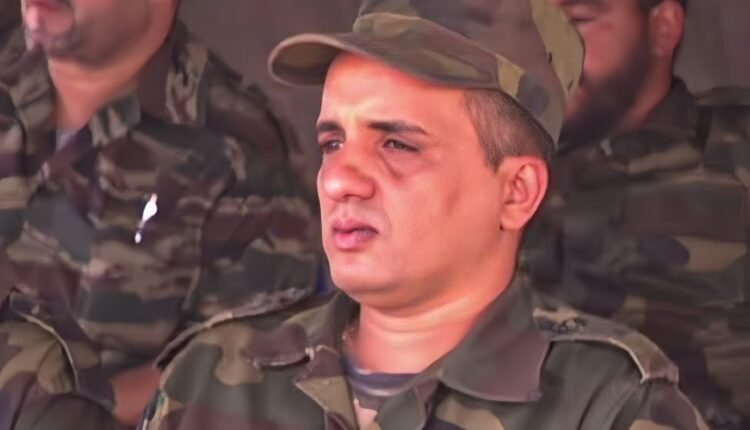
In a conflict that has stretched across decades and evolved into one of North Africa’s most complex geopolitical disputes, the significance of certain events is measured not merely by the casualties they cause or the immediate losses they inflict, but by what they reveal about deeper shifts in power balances, leadership structures, and political choices. Viewed through this lens, the announcement by the separatist Polisario Front of the death of Lahbib Mohamed Abdelaziz, son of the movement’s former leader Mohamed Abdelaziz, is far more than a routine military development. It signals a new phase marked by growing questions about the future of the Sahara conflict and the viability of the movement’s continued reliance on armed struggle amid rapidly evolving military and diplomatic realities.
The man whose death was announced was not an ordinary figure within the separatist movement’s organizational and military structures. According to information circulating among circles close to the Front, he occupied influential positions and was regarded as one of the personalities with significant weight inside decision-making networks. His death therefore represents more than a battlefield loss; it carries considerable political and symbolic significance, particularly given his association with one of the most prominent families in the history of the separatist movement.
The importance of the event is amplified by the circumstances surrounding his death. The separatist Front’s acknowledgment that he was leading operations near Morocco’s defensive wall draws attention to the nature of military activities taking place in the buffer zone in recent years. It also raises broader questions about the objectives behind such operations, especially against the backdrop of tensions that have periodically emerged in the southern provinces and concerns about efforts to expand hostilities into more sensitive areas.
These developments cannot be separated from incidents that have recently occurred around the city of Smara, where projectiles have landed near populated areas on several occasions. Even when the material damage was limited, such incidents revived debate about the current phase of the conflict and whether certain military actions are intended primarily as political signals whose significance extends beyond their immediate tactical impact.
Yet the significance of the death of a senior figure within the separatist Front extends beyond security and military considerations. It also invites a broader examination of the strategy adopted by the movement since its declaration in late 2020 that it no longer considered itself bound by the ceasefire. Since then, the separatist Front has consistently portrayed the situation as one of ongoing war. However, developments on the ground have increasingly highlighted a widening gap between rhetoric and tangible outcomes, particularly in light of the transformations that have taken place within Morocco’s military capabilities.
The nature of modern warfare has changed dramatically over the past two decades. Vast territories that once provided broad room for maneuver are now subject to constant surveillance thanks to technological advances. In the Sahara, drones have emerged as one of the most influential factors reshaping the rules of engagement. Beyond intelligence gathering and monitoring capabilities, these systems have enabled Moroccan forces to respond with greater speed and precision in areas that once posed significant operational challenges.
It is therefore unsurprising that several figures associated with the separatist Front have acknowledged in media statements over recent years that drones have fundamentally altered the dynamics of the conflict. What initially appeared to be a supporting military tool has evolved into a central component of the strategic equation, significantly reducing the operational flexibility available to both fighters and senior members of the movement near the defensive wall.
However, viewing the event solely through a military lens risks overlooking an even more important dimension: the political and diplomatic environment in which it occurred. In recent years, the Sahara issue has undergone notable international developments, including growing support from influential countries for Morocco’s autonomy proposal. At the same time, the separatist Front has found itself operating in a more complex diplomatic landscape, where influence is increasingly contested not only on the ground but also within international institutions and foreign capitals.
This reality becomes particularly evident during key diplomatic moments linked to the conflict. Every visit by the United Nations Secretary-General’s Personal Envoy and every report submitted to the Security Council intensify strategic calculations among all parties involved. In such a context, military escalation is often interpreted as part of a broader effort to strengthen political and diplomatic leverage rather than achieve decisive military gains.
Behind these developments lies a deeper challenge facing the separatist Front after years of relying on escalation. Prolonged conflicts test not only the ability of actors to sustain confrontation but also their capacity to convert that confrontation into meaningful outcomes. Over time, a fundamental question becomes unavoidable: can yesterday’s tools still produce the desired results, or have regional and international transformations imposed an entirely different reality requiring new approaches?
The death of Lahbib Mohamed Abdelaziz, son of the former leader of the separatist movement, reflects part of these broader transformations. The event is not merely about the loss of a prominent figure; it highlights changes affecting the very nature of the conflict itself. When technology becomes a decisive factor and diplomatic dynamics begin to outweigh battlefield calculations, the questions surrounding the future of the dispute inevitably evolve as well.
Ultimately, the most important question may not be how a senior member of the separatist Front was killed, but what his death reveals about the stage the conflict itself has entered. Long-running disputes eventually reach a point where strategies, tools, and assumptions must be reassessed. Amid accelerating military developments and shifting diplomatic realities, one question continues to hover over the Sahara: can armed confrontation still alter a landscape increasingly shaped by technology and international alignments, or is the future of the dispute gradually moving toward political pathways that have become more influential than the language of weapons itself?


