

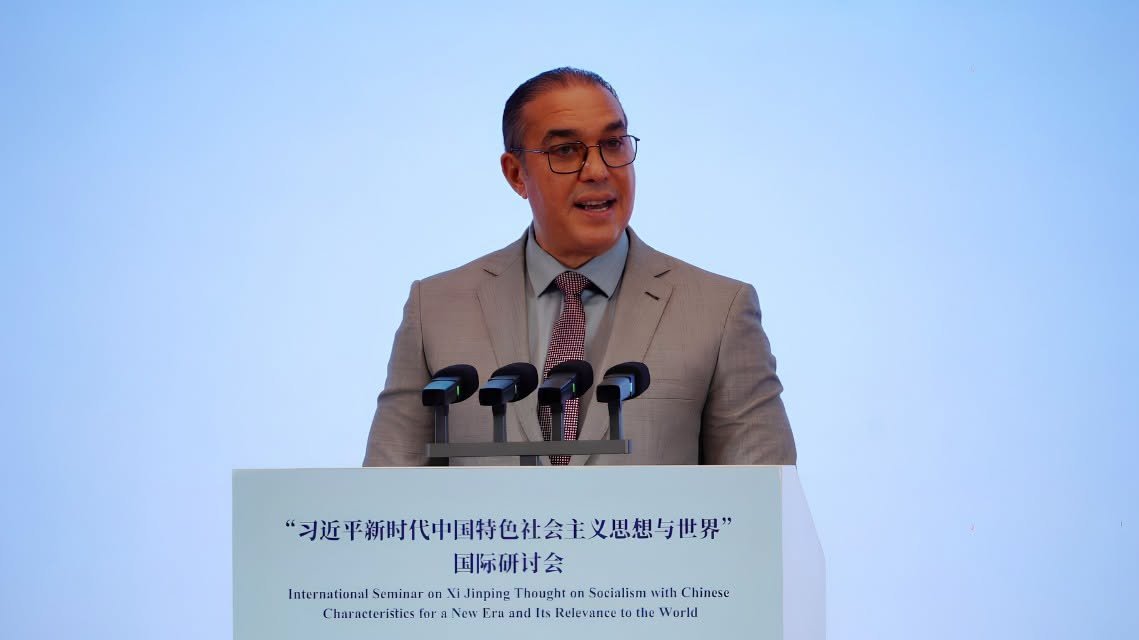
Not every international conference is merely a platform for formal speeches, just as every address delivered on the global stage cannot be measured solely by its diplomatic wording. More often, such speeches derive their true significance from the messages they convey, the strategic directions they reveal, and the political realities they subtly reflect. Viewed through this lens, the participation of Mohamed Ouzine, Vice-President of Morocco’s House of Representatives, in the international seminar held in China’s Ningxia Hui Autonomous Region on July 8–9, 2026, deserves to be read as far more than a ceremonial appearance. It represents another milestone in the evolving strategic partnership between Morocco and China—a relationship that is increasingly expanding beyond economics into the exchange of development models, governance practices, and long-term public policy visions.
Held under the theme, “The Road to Modernization: Lessons from China’s Theory and Practice in Poverty Alleviation,” the seminar was not simply an opportunity to showcase China’s internationally recognized success in lifting hundreds of millions of people out of poverty. It also served as a forum for rethinking how development should be approached in a world confronted by overlapping economic, social, and geopolitical challenges. Within this broader context, Morocco’s intervention stood out not as a routine institutional presentation, but as a reflection of a development philosophy that places people at the center of public policy, linking sustainable growth to human dignity, social inclusion, and territorial equity.
The decision to entrust Mohamed Ouzine with delivering the address on behalf of the participating delegations carries significance that extends beyond diplomatic courtesy. Within international practice, such responsibility is rarely assigned at random. It generally reflects confidence in the speaker’s credibility and, by extension, recognition of the country’s standing among its peers. This symbolic dimension adds greater weight to Morocco’s participation, illustrating the Kingdom’s growing visibility and influence in international forums where development issues have become as strategically important as traditional political and diplomatic agendas.
In discussing China’s experience, Ouzine deliberately moved beyond statistical achievements and economic indicators. Instead, he emphasized what he identified as the true foundation of China’s success: sustained political will, a long-term strategic vision, and governance capable of translating ambitious plans into tangible outcomes. Implicit in this assessment lies a broader message—that poverty eradication is not determined solely by financial resources, but fundamentally by the ability of institutions to maintain policy continuity, ensure effective implementation, and pursue development as a sustained national commitment rather than a short-term political objective.
Against this backdrop, Morocco’s own development journey was presented as an illustration of a comparable philosophy adapted to national realities. By highlighting the National Initiative for Human Development launched by His Majesty King Mohammed VI, alongside the ongoing expansion of universal social protection, direct social support programs, and reforms aimed at reducing territorial disparities, Ouzine was not merely listing government achievements. Rather, he was projecting Morocco’s development model as one built upon strategic investment in human capital, social cohesion, and inclusive growth as the cornerstones of long-term national stability.
Yet a closer reading reveals an even deeper dimension. By presenting its own experience before China, Morocco does not portray itself as a country searching for imported solutions. Instead, it positions itself as a partner capable of contributing its own expertise while learning from the experiences of others. This reflects a new diplomatic philosophy in which development cooperation is no longer defined by the traditional relationship between donor and recipient, but by reciprocal learning between countries that recognize development as a shared foundation for political stability, economic resilience, and social progress.
Viewed from a broader geopolitical perspective, the seminar also illustrates the gradual transformation of Moroccan-Chinese relations. Cooperation that was once primarily associated with investment, infrastructure, manufacturing, and industrial development is increasingly extending into more structural fields, including social policy, governance, poverty reduction, and human development. Such evolution signals that the partnership between Rabat and Beijing is becoming deeper and more multidimensional, engaging not only with economic growth but also with the institutional and societal foundations upon which sustainable development depends.
The timing of this dialogue further amplifies its significance. At a moment when development models themselves have become instruments of international competition, nations are seeking partnerships capable of delivering practical solutions rather than ideological narratives. Within this changing global landscape, Morocco continues to diversify its strategic partnerships, drawing lessons from successful international experiences while preserving its own political identity, institutional choices, and sovereign development priorities.
The concluding appeal by Mohamed Ouzine for stronger international cooperation and broader exchanges of expertise in combating poverty also deserves to be interpreted beyond its surface meaning. Behind this diplomatic language lies a broader vision of international relations—one that regards poverty not as an isolated domestic challenge but as a global issue requiring sustained cooperation, knowledge-sharing, and collective responsibility among nations.
Ultimately, Morocco’s participation in the Ningxia seminar cannot be reduced to a formal institutional presence or another diplomatic intervention on the international calendar. It reflects a broader trajectory in which Moroccan diplomacy increasingly incorporates human development, social justice, and poverty eradication into its broader strategy of international engagement. Just as investment agreements and economic partnerships serve as instruments of influence, so too do inclusive public policies and development achievements become elements of a nation’s soft power. The central message emerging from Ningxia is therefore unmistakable: Morocco is no longer content merely to present its experience to the world; it seeks to contribute actively to shaping the global conversation on development, through a strategic partnership with China that places human development at the heart of its shared ambitions.


