

When Morocco Faces France… Is the Real Challenge an Unfinished Football Development Model?
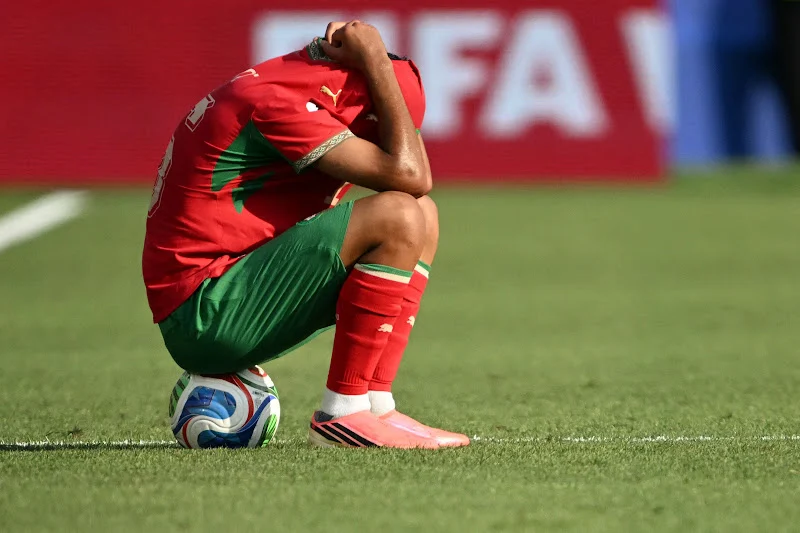
Morocco’s defeat to France in the quarter-finals of the 2026 FIFA World Cup was more than the end of a remarkable tournament run. It reopened a strategic debate that has lingered since the historic 2022 World Cup in Qatar and resurfaces every time the Atlas Lions meet France on the world’s biggest stage. The real question is not simply why Morocco lost a football match, but whether that defeat exposed the limits of a football development model that still relies heavily on players whose football education took place outside the Kingdom.
This is not a question of patriotism, nor is it an attempt to measure loyalty according to birthplace or passport. National identity cannot be reduced to geography. Many Moroccan internationals consciously chose to represent Morocco despite having the opportunity to play for other national teams. Their commitment deserves recognition. Yet analytical journalism does not stop at personal intentions. It seeks to understand the structures that shape outcomes. The deeper question, therefore, is this: what does this match reveal about Morocco’s long-term football project?
For more than two decades, Morocco has successfully pursued a strategy of recruiting talented players from its diaspora, particularly those raised and developed in France, Belgium, the Netherlands and Spain. That strategy has produced unprecedented achievements, including the historic semi-final appearance in Qatar and another deep run at the 2026 World Cup. However, success has also postponed a more fundamental debate. Was this model intended to be a permanent foundation for the national team, or merely a transitional phase until Morocco’s domestic football development system matured?
Against teams such as Canada or Brazil, Morocco enters what is essentially a football contest. Against France, however, another layer inevitably emerges. For many Moroccan internationals, France is not simply the opposing team. It is the country where they were born, educated, developed as footballers, launched their professional careers, or where members of their families continue to live. This observation should not be interpreted as an accusation. It reflects a social reality capable of creating unique psychological pressures—pressures widely recognised in sports psychology—that make such matches fundamentally different from ordinary international fixtures.
Reducing Morocco’s defeat to that single factor would nevertheless be an oversimplification. There is no objective evidence to suggest that any player intentionally underperformed or that his personal background determined his commitment on the pitch. Yet another legitimate question deserves attention: does the Royal Moroccan Football Federation adequately prepare players for the psychological complexity of identity-driven matches? Has sufficient importance been given to the mental dimension of confronting the country where many members of the squad built significant parts of their lives?
At this point, the discussion moves beyond individual players and enters the broader debate surrounding Morocco’s domestic football development strategy. Since the establishment of the Mohammed VI Football Academy, the ambition has been clear: to create generations of elite footballers largely developed within Morocco and capable of forming the backbone of the national team. The academy has undoubtedly produced outstanding professionals and has contributed significantly to raising technical standards. Nevertheless, Morocco has not yet reached the stage where its senior national team depends primarily on players whose entire football education occurred inside the country. The majority of its core squad continues to emerge from European football academies.
This reality should not be interpreted as proof that the project has failed. Rather, it suggests that Morocco has not yet completed its transition from a policy of attracting talent to a strategy of producing talent. The distinction is crucial. One model benefits from football systems developed abroad; the other creates a sustainable domestic ecosystem capable of continuously supplying elite players to future national teams.
This naturally leads to another strategic question. If youth development has become a national priority, why does the pool of locally developed players remain relatively limited at the highest international level? Does the challenge lie in coaching standards, the competitiveness of the domestic league, the early migration of promising youngsters to Europe, or the absence of a fully integrated pathway connecting academies, professional clubs and the national team?
Perhaps the greatest lesson from the match against France is not about questions of loyalty, but about the current limits of a football model that is still evolving. The real challenge is not to choose between players raised in Morocco and those raised abroad. Instead, it is to build a national system strong enough for locally developed footballers to become the foundation of the national team, while continuing to embrace the Moroccan diaspora as a natural extension of the country’s football wealth rather than a substitute for domestic development.
Moroccan players from the diaspora have repeatedly demonstrated their commitment to the national jersey and have shown that Moroccan identity extends far beyond geographical borders. Yet football’s most successful nations are not defined solely by their ability to attract talent. Their enduring strength lies in their capacity to produce it.
The World Cup in Qatar offered Morocco a historic breakthrough. The 2026 tournament now raises an even more strategic question: should Morocco continue relying primarily on footballers developed by European academies, or should it accelerate the construction of a football system capable of producing the majority of its elite talent at home while complementing that foundation with the extraordinary potential of its global diaspora?
The defeat against France may therefore represent more than the conclusion of a World Cup campaign. It may mark the beginning of a necessary national conversation about the future of Moroccan football. Great football nations are ultimately measured not only by the talent they recruit, but by the talent they consistently develop. When domestic player development becomes the rule rather than the exception, Morocco’s football project will have reached its true strategic maturity.


