

When the Atlas Lions Shake Ceuta and Melilla: The World Cup Reopens the Identity Debate, as a Spanish Party Tells the Far Right that Patriotism Is Not Measured by Hostility Toward Morocco
Ever since Morocco’s national football team emerged as one of the defining stories of modern World Cup football, the Atlas Lions have become far more than a successful sporting side. Their victories now transcend the boundaries of the football pitch, evolving into political, social and symbolic events that expose long-standing questions surrounding identity, belonging, historical memory and sovereignty. Nowhere is this transformation more evident than in Ceuta and Melilla, where every Moroccan triumph revives one of Spain’s most delicate and unresolved debates.
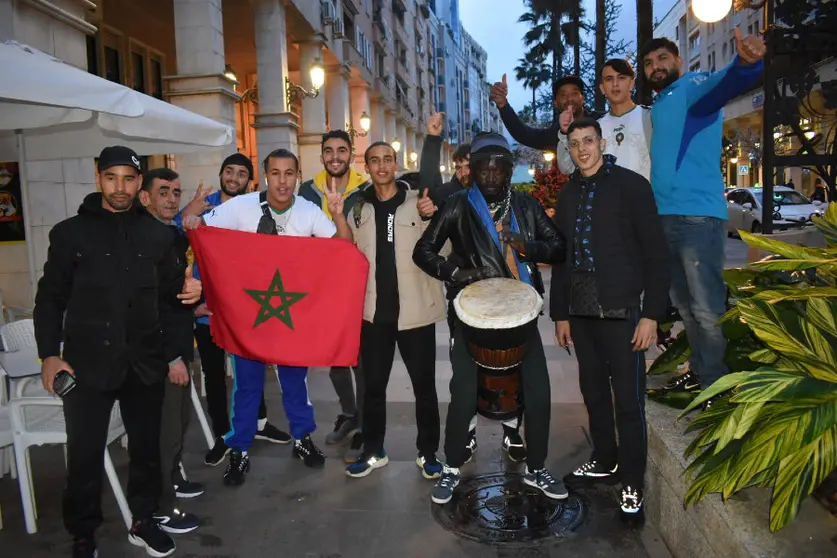
With every major international tournament, a familiar scene unfolds. Moroccan flags appear across neighborhoods, streets fill with celebrations, and thousands of residents proudly wear the colors of the Atlas Lions. For many families whose roots remain closely connected to Morocco, these celebrations are a natural expression of cultural memory and emotional attachment. Yet what appears to be a spontaneous football celebration quickly becomes something far more significant within Spain’s political discourse.
This is precisely where the deeper story begins. Behind what seems to be ordinary sporting support lies a much larger question: how far can cultural identity be expressed before it is interpreted as political disloyalty? Within certain political narratives, wearing a Moroccan jersey or waving the Moroccan flag ceases to be a gesture of sporting enthusiasm and instead becomes a supposed indicator of national allegiance.
The paradox is difficult to ignore. Spain presents itself as a modern democratic state built upon pluralism and cultural diversity. Yet every Moroccan success appears to reopen a question that has never been fully resolved: can a Spanish citizen maintain emotional, cultural and family ties with Morocco without having his or her loyalty to Spain questioned?
The reactions of Spain’s far right, particularly voices associated with the Vox party, perfectly illustrate this contradiction. Their criticism of residents celebrating Morocco’s victories extends well beyond football itself. The issue is not that people support a foreign national team; rather, it is that the team in question represents Morocco—a neighboring country whose relationship with Spain remains intertwined with historical disputes, sovereignty questions and an exceptionally dense network of human connections.
Within this ideological framework, a football celebration becomes a test of patriotism. The Moroccan flag is portrayed as evidence of questionable loyalty, despite the fact that millions of Spaniards openly support Argentina, Italy or Brazil without anyone questioning their Spanish identity. Such a double standard reveals that the controversy has very little to do with football and much more to do with Morocco’s unique place in Spain’s political imagination.
Perhaps the most remarkable aspect of this debate is that the strongest response did not come from Rabat but from within Spain’s own political landscape. Isaac Fernández Atencia, spokesperson for the local political party Nueva Melilla, openly challenged the binary narrative that attempts to portray Spain and Morocco as mutually exclusive identities.
By defending the right of Melilla’s residents to support the Atlas Lions, Atencia did more than comment on a sporting issue. He effectively redefined the meaning of patriotism itself. According to his argument, being genuinely Spanish does not require hostility toward Morocco. Loyalty to Spain should not depend upon rejecting a neighboring country, nor should it demand the denial of historical, cultural and family ties that naturally connect many residents of Ceuta and Melilla to Morocco.
His remarks therefore represent something far more significant than a routine political statement. They challenge a discourse that has long influenced parts of Spanish politics—a discourse suggesting that Spanish national identity can only be affirmed through permanent confrontation with Morocco.
Even more importantly, Atencia openly embraces a multiple identity. He affirms that he is Spanish and proudly rooted in Melilla while simultaneously expressing sympathy for Morocco’s national team. In doing so, he acknowledges a social reality that has existed for generations: identity in Ceuta and Melilla is not singular or exclusive. It is layered, combining citizenship with cultural heritage, family memory and shared history.
Viewed from a broader analytical perspective, the controversy also exposes the limitations of exclusionary identity politics in the face of profound social realities. Morocco is present in Ceuta and Melilla not merely through geographical proximity but through family structures, language, culture, religious practice, commerce and everyday human interaction. These realities cannot simply be erased by political rhetoric.
Consequently, every attempt to transform support for the Atlas Lions into a question of national security or political loyalty ultimately produces the opposite effect. Rather than weakening Morocco’s symbolic presence, it highlights the depth of the human connections linking both sides of the Mediterranean and demonstrates that historical relationships often prove stronger than administrative borders or ideological narratives.
The continued reliance of many Muslims in Ceuta and Melilla on Morocco’s religious institutions to determine Islamic holidays and religious observances, together with enduring family and social ties to northern Morocco, further illustrates that these bonds are neither temporary nor football-related. They are part of a deeply rooted historical and sociological continuity.
The debate also illustrates one of Morocco’s most effective forms of soft power. While many nations invest enormous financial resources to shape their international image, Morocco’s national football team has achieved something that traditional diplomacy often struggles to accomplish. Through its sporting success, the Atlas Lions have transformed the Moroccan flag into a symbol of pride extending far beyond Morocco itself, embraced not only by millions of Moroccans and members of the diaspora but also by many Europeans of Moroccan origin.
In this sense, the recurring controversy in Ceuta and Melilla is not fundamentally about football. It reflects a deeper transformation unfolding within Spanish society itself—a struggle between two competing visions. One remains anchored in a politics of suspicion and confrontation toward Morocco. The other increasingly recognizes that modern democracies are strengthened not by denying multiple identities but by acknowledging and accommodating them.
Ultimately, the Atlas Lions have achieved something that extends beyond victories on the football field. They have compelled part of Spain’s political establishment to revisit difficult questions concerning identity, belonging and patriotism—questions that had long remained unresolved beneath the surface.
Once again, football demonstrates that it is far more than a game. It serves as a powerful mirror reflecting symbolic power, historical memory and the silent transformations taking place within societies. If the far right continues to portray support for Morocco as a threat to Spanish identity, an increasingly audible voice within Spain argues the opposite: genuine patriotism is not defined by hostility toward Morocco but by a nation’s capacity to embrace the plurality of identities that shape its contemporary society.


