

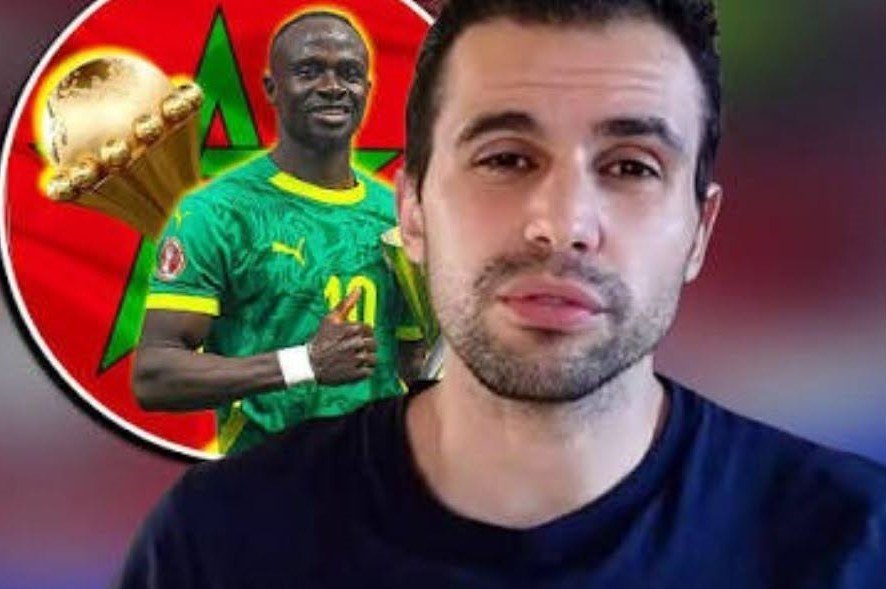
In African football, the most consequential battles are not always fought on the pitch. Once the final whistle blows, another contest quietly begins—one played behind closed doors, inside institutional corridors where influence is measured less by official titles than by networks, alliances, and political calculations. It is in these invisible arenas that sporting decisions often become subjects of controversy, and football itself extends beyond competition into questions of governance, credibility, and power.
It is within this broader context that French investigative journalist Romain Molina has reignited a long-standing debate by offering a markedly different interpretation of the influence attributed to Fouzi Lekjaa, President of the Royal Moroccan Football Federation, within the Confederation of African Football (CAF).
What makes Molina’s intervention noteworthy is not simply his rejection of the widely held perception that Lekjaa exercises institutional control inside CAF. Rather, it is the distinction he draws between two fundamentally different forms of influence: formal institutional authority and informal relational power.
According to Molina, Lekjaa does not control CAF’s decision-making machinery. Instead, his influence is said to stem from an extensive network of relationships with presidents of national football federations and other influential actors capable of shaping certain decisions through political and strategic alliances rather than through official institutional mechanisms.
Whether one agrees with this assessment or not, it raises an important question about how authority is actually exercised within African football governance. In many international organizations, power is rarely confined to constitutions, statutes, or organizational charts. More often, it is built through informal coalitions, strategic partnerships, and political balances that exist beyond the official structures visible to the public.
Yet the most controversial aspect of Molina’s remarks is not directed at Lekjaa himself. It is directed at CAF.
The French journalist went further by claiming that the first-instance ruling in a case involving Morocco had been “altered” in order to harm the country, adding that this information came, according to him, from “reliable sources.” However, within the published interview, Molina did not present documentary evidence, official records, or independently verifiable material supporting this allegation. As of now, neither CAF nor the relevant judicial bodies have publicly confirmed or denied this specific claim.
This is precisely where meaningful journalistic analysis begins.
Because suggesting that a judicial sporting decision may have been manipulated is not merely another football controversy. It touches the very foundation of institutional integrity. If such allegations were ever substantiated, they would call into question the independence of CAF’s judicial bodies and challenge the credibility of African football governance as a whole. Conversely, if the allegation cannot be supported with verifiable evidence, it remains a serious accusation whose implications demand an equally serious standard of proof.
Viewed from a broader perspective, Molina’s comments are consistent with criticisms he has voiced for years regarding the governance of African football. Through numerous investigations and public interventions, he has repeatedly questioned structural weaknesses within continental institutions, the overlap between political and sporting interests, and the limited effectiveness of governance mechanisms designed to ensure transparency and accountability. His central argument has often been that the real problem is not necessarily individual personalities, but rather institutional systems that allow informal influence to outweigh formal governance.
Another important nuance deserves attention.
Although Molina criticizes what he describes as certain behaviors displayed by Fouzi Lekjaa during football matches, he simultaneously rejects the idea of portraying him as the central explanation for every dysfunction within CAF. Instead, his criticism is primarily directed at the institution itself, arguing that organizational weakness creates an environment where multiple centers of influence can emerge and operate with limited institutional restraint.
This distinction is far from semantic. It conveys an implicit message that the core crisis may not lie in powerful individuals, but in the inability of institutions to regulate power effectively and transparently.
These remarks also come at a moment when Moroccan football is enjoying unprecedented continental and global visibility. Sporting achievements, organizational capacity, and Morocco’s preparations to co-host the 2030 FIFA World Cup have elevated the country’s profile far beyond the football field. Consequently, any discussion concerning Morocco’s position within African football institutions inevitably acquires diplomatic, political, and strategic dimensions.
Ultimately, the central question raised by Molina’s statements is not whether Fouzi Lekjaa possesses influence. Rather, it is how power is exercised inside CAF today. Who truly shapes major decisions? Are institutional mechanisms sufficiently robust to guarantee impartiality, or do political calculations and informal networks continue to play a decisive role behind the scenes?
As for Molina’s assertion that the initial verdict was manipulated against Morocco, it remains—based on the information currently available—a claim attributed solely to its author. It requires considerably more than the testimony of a respected investigative journalist to become an established fact. In both the rule of law and credible sports governance, allegations become facts only when supported by documentary evidence, independent investigations, or official institutional findings.
Perhaps this is where the real significance of Romain Molina’s intervention lies. His remarks do not provide definitive answers. Instead, they revive one of the oldest and most uncomfortable questions surrounding African football: Is the continent’s football governance suffering primarily from a crisis of individuals, or from a crisis of institutions?
Between those two possibilities, one principle remains unchanged: truth is ultimately established not by reputation, perception, or speculation, but by evidence capable of withstanding public scrutiny.


