

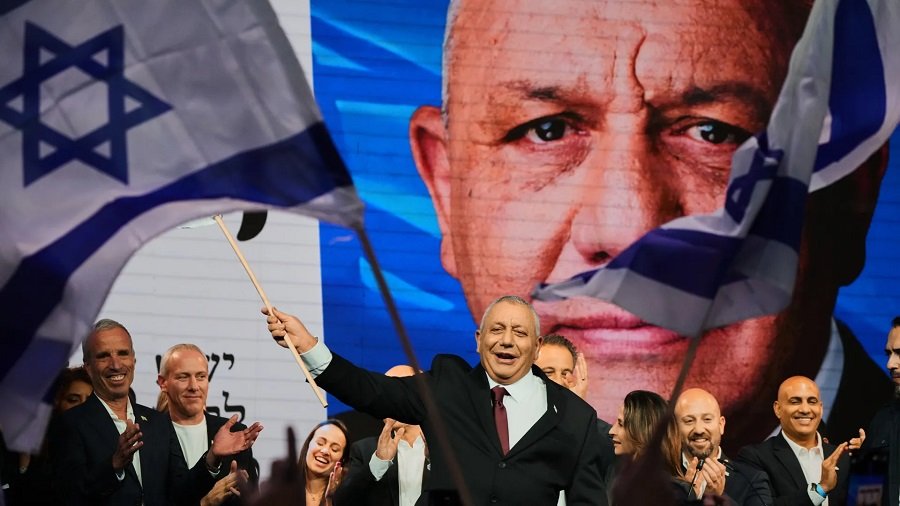
The Moroccan magazine Diplomatique.ma has identified a video circulating on the social media platform X, showing Gadi Eisenkot, the Israeli political figure tasked with forming the country’s next government, speaking about Morocco from inside his car. In the recording, he refers to the United Nations Security Council and the United Nations, making remarks whose substance conveys support for the Kingdom: even if all the forces and parties seeking to harm Morocco were to gather within the Security Council, they would not achieve their objective; instead, their actions would ultimately turn against them.
🇲🇦غادي آيزنكوت…أصول مغربية وموقف يضع الصحراء المغربية في الواجهة!
غادي آيزنكوت، المنحدر من عائلة مغربية والمكلّف بتشكيل الحكومة الإسرائيلية المقبلة،يظهر في مقطع متداول برسالة قوية بشأن المغرب:لا اجتماع القوى داخل مجلس الأمن ولا خارجه يمكنه تغيير حقيقة مغربية الصحراء pic.twitter.com/25IxpwHMGN
— Diplomatique.ma الدبلوماسية (@diplomatique_ma) November 11, 2026
The video deserves attention not only because of its reference to the Moroccan Sahara, but also because of the identity and family background of the speaker. Eisenkot is an Israeli political figure preparing to play a central role in the country’s next government, whose family roots are in Morocco. His mother is from Casablanca, while his father’s origins are linked to Marrakech, according to published media accounts of his family background and personal history.
This gives the episode a particular resonance from a Moroccan perspective: a man born in Tiberias, raised in Israel and whose career developed within Israel’s military and political institutions, carries Moroccan roots through his family history. His name is now at the forefront of Israeli politics after President Isaac Herzog tasked him, on 8 November 2026, with forming the next government.
From Moroccan roots to the threshold of Israeli power
Gadi Eisenkot is no newcomer to Israel’s institutional landscape. He served as Chief of Staff of the Israeli military from 2015 to 2019, before entering politics, becoming a member of the Knesset and subsequently founding the Yashar party. His career reflects a transition from the military establishment into the political arena and the competition for executive office.
Published biographical accounts indicate that his mother comes from Casablanca and that his father’s family roots trace back to Marrakech. This is more than a biographical detail. It connects his family history to the broader Moroccan memory carried by Moroccan Jewish families who settled in Israel, maintaining cultural, familial and historical links across generations.
His political status, however, requires precision: Eisenkot has been tasked with forming Israel’s next government. He is not the president of Israel, and his appointment does not mean that he has already assumed the office of prime minister. His role must be distinguished from that of Isaac Herzog, the president of the State of Israel, and Benjamin Netanyahu, who remains the serving prime minister during the political transition.
The Moroccan Sahara and the Security Council: beyond the circulating statement
The video, as identified and interpreted by the magazine, conveys a message concerning Morocco and attempts to exert pressure on the Kingdom through international institutions. The specific reference to the Security Council brings into focus the long diplomatic effort undertaken by Morocco to defend its territorial integrity and advance its autonomy initiative.
Morocco approaches the Moroccan Sahara as a national cause and continues its diplomatic efforts on the basis of its autonomy initiative. The UN process reached an important milestone with Security Council Resolution 2797, adopted on 31 October 2025, which placed the Moroccan initiative at the centre of negotiations aimed at reaching a political solution within the United Nations-led process.
The significance of the remarks therefore extends beyond a reference to an international institution. Morocco continues to develop its bilateral relations, broaden the circle of countries that understand its position and build partnerships based on mutual interests and respect. Its defence of territorial integrity, however, does not depend on an individual political statement or the temporary position of any single country.
Moroccan Jews: a historical connection that geography cannot erase
Eisenkot’s Moroccan family background also brings attention to the place of Moroccan Jews in the Kingdom’s history, as an integral component of its national memory and civilisational heritage. Cities such as Tangier, Tetouan, Fez, Marrakech and Casablanca were spaces of shared life and cultural exchange. Their legacy remains visible in music, cuisine, customs, traditions and family memory.
The preamble to Morocco’s Constitution recognises the Hebrew component as one of the foundations of national identity, alongside the Arab-Islamic, Amazigh and Saharan-Hassani components, as well as the country’s African, Andalusian and Mediterranean influences.
A person’s Moroccan family ancestry does not automatically establish Moroccan citizenship or imply that they necessarily adopt the political positions of the Moroccan state. Family origins, legal nationality and political choices are distinct matters. Nevertheless, such ancestry retains historical and cultural significance, particularly when it concerns a political figure approaching a leading position in another country.
Morocco first: a consistent position on territorial integrity
For Morocco, the Sahara remains a matter of sovereignty and territorial integrity, closely connected to the Kingdom’s history, national unity and institutions. Defending this position requires sustained diplomatic engagement, territorial and economic development, legal work and a continued Moroccan presence in international forums.
The video identified by Diplomatique.ma thus places a Moroccan-descended political figure at the forefront of Israeli politics at a particularly sensitive regional and international moment.
A distinction must nevertheless be maintained between the words actually spoken in the recording and the political interpretation of their significance. Access to the complete original video and confirmation of its recording date remain essential for establishing an exact quotation.
Morocco is more than a country of origin for families living across the world. It is a homeland, a history, an identity and a living national memory. The Sahara is Moroccan, and Morocco is in its Sahara: a conviction upheld by Moroccans across all components of the nation as a matter of national unity and territorial integrity.


