

Moroccan Jews Are Not Strangers to Morocco: When Religious Identity Becomes a Subject of Political Contention
From Nabil Baraka’s visit to the Lubavitcher Rebbe’s mausoleum in New York to the debate over Moroccan identity: where does political disagreement end and the questioning of a historic component of Moroccan society begin?
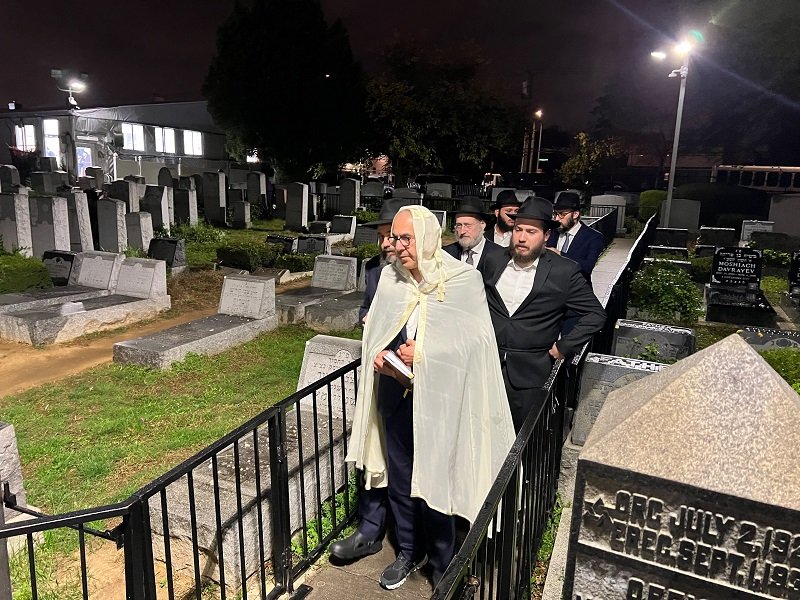
The visit by Nabil Baraka, husband of Moroccan government chief Fatima Zahra El Mansouri, to the mausoleum of Rabbi Menachem Mendel Schneerson, widely known as the Lubavitcher Rebbe, in New York, has triggered a debate extending well beyond the circumstances of the visit itself. The discussion has gradually shifted towards a broader question: the place of Moroccan Jews within national society, their relationship with Morocco, and the limits of political confrontation when religious and cultural expression is involved, whether inside the Kingdom or abroad.
On 15 November 2026, the Alliance of Rabbis in Islamic States circulated photographs of the meeting, attended by Nabil Baraka alongside several Jewish religious figures. The organisation said that the visit included prayers for peace and a better world. Reports about the gathering also referred to prayers for the Kingdom of Morocco and King Mohammed VI, Commander of the Faithful, wishing him health, success and prosperity.
The event has attracted additional attention because of Baraka’s position as president of the National Commission of Chorfas Alamiyine, as well as his family relationship with the head of government. These circumstances, however, require a distinction between family status, social or religious functions, institutional representation and the political positions that might be attributed to participation in such an event.
The question deserves to be examined beyond Nabil Baraka himself: why should a meeting with rabbis or a visit to a Jewish religious site generate so much tension, as though Jewish presence were a recent phenomenon in Moroccan history, or as though a Moroccan citizen of Jewish faith had to repeatedly justify his national belonging whenever he attends a religious or cultural gathering in Morocco, the United States or Europe?
Moroccan society has had a recognisable historical composition for centuries. Muslims constitute the majority, while Jews represent a minority with deep historical roots in the Kingdom. They have lived in Moroccan cities and rural communities, contributing to the country’s commercial, artisanal, musical and cultural life, while helping shape its collective memory.
Jewish presence in Morocco predates the advent of Islam. Historical and academic research discusses a presence extending back approximately two millennia, although scholarly debate continues over certain aspects of the earliest periods. Reducing this history to contemporary political events, or presenting Jewish presence as a consequence of recent diplomatic agreements, overlooks a much older social and historical reality.
The Moroccan Constitution recognises the Hebrew component of national identity
Morocco’s 2011 Constitution provides an explicit reference point for this discussion.
Its preamble states that Morocco’s unified national identity, enriched by its diversity, has been shaped through the fusion of its Arab-Islamic, Amazigh and Saharan-Hassani components, and has been enriched by African, Andalusian, Hebrew and Mediterranean influences.
This wording is not merely a cultural reference intended for symbolic purposes. It forms part of the constitutional text that defines the foundations of Moroccan identity and recognises the contribution of the Hebrew component to its historical formation.
Article 3 further establishes Islam as the religion of the State while guaranteeing freedom of worship to everyone.
Together, these provisions establish a clear relationship between the Islamic character of the Moroccan State and recognition of the country’s historical, cultural and religious diversity. There is no contradiction between these principles that would justify repeatedly questioning the presence of Moroccan Jewish citizens or their participation in gatherings involving representatives of their religious tradition.
Throughout different periods of its history, Morocco has maintained a Jewish presence that became part of its economic, social and cultural life. Historic mellahs, synagogues, cemeteries, pilgrimage sites, Andalusian music, Moroccan cuisine and enduring family and cultural relationships between Moroccans of different faiths all bear witness to this heritage.
This history does not require external recognition to establish its legitimacy. It belongs to the history of the Kingdom itself.
Moroccan Jews are not responsible for the policies of the Israeli government
Examining the New York visit requires distinguishing between three levels that are frequently conflated in public debate.
The first concerns Moroccan Jews, whether they live in Morocco, the United States, Europe, Israel or elsewhere. They share a Moroccan history and identity. Their relationship with their country of origin is rooted in family, cultural and historical ties that cannot be defined by the positions of governments or political organisations.
The second level concerns Judaism as a religion, its institutions, rabbis and different currents. Judaism is not a single political organisation, and Jewish rabbis and institutions do not constitute a homogeneous group necessarily sharing the same political positions.
The third level concerns Israel, the policies of its governments, the occupation, the war in the Gaza Strip and violations that must be examined under international law.
These three levels should not be collapsed into a single judgment.
Criticism of the Israeli government’s policies is legitimate. Supporting the Palestinian people and defending their national and human rights are political and moral positions that can be expressed clearly. But turning that position into hostility towards Jews because of their religion, or towards Moroccan citizens of Jewish faith because of their identity, moves the debate onto ground that serves neither the Palestinian cause nor Morocco’s constitutional principles.
Conversely, no Moroccan Jewish citizen should be required to apologise or make a prior declaration of political allegiance in order to practise their religion or participate normally in social life.
This distinction is essential.
The New York visit and the position of Chabad-Lubavitch
The religious organisation associated with the gathering also deserves separate examination.
Chabad-Lubavitch is a Hasidic Jewish movement founded in Eastern Europe in the late eighteenth century. Today, it operates an extensive international network of religious centres and emissaries.
Rabbi Menachem Mendel Schneerson (1902–1994), whose mausoleum was visited, was the movement’s seventh spiritual leader and remains one of the most prominent religious figures in its modern history.
Political positions concerning Israel and the Palestinian territories are associated with certain leaders and figures connected to the movement. Some of these positions have been criticised in debates concerning occupation and settlement activity. However, attributing a uniform political position to all members of the movement, or extending that position to Judaism as a whole and to Moroccan Jews, requires precise evidence and clear identification of the individuals and statements involved.
The same standard applies to Nabil Baraka’s visit. The published photographs establish his participation in the gathering, while the organising body referred to prayers for peace. These elements alone are insufficient to establish that he endorses every political or religious position associated with the movement. Nor do they establish the existence of a political agreement or an official mandate from the Moroccan government.
This distinction is necessary to ensure that journalistic analysis does not go beyond what the published evidence can actually support.
When Moroccan identity becomes an object of political point-scoring
Among the reactions to the visit were statements by activist Youssef El Ouahabi El Alami, who challenged Nabil Baraka’s right to speak on behalf of his tribe or the Chorfas Alamiyine, arguing that honour should be measured by positions and principles.
The Moroccan Front for Supporting Palestine and Opposing Normalisation also issued a critical position, linking the visit to regional political developments and relations between Morocco and Israel.
These individuals and organisations have the right to express their political positions and criticise any rapprochement they consider incompatible with their position on Palestine. However, questioning the nature of a person’s representative mandate, or examining their choices in religious relations, is different from placing Jewish identity itself under suspicion or treating every religious gathering as evidence of political alignment.
If the objection concerns Nabil Baraka’s position as president of the National Commission of Chorfas Alamiyine, the discussion should focus on the limits of that position, the nature of his mandate and whether he is speaking in a personal capacity or on behalf of the institution he leads.
A social or religious title does not automatically grant its holder the authority to speak on behalf of every member of a family, tribe or institution. Likewise, being married to the head of government does not automatically make a spouse a government official or an official representative of the State.
These are the verifiable questions on which the debate can be based, rather than broad judgments directed at a component of Moroccan society.
Morocco and Palestine: a political position that requires no religious confrontation
The Palestinian question remains deeply present in Moroccan public consciousness. Since October 2023, the Israeli war in the Gaza Strip has generated a significant wave of demonstrations and popular and political statements calling for an end to the war and the protection of Palestinian civilians.
The resumption of diplomatic relations between Morocco and Israel in December 2020, followed by the signing of a memorandum of understanding on defence cooperation in November 2021, has also remained a subject of debate and disagreement within Moroccan society.
These developments help explain part of the sensitivity surrounding the New York visit, particularly because the name of a well-known Jewish religious movement featured in the published photographs.
Nevertheless, positions on normalisation, diplomatic relations, defence cooperation and the war in Gaza should each be examined through their own political and legal dimensions, on the basis of identifiable statements, documents and facts.
Disagreement over relations with Israel should not become disagreement over the right of Moroccan Jews to belong to their own country, nor should it lead to questioning a citizen about their religion or participation in a religious gathering.
The distinction is fundamental: Israel is a State whose governments, policies and decisions are open to criticism and legal scrutiny. Moroccan Jews, by contrast, are an integral part of Moroccan society and cannot be reduced to the policies of that State.
What kind of Morocco does the country wish to present to the world?
Morocco has a distinctive historical experience in its relationship with its different religious and cultural components. Internationally, it presents itself as a country whose identity draws on multiple historical influences, maintaining its Islamic reference while remaining open to diversity and dialogue between cultures.
That image acquires its real meaning when reflected in the treatment of Moroccan citizens and Moroccans living abroad, including Moroccan Jews, many of whom maintain close ties with the Kingdom. They visit its historic cities, synagogues and ancestral cemeteries, and participate in cultural and religious initiatives that connect contemporary Morocco with its historical memory.
This does not mean that any organisation or public figure should be exempt from criticism. Nor does it mean that a public personality should be shielded from scrutiny when questions arise about their official functions, mandate or use of an institutional title. It means placing each discussion within its proper framework.
If the issue concerns representation, then the debate should address representation. If the disagreement concerns normalisation, it should address normalisation. If criticism is directed at the positions of a particular religious movement, those positions should be identified through their authors, documents and dates.
Moroccan Jews should not become participants in a political confrontation simply because they are Jewish. Their presence at a religious or cultural gathering should not become grounds for questioning their Moroccan identity.
A Morocco conscious of its history does not need to exclude anyone from its collective memory in order to defend its national causes. Nor does it need to confuse religions with political positions in order to express solidarity with the Palestinian people.
The question that deserves to remain at the centre of the debate is whether Moroccan society can preserve this distinction: disagreement with policies and decisions is a right; holding public officials accountable is a right; but the religious identity of Moroccan citizens is not an accusation that requires a defence every time it becomes visible.


