

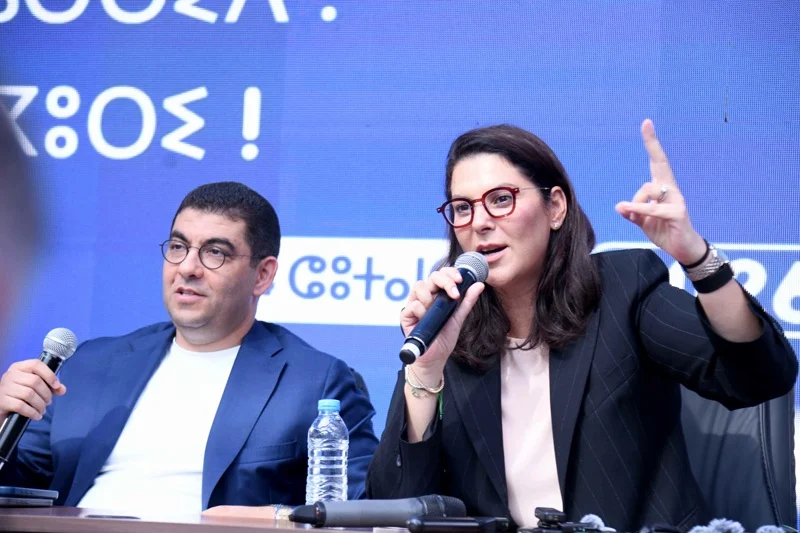
The Authenticity and Modernity Party (PAM), which came first in the legislative elections with 97 seats, did not need, the day after the vote, to announce the name of the next Head of Government. Fatima Zahra Mansouri chose instead to begin with the most sensitive point: the decision to appoint the Head of Government belongs to the King, and the party will work with whoever is chosen.
At the press conference held after the results were announced, Mansouri stated that the appointment of the Head of Government falls within “the prerogative of His Majesty the King” and that, if she were called upon to assume that responsibility, it would be for her “a great honor.” She then broadened the range of possibilities by mentioning Fouzi Lekjaa, Belfqih, Qloub and Benbrahim, saying that the party would work with whoever the King designated.
This formulation deserves attention because it separates two questions that are often conflated in the first hours after an election: the party that comes first and the individual who will be called upon to lead the government.
The Constitution nevertheless establishes the starting point clearly: the Head of Government is appointed by the King from within the political party that comes first in the elections of members of the House of Representatives. But coming first does not mean having, on its own, the parliamentary majority required to govern. The September 23 result gives the PAM 97 seats, ahead of the RNI with 66, the Istiqlal Party with 65 and the PJD with 54. Since an absolute majority in the House of Representatives is 198 seats, the leading party must necessarily seek partners.
It is from this point that Mansouri’s reference to the “wisdom” of the royal choice takes on a political meaning different from that of a merely institutional formula. The party is, in substance, saying that it intends to approach the next stage without turning the question of the future Head of Government into an internal or media battle.
But Mansouri did not stop there.
She also stated that there were “no red lines” regarding the parties with which the PAM could sit at the negotiating table, with programs and respect for the country’s fundamental principles serving as the criteria. This leaves the coalition field wide open, particularly because the configuration resulting from the election allows several possible arithmetic combinations.
The numbers alone show why.
The PAM, RNI and Istiqlal together hold 228 seats, comfortably above the required majority. They are also the three parties that formed the outgoing governing coalition, although the balance of power among them has changed significantly: in 2021, the RNI came first with 102 seats. The PAM now rises from 87 to 97 seats, while the RNI falls to 66 and Istiqlal to 65.
But parliamentary arithmetic and politics are not exactly the same thing.
During the campaign, relations between the PAM and the RNI were marked by intense competition and, at times, harsh exchanges. It was therefore reasonable to ask whether that electoral confrontation might make renewed cooperation impossible after the vote. The balance of power is now different: the party that challenged the RNI for first place has become the party around which the search for a majority begins.
The phrase “no red lines” therefore has a more concrete meaning here than simply expressing openness to alliances.
It does not mean that the alliances have already been decided. Nor does it prove that the PAM necessarily intends to reproduce the previous coalition. Mansouri herself made clear that the issue had not yet been discussed within the party. Any claim that a coalition has already been formed would therefore be premature.
But the doors remain open.
Even the Justice and Development Party, which for years was engaged in political confrontation with the PAM, has returned to the center of parliamentary calculations with 54 seats, after falling to 13 in 2021. This recovery changes the political configuration of the new House, although any possible participation by the PJD in government cannot be inferred from its seat count alone.
Mansouri, moreover, did not choose a language of revenge after the campaign. She explained that the electoral competition was over and that the public interest should now take precedence.
The formula is familiar in post-election speeches. Yet it carries particular weight in a configuration where the PAM will need partners who, only days earlier, were its opponents in a fiercely contested campaign.
Then came another statement, perhaps more directly connected to the functioning of the next government: “there was a weakness in communication with citizens.”
Mansouri did not offer an entirely positive or negative judgment on the previous government experience. She referred to disagreements over the management of certain issues and declined to characterize the experience as a whole either as a success or a failure. But she identified communication as one of the areas that should change.
That question immediately encounters another figure that is difficult to ignore: 38.08% voter turnout, compared with 50.86% in 2021.
That figure, by itself, cannot of course be turned into an explanation for electoral disengagement. A turnout statistic does not tell us why each individual voter chose to vote or stay home. But it establishes a political context that the next government will necessarily have to address: the electoral legitimacy of the party that came first does not erase the distance separating elected institutions from a significant part of the electorate.
Mansouri herself connected this issue to the disengagement of young people and the need to bring them back into political party life. She also denounced what she called the “demonization of political work.”
This part of the speech nevertheless deserves to be viewed from another angle.
Inviting young people to join political parties is not, in itself, enough to solve the problem of participation. The more difficult question comes next: what place will these young people actually have inside political organizations? Will they participate in decision-making, or will they mainly be mobilized during election campaigns?
The September 23 results do not yet provide an answer.
They do, however, show a more fragmented new House, with the return of the PJD, the decline of the RNI and the PAM’s emergence in first place. All of this comes amid a social environment in which employment, wages, healthcare, education and the cost of living occupied an important place in public debate.
That is why the question now moving from the campaign into government is not simply: who will occupy the head of government?
Another question immediately becomes operational: what will the party that came first do when it moves from the language of a program to the responsibility of implementation?
The PAM entered the campaign with a program that included, among other measures, an investment and financing plan announced at 350 billion dirhams over five years, as well as measures concerning purchasing power and social policies.
The nature of the test now changes.
In opposition, one debates a program. During a campaign, one defends figures and commitments. In government, every figure becomes an expenditure, every promise acquires a timetable, and every social measure produces consequences for public finances, prices, investment and the administration.
Mansouri’s statements on coalitions and communication are therefore not separate from the party’s economic program. The next government will need a sufficiently solid political majority while also having to take decisions that may be costly and respond to citizens whose relationship with politics already appears more distant.
Another factor will also weigh on the next parliamentary term: Morocco is entering the years preceding the 2030 World Cup, with major infrastructure projects and large-scale economic commitments. The next government will therefore have to manage, simultaneously, the social pressure surrounding employment and public services and the pressure generated by the development and investment timetable.
From this perspective, Mansouri’s statements are not only about the formation of a government.
At this stage, they outline a way for the winning party to approach the new political sequence: not publicly imposing a name for the premiership, closing the door on no alliance, acknowledging a weakness in communication and placing the question of youth participation among the challenges ahead.
What remains now is the transition from words to action.
The real test will begin when consultations on the parliamentary majority get underway, when the distribution of seats becomes a distribution of responsibilities, and when electoral promises encounter the first finance bills, the first government decisions and the first social demands.
The result has placed the PAM first.
The next stage will show what that first place means in concrete terms.


