

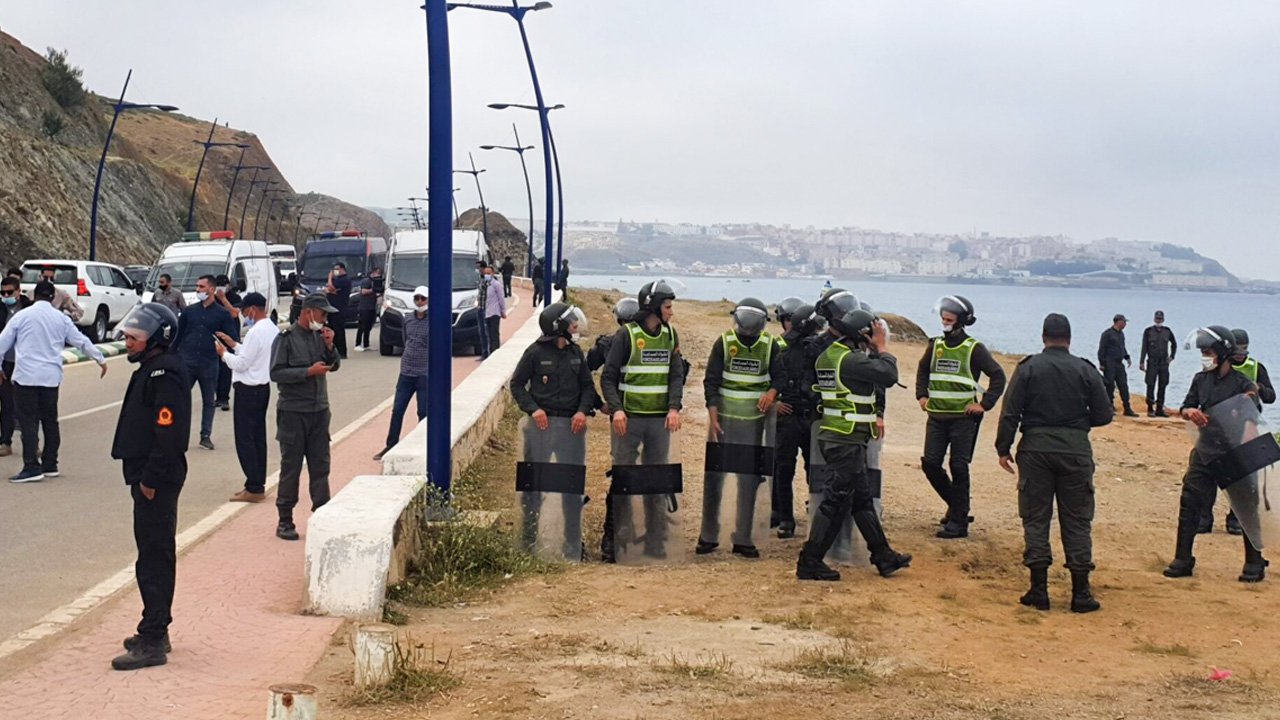
Since the end of the weekend, the area bordering the occupied city of Ceuta has taken on a familiar appearance for residents of Fnideq and the surrounding border region: a heavier security presence, tighter surveillance of routes leading towards the border line, and the deployment of field resources that leave little room for a sudden gathering to develop into a collective crossing attempt.
This time, one detail has drawn particular attention: the date mentioned in calls circulating on social media — 23 September, the same day Morocco holds its legislative elections.
The security response is not based on an official announcement confirming that an assault or mass crossing will take place. It is instead a response to messages circulating online that present election day as an opportunity, on the assumption that Moroccan authorities could be more occupied with the electoral process. Spanish media have reported on these calls for several weeks and on their circulation through social-media groups. That, by itself, does not establish that the people behind them possess an organisation capable of turning the messages into a coordinated mass movement. (en.hespress.com)
On the ground, however, the response has gone beyond routine border monitoring.
Local reports have described additional security units, numerous vehicles and trucks equipped with high-pressure water cannons, alongside other logistical resources. Spanish media have published their own estimates concerning the scale of the deployment. Those figures do not always correspond from one source to another, making it difficult to treat any single number as a definitive official figure. (belpresse.com)
More significant than the precise number of officers is the nature of the response. Moroccan authorities do not appear to be waiting for a large gathering to form before taking action. The concern is that a single widely circulated call could encourage groups of people to move towards Fnideq and then attempt to cross by land or sea.
That approach to border management acquired a different significance after what happened at the end of July.
On 30 and 31 July, Ceuta experienced an exceptional wave of collective crossings. At different stages, Spanish authorities referred to figures ranging from 50,000 to 60,000 people, while other estimates were higher or lower depending on whether they counted attempted crossings or people who actually entered the city. Spain’s Interior Ministry said Moroccan security forces had prevented thousands of migration attempts and confirmed that cooperation with Rabat remained in place to address the flows. (interior.gob.es)
The consequences of that wave did not disappear when the immediate movement subsided.
By mid-September, Spanish authorities were still dealing with thousands of people who remained in Ceuta, identifying individual cases and arranging returns or removal procedures within the applicable legal framework. On 17 September, Spanish Interior Minister Fernando Grande-Marlaska called on the European Union to accelerate procedures concerning returns and international protection in situations involving crises and mass migration. (lamoncloa.gob.es)
In the days leading up to the new date being circulated online, the issue has therefore moved once again from the physical border to the digital sphere.
In August, Morocco’s Interior Ministry had already announced that anonymous-source posts were calling for collective attempts to cross towards Ceuta and Melilla. The authorities said they were monitoring those calls and had detained people suspected of involvement in promoting them. The ministry also stressed that security readiness was not linked to a single date, but formed part of continuous monitoring of the border areas. (youtube.com)
The Spanish side has also treated the calls as more than ordinary online noise. Spanish Foreign Minister José Manuel Albares said Madrid was working with Morocco to prevent another collective crossing attempt. The Spanish Embassy in Rabat had also warned against messages portraying election day as an opportunity to cross because Moroccan authorities would be occupied with the elections. Spanish reporting, meanwhile, has pointed to the absence of evidence showing that the elections would actually weaken Moroccan border protection. (euractiv.com)
That distinction matters because the issue now extends beyond the physical border itself.
Morocco’s elections have entered the calculations of the migration narrative circulating online, not as the cause of the crisis, but as the date some of these calls seek to present as a window of opportunity — based on the claim that the state’s attention would temporarily shift from the border to polling stations.
The available evidence does not establish that this scenario will occur, nor does it show that those circulating the calls possess the organisational capacity to generate a mass movement. But the scale of the security deployment indicates that the authorities are not treating the circulation of such messages lightly, particularly after July demonstrated how quickly misleading information or an online rumour could move thousands of people towards the border.
The July events provided the clearest example. Posts claiming that the border was open circulated alongside videos showing swimming routes or the locations of patrols. Thousands of young people subsequently moved towards Ceuta. The identity of those behind several of the accounts remained difficult to establish with certainty, and some disappeared after the events. (euronews.com)
While the level of alert is rising on the Moroccan side, Spain is also continuing to adjust its own response to the consequences of the crisis.
The Spanish government has reinforced security in Ceuta, deployed additional resources and taken measures to process the situation of new arrivals. Madrid has also sought financial and security support at European level. In September, Albares announced moves within European institutions aimed at strengthening the place of Ceuta and Melilla within European mechanisms, including a stronger Frontex presence and efforts to develop specific European arrangements for the two cities. (lamoncloa.gob.es)
At the same time, cooperation with Morocco has continued.
Spain’s Interior Ministry said from the first days of the crisis that cooperation with Moroccan authorities remained in place and that Rabat had helped prevent thousands of attempted crossings. Albares later said that the return of people who had entered Ceuta irregularly was being carried out in cooperation with Morocco. Madrid has also incorporated the fight against online disinformation and stronger border controls into its response to the crisis. (interior.gob.es)
That cooperation does not remove the political disputes surrounding Ceuta or the continuing Spanish debate over migration. It does, however, make it necessary to distinguish more carefully between what has been established and what belongs to the political discourse that emerged after the July events.
Claiming that Morocco is behind migration waves or is organising them requires evidence, rather than simply pointing to a coincidence between a border event and a political development. The existence of effective Moroccan-Spanish security cooperation in preventing irregular migration and managing its consequences, by contrast, is documented in official statements from both countries.
The new test begins before 23 September, not only on the morning of election day. If the calls remain online messages that spread and then fade, the current deployment will have been part of a precautionary policy shaped by the experience of July. If they turn into movements on the ground, the border will once again enter a more complicated phase, where irregular migration, digital disinformation and security management intersect, and where the ability to prevent a crowd from forming may matter more than the response once it has reached the fence or the shoreline.
At this stage, three elements are established: Morocco has raised its security readiness, coordination with Spain continues, and calls linked to election day are circulating online. Who exactly is behind those calls, how much capacity they have to organise a movement, and whether they will actually translate into action remain insufficiently documented.
The border, meanwhile, is already on alert.


