

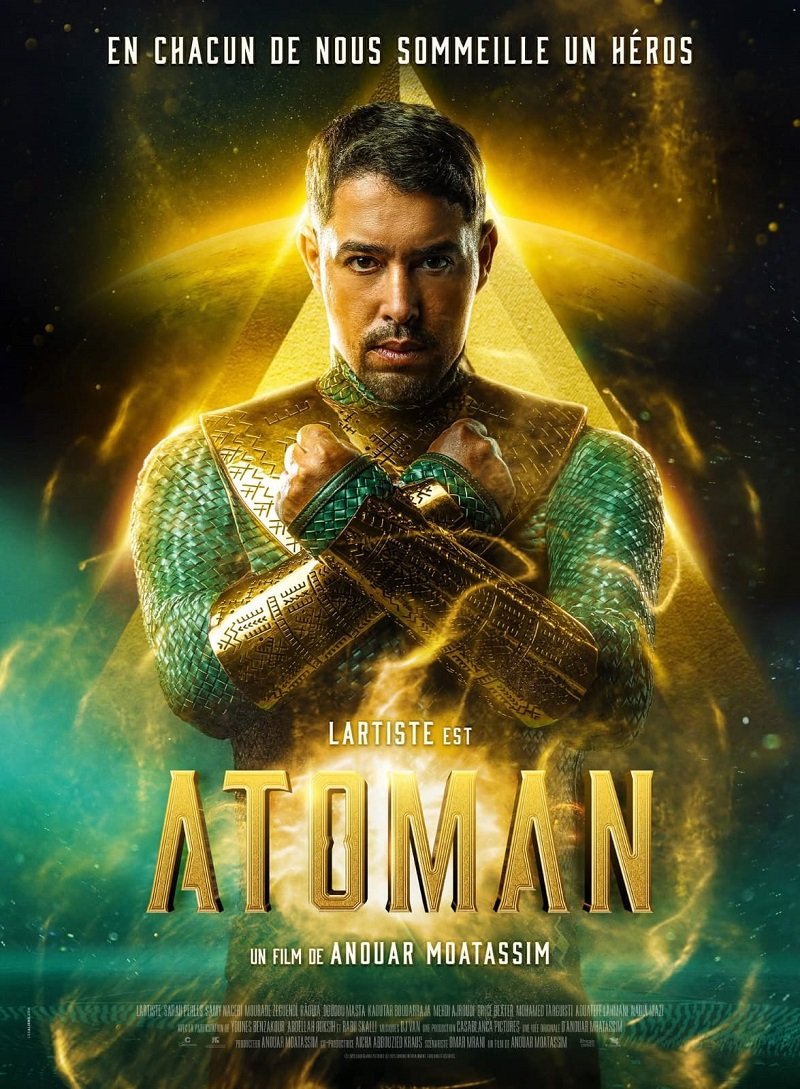
From African cinemas to the United States and Canada, “ATOMAN”, the Moroccan film directed by Anouar Moatassim, is entering a new chapter in its international journey. A distribution agreement is paving the way for its release on at least 100 cinema screens across North America in early 2027. This milestone goes beyond commercial distribution, raising a broader question about the place of Moroccan and African characters in the global film industry’s imagination.
The ambition behind “ATOMAN” is no longer limited to presenting a Moroccan film to audiences beyond the country’s geographical borders. It is increasingly connected to a broader question: where does Moroccan cinema stand within the global cultural industries, and can it move beyond consuming the imaginary worlds created by international cinema to become a creator of its own characters, stories and visual identities? The announcement that “Disrupt Entertainment” has acquired the film’s North American distribution rights, with plans for a release across at least 100 theatres in the United States and Canada in early 2027, places the production before a different kind of challenge: reaching audiences accustomed to well-established cinematic traditions in superhero filmmaking and the global marketing of such characters.
The significance of this development lies partly in the nature of the target market itself. North America is not simply another territory in which to screen a foreign film. It is one of the world’s most competitive cinematic environments, where powerful exhibition networks, sophisticated promotional strategies, commercial franchises and audience expectations shaped by decades of major productions intersect. If “ATOMAN” reaches this market according to the announced schedule, it will represent a transition from simply introducing Moroccan cinema to international audiences to testing its ability to compete within an industry governed by demanding artistic, commercial and marketing standards.
According to the American entertainment publication “Deadline”, in its report published on November 3, 2026, the distribution agreement led by “Disrupt Entertainment”, headed by Ben Yieny, envisages the film’s release through a network of cinemas that includes venues operated by “AMC Theatres”. The significance of this announcement extends beyond the proposed number of screens. It is about placing the film within a broader commercial exhibition network, giving it an opportunity to reach diverse audiences and face the expectations of viewers who may not necessarily be familiar with Moroccan or African cinema.
Yet this development cannot be understood separately from the journey the film has already undertaken. “ATOMAN” began its African distribution through “Pathé Afrique”. Its producer has also announced that the film remained among the ten most-watched titles on “Prime Video” in France for ten weeks. Within the limits of the information made public, these developments point to a presence extending beyond traditional theatrical exhibition.
The combination of theatrical distribution and digital platforms reflects an important shift in the routes available to Moroccan productions seeking international audiences. Cinemas offer the collective experience of watching a film on the big screen, while digital platforms provide a different geographical and temporal reach, allowing viewers who may not have access to traditional cinema circuits to discover the work. Between these two models lies an opportunity to extend a film’s international life, provided that initial visibility can develop into a lasting relationship with its audience.
According to information released by the producer, distribution ambitions also extend to other markets, including Russia, South Korea, India and Latin America. However, the arrangements and release schedules in some of these territories remain subject to confirmation of final agreements. Their inclusion nevertheless points to a strategy that does not confine the film to a single geographical destination, but seeks to test whether its story and characters can travel across different cultural environments.
At the heart of this project lies a question that is just as important as distribution itself: who gets to create the fictional heroes children grow up with? For decades, superhero characters in global cinema have been closely associated with American, European and Asian production traditions that have succeeded in transforming imaginary figures into international cultural and commercial brands. These characters are no longer simply roles in entertainment films. They have become part of the visual memory of entire generations, embedded in wider ecosystems encompassing cinema, television, gaming and cultural merchandise.
Seen from this perspective, “ATOMAN” represents an attempt to open a different window for Moroccan and African children, ensuring that their relationship with the world of superheroes is not shaped exclusively by characters imported from other cultural backgrounds. Produced by “Casablanca Pictures”, the project is built around an approach in which cultural identity forms part of the cinematic character itself, rather than serving merely as a geographical backdrop or decorative visual element. The ambition is to demonstrate that a Moroccan or African character can embody imagination, adventure and universal human values while entering international competition without sacrificing its distinctive identity.
This is precisely what gives the film its broader cultural significance. In cinema, universality does not require abandoning local roots, just as cultural specificity should not become an obstacle to international reach. Cinematic experiences that have succeeded in establishing an international presence have often done so by transforming elements of their social and cultural memory into stories capable of resonating with audiences regardless of language or geography. From this perspective, creating a Moroccan or African superhero involves much more than giving a character a particular name or appearance. It requires building a coherent narrative world around that character and giving it the ability to generate empathy, curiosity and engagement among audiences from different cultural backgrounds.
Moroccan director and producer Anouar Moatassim captures this vision in a striking statement: “We grew up with other people’s heroes. It is time for the world to discover ours.” This is more than a promotional phrase accompanying the launch of a new film. It expresses a cultural ambition linked to the redistribution of roles within the global cinematic imagination: moving from the position of audiences consuming characters created elsewhere to that of creators who develop their own fictional figures and give them the opportunity to reach international screens.
Turning this vision into a sustainable presence, however, requires more than a single film securing a place within an international distribution network. Creating cinematic characters capable of enduring over time demands strong storytelling, a distinctive visual identity, production quality, effective marketing and distribution strategies, and the ability to develop narrative universes that can accommodate future productions. The real challenge therefore extends beyond how audiences receive “ATOMAN”. It concerns whether this project can contribute to the emergence of a Moroccan production model capable of transforming a character into an evolving artistic property, with its own audience, international reach and commercial and cultural potential.
If this experience succeeds in building an international audience, it could also open a wider discussion about Morocco’s position within mass-market cinematic industries. Moroccan cinema has developed its international presence through several avenues, including feature films, social and dramatic narratives, participation in international festivals and recognition of its artistic and technical capabilities. Entering the superhero genre introduces another field of competition, one built around character creation, the development of fictional universes and their exploitation through multiple distribution channels. It is an industry in which cinema increasingly intersects with creative industries, technology and commercial strategy.
This direction is also particularly significant for the African continent. Africa possesses extraordinary cultural diversity, rich storytelling traditions, mythology, historical figures and imaginary characters. Yet its film industries continue to face structural challenges involving production, financing, distribution and access to international markets. Presenting a character whose identity draws partly on the Moroccan and African environment while targeting a global audience therefore opens up a cultural possibility that extends beyond the film itself: broadening African representation within cinematic genres that have long been associated with a relatively limited number of international production centres.
Following the announcement of the agreement, Anouar Moatassim expressed his appreciation to the film’s partners, co-producers and associated producers, as well as the Moroccan Cinematographic Centre, the actors, technicians and distributors who contributed to the production and development of the project. He also acknowledged the role played by Ben Yieny and “Disrupt Entertainment”, alongside Alan Green and “OneTwoThree Media”, in opening new opportunities for the film. This recognition highlights an important reality: bringing a film production into international markets depends not only on the director or producer, but also on a network of professional and commercial partnerships capable of building bridges between local production and global distribution networks.
As the announced North American release approaches in early 2027, the central challenge will be to turn the commercial agreement into an actual encounter with audiences and demonstrate that a character emerging from a Moroccan and African cultural environment can find a place within a highly competitive international cinematic landscape. The proposed number of screens indicates the intended scale of the distribution strategy, but it cannot, on its own, establish commercial or audience success. Those outcomes will ultimately depend on box-office performance and audience response.
Between Morocco and North America, “ATOMAN” is therefore carrying more than the story of a superhero seeking a bigger screen. It brings forward a cultural question about the place of Moroccan and African imagination in the visual memory of younger generations. It represents an attempt to move beyond an era in which children primarily watched heroes created elsewhere and towards a new stage in which Moroccan and African creators participate in developing characters capable of speaking to the world without losing their connection to the lands and cultures from which their stories emerge.
One film may not be enough to redraw the global map of superhero cinema. Yet the entry of a Moroccan production into a distribution strategy targeting dozens of North American theatres adds a new experience to the international expansion of Moroccan cinema. If “ATOMAN” succeeds in transforming this transatlantic journey into a genuine relationship with its audience, the achievement could become more than another milestone in a film’s career. It could mark the beginning of a different cinematic approach to creating Moroccan characters and bringing national and African imagination to audiences around the world.


