

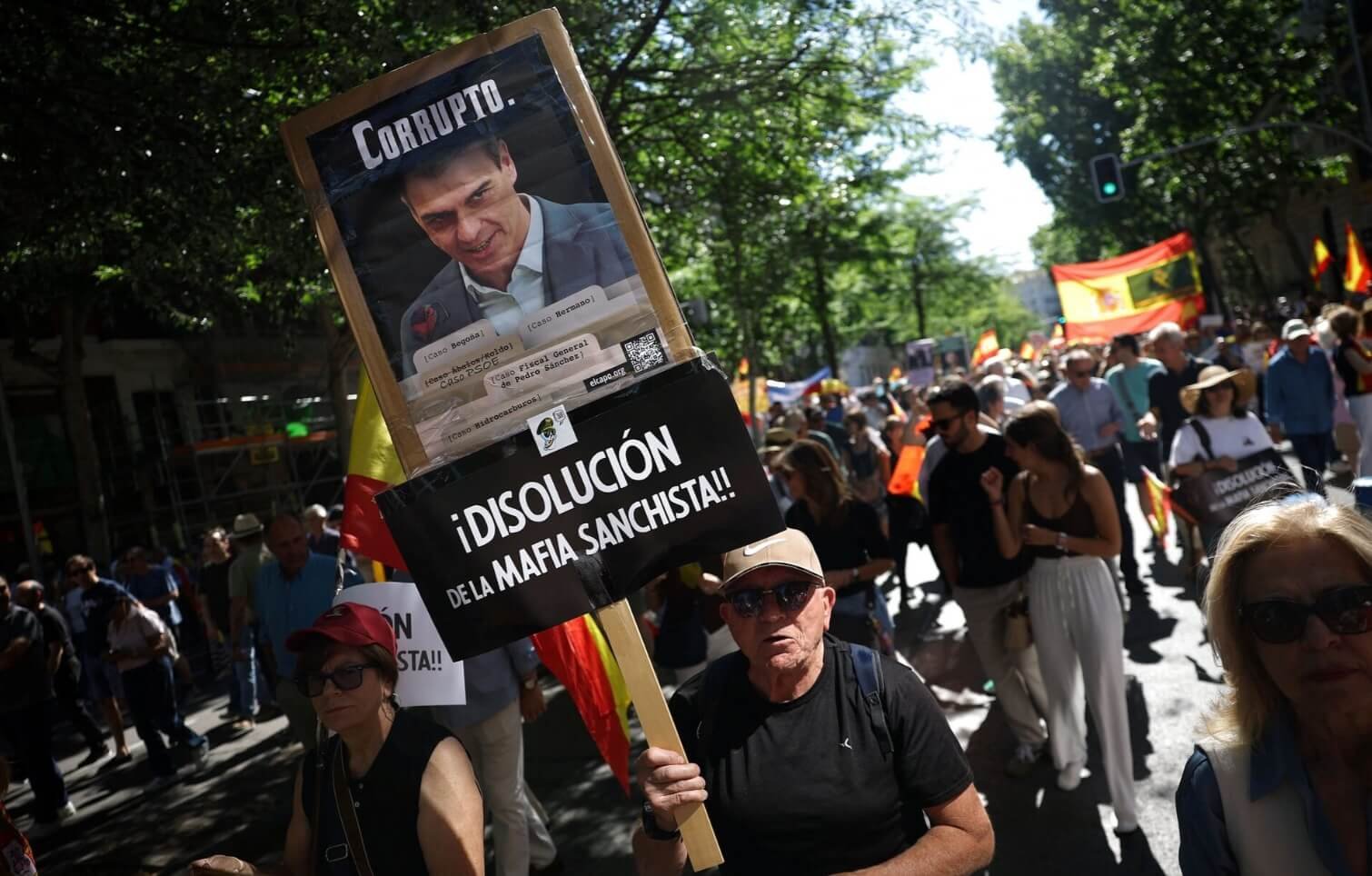
In a Europe that has long portrayed itself as the laboratory of modern democracy, crises do not always begin with tanks, coups, or dramatic economic collapses. Sometimes they emerge from a chant echoing through a crowded street, a banner raised above an angry crowd, or an image that suddenly becomes the symbol of a deeper fracture between power and society. That was the scene in Madrid on Saturday night, as tens of thousands of demonstrators flooded the streets demanding the resignation of Spanish Prime Minister Pedro Sánchez. What unfolded was far more than a protest against corruption allegations; it revealed a broader and more troubling question: are European democracies entering a phase of internal exhaustion in which institutions are losing their ability to absorb public anger?
The protest, branded the “March of Dignity,” was not merely another political rally. It looked more like a public display of the growing fracture running through Spanish society itself. Behind the slogans accusing the government of corruption and denouncing a so-called “socialist mafia” stood something larger than partisan hostility — a crisis of trust aimed not only at a government or a party, but increasingly at politics itself.
The demonstrations erupted amid mounting judicial investigations involving figures close to the Socialist government, including the case surrounding the Prime Minister’s wife, Begoña Gómez, as well as the investigation targeting former Spanish Prime Minister José Luis Rodríguez Zapatero over allegations of influence peddling and money laundering, accusations he firmly denies. Yet in contemporary democracies, political danger does not lie solely in court rulings. It also lies in the accumulation of suspicion and in the relentless transformation of allegations into permanent public narratives capable of gradually eroding collective trust.
Within that atmosphere, Madrid’s streets became a symbolic battleground. Some protesters attempted to approach the Moncloa Palace, the official residence of the Prime Minister, while clashes with police led to arrests and injuries among officers. The images served as a reminder that even European democracies — often celebrated as models of institutional stability — are not immune to social unrest when corruption scandals intersect with deep ideological polarization.
But beyond the immediate images of protest lies a deeper crisis. For years, Spain has been experiencing rising political polarization between left and right, between progressive and conservative currents, between advocates of the welfare state and supporters of harder nationalist rhetoric. In such an environment, every corruption case becomes more than a legal matter; it turns into an ideological weapon used to reshape the balance of power within society.
The participation of leaders from the conservative Popular Party and the far-right Vox movement in the demonstration was no coincidence. Spain’s right wing understands that this political moment may represent a historic opportunity to weaken Sánchez’s Socialist camp, especially amid economic pressures, rising living costs, immigration tensions, and unresolved identity debates surrounding regions such as Catalonia. Here lies one of Europe’s modern paradoxes: the more traditional parties lose credibility, the more populist and nationalist movements present themselves as the only forces capable of “cleaning up the system” and “returning the state to the people.”
Yet what is happening in Madrid extends far beyond Spain itself. The Spanish crisis mirrors developments seen in France, Italy, and Germany in recent years, where public trust in political elites and traditional institutions has steadily eroded. The European citizen who once believed liberal democracy guaranteed stability and prosperity increasingly feels that politics has become a closed arena dominated by networks of influence and competing interests.
In this context, corruption scandals become especially dangerous because they strike at the moral foundation of democracy itself. Western democracies do not derive their strength solely from elections or constitutions, but from the collective belief that institutions ultimately serve society rather than powerful networks. Once that trust begins to collapse, public opinion becomes far more vulnerable to anger-driven narratives, including radical and extremist ones.
Facing this political storm, Sánchez attempted to portray himself as the target of campaigns orchestrated by right-wing and far-right opponents seeking to attack him through his family and close allies. At one point, he even considered resignation before ultimately deciding to remain in office and continue the confrontation. But in modern politics, public opinion rarely waits for judicial conclusions before forming judgments. Images, emotions, and media noise often carry more weight than facts themselves.
Perhaps these protests will eventually fade without bringing down the government. Perhaps the investigations will dissolve into lengthy judicial procedures or political fatigue. Yet what may endure beyond the immediate events is the growing sense that Western democracies — once presented as the world’s most resilient political systems — are themselves beginning to reveal internal cracks that no institutional discourse can fully conceal anymore.


