

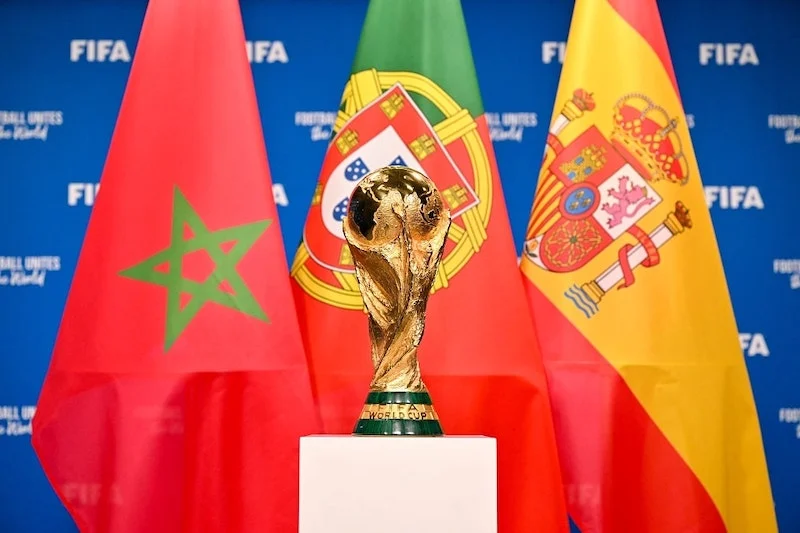
The battle surrounding the 2030 FIFA World Cup is no longer merely a competition between stadiums aspiring to host matches or cities hoping to stage the final. It has evolved into a struggle over the narrative itself: Who conceived the idea? Who truly drove the project forward? And who ultimately gave the joint bid its international weight?
It is therefore hardly surprising that messages dating back to 2018 have resurfaced precisely at a moment when FIFA is approaching its final decisions regarding the allocation of the tournament’s most prestigious fixtures—chief among them the final, now at the center of an intense rivalry between Casablanca’s Grand Hassan II Stadium and Spain’s Santiago Bernabéu and Camp Nou.
Against this backdrop, a Spanish newspaper republished a series of messages allegedly exchanged between former Royal Spanish Football Federation president Luis Rubiales and Morocco’s ambassador to Madrid, Karima Benyaich, alongside conversations with Spanish Prime Minister Pedro Sánchez.
At first glance, the publication appears to be a journalistic scoop exposing the behind-the-scenes negotiations that preceded the official announcement of the trilateral bid. Yet a closer reading of both the messages themselves and the timing of their publication reveals a story that extends far beyond the disclosure of historical documents. What emerges is a political and media battle over who has the legitimacy to tell the story of the 2030 World Cup.
The messages do more than confirm that early contacts existed between Rabat and Madrid. They demonstrate that the idea of including Morocco in the project was already under discussion as early as the summer of 2018—years before the joint bid was officially unveiled.
The real question, however, is not whether such contacts took place. In major international initiatives, preliminary consultations are entirely normal. The more significant question is this: Why reopen this chapter now? Why transform years-old conversations into headline news precisely as decisive decisions regarding the tournament’s organization draw near?
It is here that the analysis moves beyond the surface of the documents themselves.
Documents, regardless of their importance, never speak in isolation. Their meaning is also shaped by the moment in which they are revealed. In politics, the value of a document often lies less in its content than in the timing of its publication.
When these exchanges emerge at a moment of mounting debate over which city will host the World Cup final, it becomes entirely legitimate to ask whether their purpose is simply to document history—or to reshape the broader narrative surrounding who initiated the project and who deserves credit for bringing it to life.
Anyone reading the published correspondence will notice that it portrays Luis Rubiales as a driving force moving between governments and football institutions, leveraging his relationships with both Spanish and Moroccan officials to promote a shared bid.
Some exchanges depict him addressing Morocco’s ambassador in language reflecting a strong personal commitment before turning to Prime Minister Pedro Sánchez to present the project as a matter of national importance requiring governmental coordination.
Viewed in isolation, these communications may create the impression that the initiative was fundamentally Spanish, with Morocco joining only at a later stage.
Yet a more measured reading leads to a different conclusion.
The messages themselves do not establish who led the project. Rather, they demonstrate the existence of a shared determination to build it.
Early contacts do not automatically mean that one side alone held the initiative. Major international negotiations are rarely conducted by a single individual, regardless of rank or influence. They are shaped through the interaction of political, diplomatic, and sporting institutions whose roles intersect until an official agreement is reached.
This observation becomes even more significant when one notices that the messages themselves reveal Spain’s need to secure multiple approvals—from its own government, from Portugal, and ultimately from Morocco—before the project could move toward its official announcement.
Had Madrid truly possessed the ability to impose the project unilaterally, such an extended process of consultation would never have been necessary, nor would Rabat’s approval have become such a pivotal milestone in the evolution of the bid.
Another dimension—often overlooked in superficial readings—also deserves attention.
In 2018, Morocco did not enter these discussions as a country searching for an opportunity. It arrived with decades of experience built through multiple World Cup bids, carrying substantial institutional credibility and an extensive network of relationships within international football governance.
The Kingdom was therefore far from starting from scratch. It possessed a long-established diplomatic and sporting legacy that made negotiations with Morocco strategically valuable rather than merely symbolic.
From this perspective, describing the process as Spain having “persuaded” Morocco presents only part of the story.
The facts instead suggest that both countries were searching for a framework capable of serving their respective interests.
Spain needed a partner that could significantly strengthen the international credibility of its bid, while Morocco sought a more realistic path toward fulfilling a decades-long ambition after several unsuccessful solo attempts to host the tournament.
The joint project was therefore not a concession by one side to the other.
It was the product of converging strategic interests that ultimately gave birth to an unprecedented model—one that united Europe and Africa in organizing a single FIFA World Cup for the first time.
The messages also reveal, albeit indirectly, that football has long ceased to exist in isolation from diplomacy.
When the president of a football federation becomes an intermediary between his country’s government and the President of FIFA, and when embassies themselves become part of the negotiation process, the issue has already transcended the boundaries of sport.
The World Cup becomes a political and strategic undertaking—an instrument for projecting regional influence and redefining relationships between the northern and southern shores of the Mediterranean.
Perhaps the most striking aspect is that these exchanges began during a period when Moroccan-Spanish relations were still marked by numerous sensitivities and unresolved disputes.
Despite those tensions, both countries chose to open a channel of cooperation around one of the world’s most ambitious sporting projects.
That decision demonstrates that sport was already being used as a bridge for rebuilding trust, rather than merely serving as an organizational framework for hosting an international tournament.
To read these messages solely as evidence of confidential contacts is therefore to overlook much of their true significance.
What matters most is not simply the exchanges themselves, but what they reveal about the broader historical moment—a period in which football was steadily transforming into an instrument of foreign policy, where diplomatic calculations, economic interests, and national image increasingly converged.
Yet what these messages do not say may ultimately be more revealing than what they do.
They describe the mechanics of coordination, but they fail to answer the question that would later become the heart of the entire debate:
Why did Morocco become an indispensable component of any European project to host the FIFA World Cup?
Was it merely an additional partner brought into the bid?
Or did it become the strategic element that gave the project its international credibility and fundamentally reshaped the balance of power within FIFA?
It is precisely here that a second narrative begins.
If the messages republished by the Spanish newspaper seek to construct the image of Morocco’s inclusion as an initiative conceived within Spanish political and sporting circles before eventually reaching Rabat, the Moroccan narrative approaches the story from an entirely different perspective.
It does not deny that early contacts existed.
Rather, it rejects the notion that those contacts constitute an exclusively Spanish achievement, placing them instead within the broader framework of mutual strategic interests shaped by the realities of power inside FIFA.
At this point, the discussion moves away from individuals and private correspondence toward numbers, alliances, and the geopolitical architecture of international sport.
Morocco’s argument is not built upon the contents of the messages themselves.
It rests on a far simpler equation:
Those capable of influencing the balance of votes within FIFA possess a negotiating value that cannot be ignored.
This is not merely a Moroccan interpretation of events.
It reflects the very logic through which international institutions operate.
In football, just as in global politics, major decisions are not determined solely by intentions or goodwill.
They are shaped through networks of alliances and the capacity to build broad coalitions of support.
That is where Morocco’s real strategic value lay.
Its importance was never limited to being the third member of the joint bid.
Rather, it stemmed from its natural position as the gateway to Africa—a continent whose electoral weight and symbolic influence within world football have become increasingly significant.
Viewed from this angle, the central question changes entirely.
Instead of asking who invited Morocco into the project, the more important question becomes:
Could the bid have reached the finish line in the form it ultimately did had it remained an exclusively European project?
This is precisely where the Moroccan perspective focuses its argument.
According to this reading, the strength of the trilateral bid did not arise simply from bringing together three countries on a map.
Its true power emerged from uniting two continents within a single vision: Europe and Africa.
This was never a merely logistical arrangement.
It was, first and foremost, a political statement.
The 2030 World Cup was intended to become more than a tournament hosted by three neighboring nations.
It was designed to symbolize an unprecedented partnership linking the two shores of the Mediterranean through a common global project.
From this perspective, the Spanish messages tell only the beginning of the story.
The Moroccan response focuses on how that story ultimately ended.
The beginning is about conversations, consultations, and early initiatives.
The ending is about results.
The trilateral bid became the sole candidate before ultimately receiving consensus approval within FIFA’s governing structures.
Between those two moments lies a long process of political, diplomatic, and sporting transformation that cannot be reduced to a handful of WhatsApp exchanges, regardless of how revealing they may appear.


