

When Others Begin Talking About Morocco… It Means the Narrative Is Changing
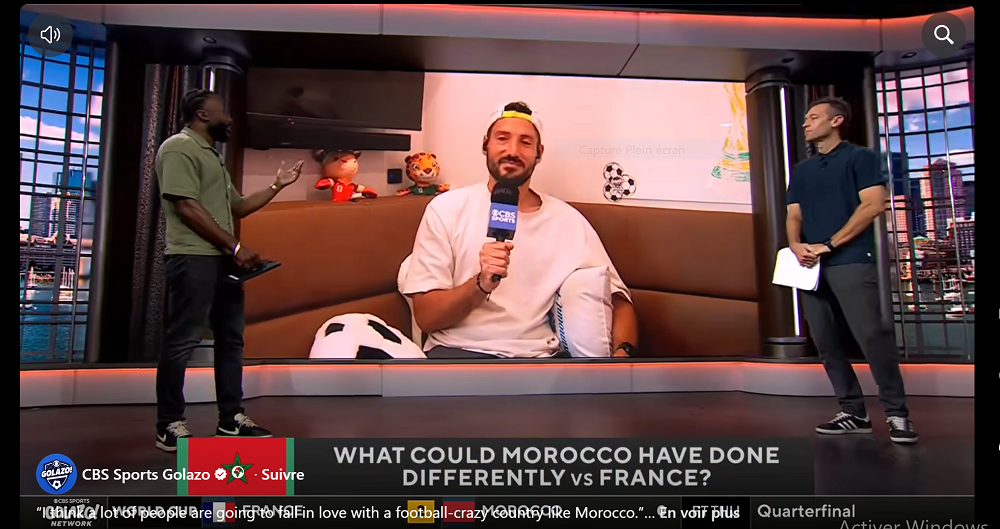
American sports journalist Nico Cantor’s remarks on CBS Sports about Morocco’s role in the 2030 FIFA World Cup were far more than an enthusiastic reaction to a country preparing to host the world’s biggest sporting event. Nor were they simply a series of compliments about stadiums, railways, or modern infrastructure. In international media, such statements often serve a broader purpose: they help shape collective perceptions and signal how the global narrative surrounding a nation is beginning to evolve long before the opening whistle is blown.
What Cantor articulated extends well beyond football. His observations reveal the emergence of a new international narrative—one in which Morocco is no longer viewed merely as a co-host alongside Spain and Portugal, but increasingly as the most intriguing host nation, the country most likely to surprise the world and redefine expectations.
That is precisely where the significance of his remarks lies.
Cantor begins by acknowledging what everyone already knows: the world is deeply familiar with Spanish and Portuguese football. Their clubs, stadiums, football culture, and European sporting heritage have long been embedded in the global imagination. Morocco, by contrast, occupies a different position. It remains, for many international audiences, a country still waiting to be fully discovered.
Yet rather than presenting that lack of familiarity as a disadvantage, he reframes it as Morocco’s greatest strength. In the world of global events, surprise often leaves a more enduring impression than reputation.
One of the most striking moments in his commentary concerns the future Grand Stadium outside Casablanca, which he describes as the largest football stadium in the world. Beyond its architectural scale, the message is symbolic. Morocco is not merely seeking to host matches; it is seeking to leave a lasting imprint on the history of the FIFA World Cup itself.
But Cantor’s analysis goes well beyond concrete and steel.
What appears to impress him most is Moroccan society. When he describes children discussing football tactics, playing the game in every neighborhood, and living football as part of everyday life, he is portraying more than widespread enthusiasm. He is depicting football as a shared cultural language—a national identity expressed through the sport.
Within that context, he refers to what he calls Morocco’s “grassroots revolution.” His point is clear: the remarkable achievement of the Atlas Lions at the 2022 FIFA World Cup in Qatar was not a miracle or a fleeting success. It was the outcome of years of systematic investment in youth development, coaching, infrastructure, and long-term strategic planning.
A closer reading, however, reveals an even deeper layer.
When Cantor praises Morocco’s railway system and compares it favorably with transportation in the United States—arguing that it rivals the standards of Europe’s best networks—he is not simply discussing trains. He is challenging deeply rooted perceptions about Africa itself.
His spontaneous remark—“I can’t believe I’m sitting on a train in Africa”—may sound complimentary, but it simultaneously exposes the stereotypes that have long shaped Western perceptions of the continent. Those words unintentionally acknowledge how expectations about Africa remain anchored in outdated assumptions about underdevelopment and inadequate infrastructure.
What his experience demonstrates is that Morocco is actively dismantling those assumptions.
At that point, football ceases to be the central story.
Morocco is no longer marketing only a sporting tournament. It is presenting a national experience—an invitation to discover a country that combines modern infrastructure, hospitality, cultural authenticity, and strategic investment. It is projecting a development model built less on abundant natural resources than on human capital, long-term planning, connectivity, and the effective use of soft power.
Another statement deserves particular attention.
Cantor describes Morocco as perhaps the “most underrated” among the tournament’s host nations.
This observation extends well beyond sport. It suggests that much of international public opinion continues to view Morocco through outdated reference points, while the country itself has been quietly repositioning its geopolitical, economic, and diplomatic standing over the past two decades.
In essence, the 2030 FIFA World Cup is increasingly revealing itself not merely as a sporting event, but as a comprehensive national project.
Investments in high-speed rail, airports, highways, hotels, and world-class sporting facilities are not designed solely for a month-long tournament. They are intended to reshape Morocco’s long-term economic landscape, strengthen its tourism sector, enhance logistical connectivity, and reinforce its international competitiveness for decades beyond 2030.
Yet beneath this optimistic narrative lies an essential question that deserves equal attention.
If the world is only now beginning to discover a different Morocco, can the country sustain this momentum once the tournament is over? Will these unprecedented investments become lasting engines of economic development, territorial cohesion, and social progress, or will some of them remain closely tied to the exceptional circumstances of hosting a global sporting spectacle?
That is the real challenge.
Success will ultimately not be measured by the number of stadiums inaugurated, the speed of trains, or the millions of visitors welcomed. It will be measured by Morocco’s ability to transform a historic sporting occasion into a lasting economic, social, cultural, and institutional legacy.
Over the past several years, Morocco has increasingly sought to redefine its international image through tangible achievements rather than ambitious rhetoric. When recognition comes from influential international media voices, its significance lies not simply in the praise itself, but in what that praise represents: evidence that the global narrative surrounding Morocco is beginning to shift.
Perhaps that is why Nico Cantor’s concluding remark carries greater significance than any statistic or infrastructure project discussed during the interview:
“I think a lot of people are going to fall in love with a football-crazy country like Morocco.”
At first glance, the sentence may sound emotional. In reality, it encapsulates Morocco’s broader ambition for 2030: ensuring that visitors leave not merely remembering a well-organized World Cup, but carrying with them a fundamentally transformed perception of a nation that has chosen football as a vehicle for national renewal—and as a universal language through which to redefine its place in the world.


