

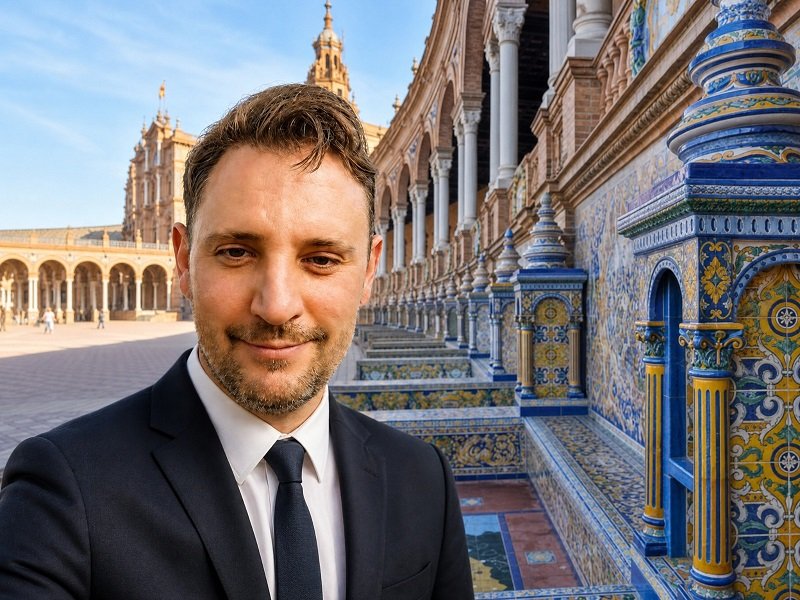
In politics, major resignations are rarely just personal departures. More often, they signal the end of one political cycle and the beginning of another. From this perspective, the resignation of Javier Izquierdo, former president of the Andalusian Party in Barcelona and the party’s chief organizational leader throughout Catalonia, should not be read as an ordinary internal dispute. Rather, it reflects deeper transformations unfolding within Spain’s political landscape, where questions of identity, religion, and values are increasingly reshaping the traditional contours of political competition.
According to Izquierdo, the conflict was never about leadership or personal ambition. It was rooted in a profound ideological and moral divide. The breaking point, he argues, came when the Andalusian Party officially displayed the LGBT flag on its digital platforms—a move he described as fundamentally incompatible with his Islamic convictions and conservative ethical principles. Yet beyond the symbolism of that decision lies a broader European phenomenon: the growing tension between cultural liberalism and conservative value systems, a divide that is no longer confined to traditional left-right politics but is increasingly visible within regional and identity-based political movements themselves.
A closer reading suggests that the real issue extends far beyond a dispute over a flag. At the heart of Izquierdo’s message lies a more consequential political question: who represents the politically conservative Muslim voter in contemporary European democracies? For years, many within this constituency have found themselves politically homeless. Progressive parties often link minority rights with broader social agendas that many religious conservatives do not necessarily embrace, while mainstream right-wing parties continue to adopt increasingly restrictive positions toward immigration and Islam. Between these two political poles, Izquierdo sees a growing electoral vacuum waiting to be filled.
It is precisely within this space that the proposed “Islamic Party” seeks to establish itself. More than the creation of another political organization, the initiative represents an attempt to redefine Muslim political representation in Spain. Izquierdo does not portray his movement as a religious party in the conventional sense. Instead, he presents it as a center-right political force rooted in Spanish patriotism, committed to the Spanish Constitution, supportive of national unity, and inspired by conservative Islamic values. This deliberate combination of Islamic identity and constitutional loyalty forms the central pillar of his political narrative.
Between the lines, however, the message appears directed as much toward Spanish institutions as toward potential voters. By repeatedly emphasizing constitutional legitimacy and commitment to Spain’s democratic framework, Izquierdo seems intent on distancing his project from any perception that Islamic political identity is inherently incompatible with the secular constitutional state. Such careful positioning reflects a clear awareness of the heightened political, media, and institutional scrutiny surrounding faith-based political initiatives across Europe.
Another strategic question naturally emerges: why now, and why Catalonia?
The answer lies in the region’s evolving demographic and political realities. Catalonia is home to one of Spain’s largest Muslim populations and has witnessed significant political realignment in recent years as the independence debate gradually loses its dominant place in public discourse. In this new environment, issues of identity, cultural integration, and shared values have become increasingly influential in electoral politics. Barcelona, therefore, is not merely the geographical birthplace of the project but a carefully chosen political testing ground.
At the same time, Izquierdo’s departure represents a significant organizational setback for the Andalusian Party. His resignation deprives the party not only of one of its senior leaders but also of an extensive organizational network across Catalonia. Should a substantial portion of that network follow him into his new political venture, the regional balance of political influence could undergo meaningful change.
Nevertheless, the future success of the proposed Islamic Party will depend on far more than its legal registration. It faces at least three major challenges. First, it must persuade Muslim voters that religious identity can serve as the foundation of an inclusive political project rather than a source of internal fragmentation. Second, it must reassure the broader Spanish public that its Islamic reference framework remains fully compatible with democratic constitutional governance. Third—and perhaps most importantly—it must demonstrate that its political vision extends beyond questions of identity and morality by offering credible economic, social, and institutional policies capable of addressing the everyday concerns of Spanish citizens.
Significantly, Izquierdo has made no secret of his long-term ambitions. Municipal elections scheduled for 2027 represent only the first step in a broader electoral roadmap leading toward Spain’s national parliament, regional assemblies, and ultimately the European Parliament. This strategy reveals an approach centered not on political protest but on gradual institutional legitimacy—a recognition that democratic influence in Europe is built through electoral participation rather than ideological confrontation alone.
Ultimately, this story is not simply about the creation of another political party. It raises a broader question about the future of European democracy itself: has Europe reached a point where the traditional left-right divide is no longer sufficient to explain political behavior? Are issues of identity, culture, religion, and civilizational values becoming the primary forces shaping electoral competition?
Seen through this broader lens, the announcement of an Islamic Party in Spain may appear today as a relatively modest political development. Yet it could also represent an early indication of a much deeper transformation taking place across Europe—a shift in which political conflict increasingly moves from economics to identity, from policy platforms to systems of values, and from traditional party loyalties toward new forms of representation grounded less in material interests than in cultural and moral convictions. Should this project succeed in translating its narrative into electoral support, it may come to symbolize not merely the birth of another political party, but the opening of a new chapter in the evolution of Spanish—and perhaps European—democracy.


