

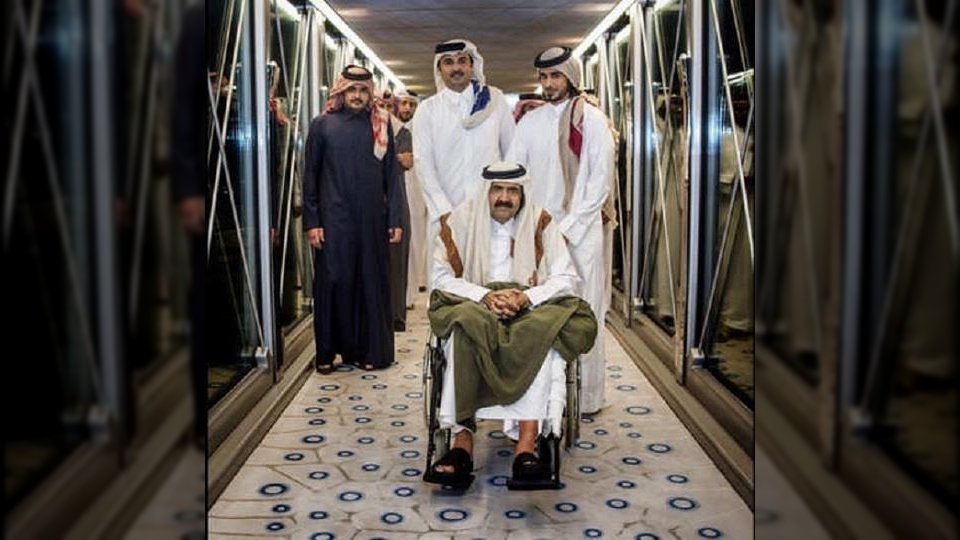
The announcement by Qatar’s Amiri Diwan on Sunday of the death of His Highness Sheikh Hamad bin Khalifa Al Thani at the age of 74 was far more than a formal notice marking the passing of a former ruler. It represented a defining historical moment, bringing to a close one of the most influential chapters in the modern history of the State of Qatar. With the passing of the “Father Emir,” an entire political era comes to an end—one associated with a statesman who fundamentally transformed his country’s position within regional and international affairs.
The Amiri Diwan announced that funeral prayers would be held after the Maghrib prayer at the Imam Muhammad ibn Abd al-Wahhab Mosque in Doha, followed by burial at Lusail Cemetery. The State also declared four days of national mourning, while official condolences will be received over three days at Lusail Palace, where His Highness Sheikh Tamim bin Hamad Al Thani will welcome heads of state, senior officials, members of the ruling family, and citizens wishing to pay tribute to the architect of modern Qatar.
Yet the significance of this event extends well beyond the passing of a former head of state. Sheikh Hamad bin Khalifa Al Thani will be remembered as the principal architect of Qatar’s modern transformation. When he assumed power in 1995, the country embarked on an unprecedented political, economic, and developmental journey. Within less than two decades, Qatar evolved from a relatively small Gulf state into an influential diplomatic, economic, and media power whose international weight far exceeded its geographical size and demographic scale.
His governing philosophy rested on a strategic conviction: energy wealth should not merely finance domestic prosperity, but should also serve as the foundation for projecting national influence on the global stage. Under his leadership, Qatar dramatically expanded its liquefied natural gas industry, becoming one of the world’s leading LNG exporters. The revenues generated from this energy revolution enabled the creation of one of the world’s most influential sovereign wealth funds, while financing strategic investments across Europe, Asia, and North America, positioning Qatar as a major player in international financial markets.
However, Sheikh Hamad’s vision was never confined to economic strength alone. He recognized early that, in the contemporary international system, soft power could often achieve what conventional power could not. This strategic thinking gave birth to Al Jazeera, which transformed the Arab media landscape, while Doha simultaneously developed an active foreign policy centered on mediation in regional conflicts—from Lebanon and Sudan to Afghanistan and Gaza. As a result, Qatar emerged as an indispensable venue for dialogue and negotiation in some of the world’s most complex crises, even as this proactive diplomacy occasionally generated tensions with several neighboring Arab and Gulf states.
Among the defining milestones of his political career was his historic decision in 2013 to voluntarily transfer power to his son, Sheikh Tamim bin Hamad Al Thani. It was the first peaceful and voluntary transfer of authority between two emirs in Qatar’s modern history. More than a simple succession, the decision reflected a broader political philosophy emphasizing institutional continuity, orderly governance, and long-term stability over uncertainty surrounding leadership transitions.
Today, as Doha receives foreign leaders and official delegations offering their condolences, the mourning ceremonies transcend their ceremonial dimension to become a diplomatic gathering reflecting the extensive international relationships that Sheikh Hamad cultivated over nearly three decades. His legacy is measured not only by Qatar’s economic rise, but equally by its emergence as a respected diplomatic mediator and an increasingly influential actor in regional and global affairs.
Initial reactions from within Qatar and abroad demonstrate that his death is widely perceived not merely as the passing of a former ruler, but as the conclusion of an entire political era that profoundly shaped the identity and trajectory of the modern Qatari state. For many Qataris, he remains the founding architect of contemporary Qatar; for international observers, he stands among the Gulf’s most influential leaders of the past three decades, regardless of differing assessments of the strategic choices that defined his rule.
The central question that now emerges is whether Qatar will continue along the strategic path established by the Father Emir—one built upon the integration of energy wealth, diplomatic activism, and soft power—or whether the profound geopolitical transformations reshaping the Middle East will compel Doha to redefine its regional and global role in ways that differ from the vision established by Sheikh Hamad bin Khalifa Al Thani.
With the passing of Sheikh Hamad bin Khalifa Al Thani, Qatar loses far more than one of its former rulers. It closes the chapter on a leader who succeeded in transforming a geographically small Gulf state into a globally recognized diplomatic and economic actor. His political legacy will continue to shape scholarly debate, strategic analysis, and international discussions about how emerging powers build influence in the twenty-first century.


