

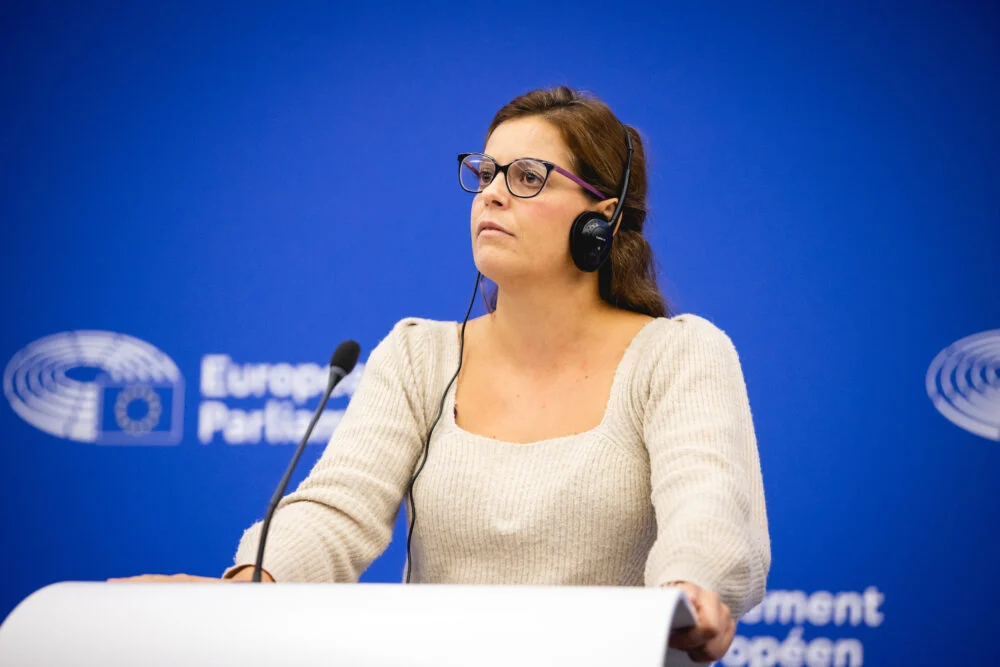
“Ceuta is not Spain.” Then, even more directly: “Ceuta is not Europe.” The two statements made by Italian MEP Ilaria Salis were enough to move the debate over Ceuta beyond the immediate question of migration.
Salis, a member of The Left group in the European Parliament, also described Ceuta as geographically located in Africa and referred to it as a “remnant of European colonialism”. The remarks were made during a European Parliament debate dealing with Ceuta, migration and the European Union’s external borders.
The choice of words matters. By saying that Ceuta is neither Spanish nor European, Salis did not limit her intervention to border management or migratory pressure. She brought geography and the history of European colonialism in North Africa directly into the discussion.
Ilaria Salis in the European Parliament: “Ceuta Is Not Spain, Nor Europe”
إيلاريا ساليس داخل البرلمان الأوروبي: «سبتة ليست إسبانيا ولا أوروبا»
Ilaria Salis au Parlement européen : « Ceuta n’est pas l’Espagne, ni l’Europe » pic.twitter.com/fFyQNS3l5K
— Diplomatique.ma الدبلوماسية (@diplomatique_ma) September 15, 2026
That reading conflicts with Spain’s official position. Madrid considers Ceuta a Spanish city and part of the territory of the European Union. Its status has repeatedly returned to Spanish and European political debates, particularly during periods of intense migratory pressure.
Morocco approaches the issue differently, both historically and territorially. Moroccan officials have repeatedly described Ceuta as Moroccan territory located on the soil of the Kingdom and have challenged its characterization as European. That position was publicly expressed in the Moroccan Parliament in 2021.
Salis’s statement does not, by itself, alter Ceuta’s institutional or legal status. Its significance lies instead in where it was made: inside the European Parliament itself, during a debate in which the Spanish and European definition of Ceuta is normally the institutional reference point.
Her intervention therefore introduces a different reading into an institution where migration, borders and sovereignty are generally discussed within the existing legal framework. It does not represent the position of the European Union as a whole, nor that of all MEPs. It represents the political position expressed by an Italian member of the European Parliament belonging to The Left.
Most positions expressed around Ceuta remain tied to the Spanish and European definition of the city. That is precisely why Salis’s remarks attracted attention: they came from within the European institution itself and relied on two perspectives — Africa’s geography and the colonial legacy — that shift the discussion toward a different understanding of Ceuta.
Ceuta therefore sits at the intersection of three definitions that do not fully coincide: a Spanish and European definition based on its institutional status; a Moroccan reading rooted in history and the territorial question; and, now expressed inside the European Parliament by Salis, a reading that emphasizes its African geographical location and the history of European colonial presence in North Africa.
Her statement has no immediate legal effect. But it is now part of the European political debate: inside the European Parliament, an Italian MEP publicly rejected the idea that Ceuta should be understood solely through its Spanish and European definition and chose instead to place the city within its African geographical setting and the history of European colonial presence in North Africa.


