

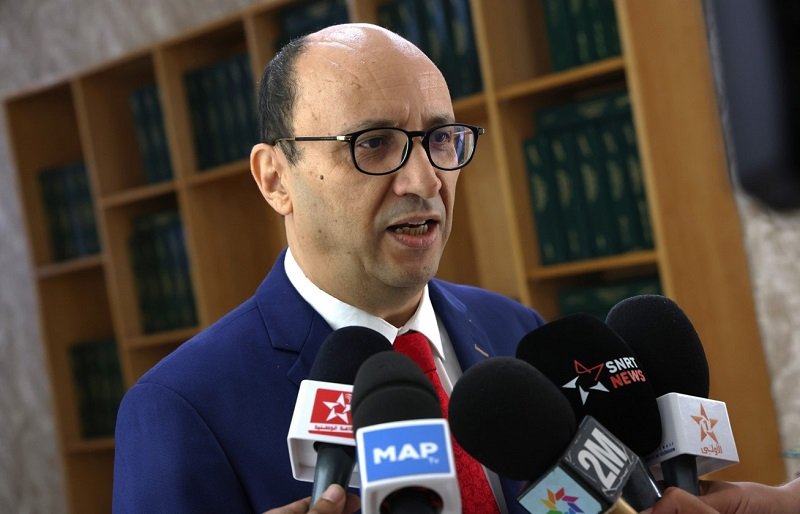
Hassan Tariq’s move from Morocco’s Ombudsman institution to the General Secretariat of the Government, following his appointment on 16 October 2026, raises questions that go beyond a change of position within the government apparatus. Having previously served as Ombudsman, he now occupies a role connected to coordinating the government’s legal work and examining draft legislative and regulatory texts. The two responsibilities are institutionally distinct. Yet the transition also invites scrutiny of the record left by his previous role and of the criteria through which certain professional careers lead to positions with more direct influence over government action.
This is not an attempt to challenge Hassan Tariq’s right to hold his new office, nor to treat a change of position as proof of either success or failure. The issue is what public accountability should mean. Should a public responsibility be assessed primarily through the experience and expertise accumulated by its holder, or also through verifiable results in citizens’ lives and in their dealings with the administration? Institutions operate in the midst of real disputes and unresolved grievances. When an official leaves a position, the files, recommendations and procedures inherited by the institution do not necessarily reach a conclusion with that departure.
In July, when the 2025 annual report of Morocco’s Ombudsman institution was presented, Hassan Tariq announced that the number of outstanding recommendations had fallen to 557, compared with 640 in 2024 and 845 in 2023. At the same time, the average time required to implement recommendations had increased to 815 days, up from 672 days in 2024. The figures point to two developments occurring simultaneously: a reduction in the backlog of unimplemented recommendations and a longer average period for their implementation. These indicators cannot, on their own, measure every aspect of the institution’s performance. They do, however, place the time required to secure redress at the centre of any discussion about the effectiveness of administrative mediation.
For citizens, fairness is not guaranteed simply because an institution receives complaints or issues recommendations. It also depends on what happens after a complaint is filed. Does the administration examine the facts? Does it engage with the documents and arguments submitted? Does the Ombudsman receive a response that can be scrutinised and challenged? And does the complainant receive a sufficiently clear explanation of the position taken on the case? Such details do not necessarily appear in aggregate performance indicators. Yet they determine whether mediation has made a tangible difference to the person seeking redress.
A journalist and sports administrator’s experience with the Ombudsman
My own experience places me directly within this debate. I am Jamal Soussi, a journalist and publishing director of Diplomatie, Maroc Maintenant and MMA Mag. I also hold sports responsibilities in Brazilian jiu-jitsu and mixed martial arts. My work in these fields is supported by documents, decisions and registered trademarks that I consider the basis of my professional and sporting rights.
I submitted a complaint to Morocco’s Ombudsman institution concerning what I regard as infringements of my rights and irregularities in the way a public administration handled my case. In my assessment, however, the response I received reproduced the substance of the administration’s reply, with the issuing institution’s identity changed. I believe a direct comparison of the two letters warrants examination and an explanation, because the Ombudsman’s response did not convince me that my complaint had received the fair consideration I expected.
I do not present this experience as a definitive judgment on the entire institution. I present it as a specific case that deserves clarification. Its significance lies not merely in my status as a journalist or in my sports responsibilities, but in the question it raises about institutions’ ability to assess complaints on the basis of the evidence and arguments submitted to them.
A registered trademark does not automatically settle every dispute concerning its use. Nor does an administrative or ministerial decision eliminate the need to examine its legal scope and consequences. But where documents have been submitted and their relevance to a dispute is established, they must be examined before conclusions are reached. If a dispute falls outside the Ombudsman’s remit, the complainant should be told clearly and directed towards the appropriate legal avenue, rather than being left with a response that does not resolve the objections raised.
I am not asking for special treatment because I am a journalist or because, according to the documentation I hold, I have contributed to the development of sporting activities and the registration of related trademarks. I am asking for my rights to be examined under the same standards that should apply to any administrative complaint. I believe that journalism, the defence of Morocco’s interests and sporting work should be pursued without a request for fair treatment turning into an endless personal dispute.
How are senior public appointments made, and what sustains public confidence?
This question is not exclusive to Hassan Tariq, nor can it be reduced to his academic, political or diplomatic background. Senior public responsibilities require knowledge, experience and the ability to work within institutions. They also call for sufficiently clear assessment criteria and a meaningful opportunity to examine results. When an official moves from one position to another, it is reasonable to consider what the previous role achieved and what lessons can be carried into the new one.
By contrast, the claim that loyalty to the state or proximity to centres of power is the decisive factor in appointments requires specific evidence. A move from one institution to another does not establish that appointments are based on loyalty alone. Equally, an academic or political career is not, by itself, sufficient proof of merit. What can be discussed publicly is an official’s professional record, the responsibilities carried out, the results documented and the ability of institutions to explain their decisions and allow those decisions to be assessed.
As a journalist, I believe commitment to the state should not be reduced to proximity to power or to a career built around official positions. It can also be expressed through daily work, the defence of Morocco’s interests, respect for the law and professional activity carried out without expecting compensation in return. This is my personal position, grounded in my own experience, not a judgment about any official’s patriotism or intentions. Patriotism is not a privilege reserved for officeholders, just as criticism of an official or institution does not, in itself, amount to opposition to the state.
As a publishing director and sports administrator, I believe my work in both fields should be assessed through documents and results, not through my relationships or my position outside the institutions. Working without financial support or compensation does not create a special legal advantage, but neither does it remove the right to protection and fair treatment. Rights should not depend on whether the person asserting them is close to or distant from decision-making centres.
The General Secretariat of the Government: a new responsibility, a different test
According to its official description, the General Secretariat of the Government plays a role in coordinating the preparation of legislative and regulatory drafts submitted by government departments and provides legal advice to the government. This differs from the Ombudsman’s role in receiving complaints and helping address shortcomings in relations between public administrations and citizens. The Secretary-General of the Government does not, simply by virtue of holding that office, have the power to implement every Ombudsman recommendation or decide every administrative dispute.
Nevertheless, the move between these two positions provides an opportunity to examine how the institutions can complement one another. An official who has encountered citizens’ grievances and the difficulties involved in implementing mediation recommendations may, within the scope of the new responsibilities, draw on those experiences when reviewing the legal texts and procedures submitted to the General Secretariat. But the impact of that experience cannot be assessed on the basis of the appointment alone. It will depend on observable practices and results: legal clarity, the handling of administrative shortcomings and respect for citizens’ rights.
My own case does not allow me to assess every file handled by the Ombudsman during Hassan Tariq’s tenure. Nor do the published figures support such a sweeping conclusion. What I can do is request an explanation of how my case was handled, insist on a comparison of the correspondence I hold and seek a professional justification for the response I received.
The broader question concerns whether public institutions make responsibility open to meaningful evaluation, so that changing positions does not bring scrutiny of the previous record to an end, and a new appointment does not replace the need to understand what was actually accomplished. An appointment is an official fact. Assessing performance requires evidence, results and a comparison between the responsibilities assigned and the work carried out.
For me, this is neither an attempt to turn my experience into a national cause nor a basis for passing judgment on Hassan Tariq’s appointment. It is a professional case in which I am seeking fair treatment, and part of a wider discussion about the standards that should govern public responsibility. What I seek in my own case is specific: an examination of the documents, an explanation of the grounds for the response I received and respect for my right to know whether my complaint was independently assessed. Hassan Tariq’s new responsibilities, in turn, should be judged by the work performed and the results achieved, not merely by his move from one institution to another.


