

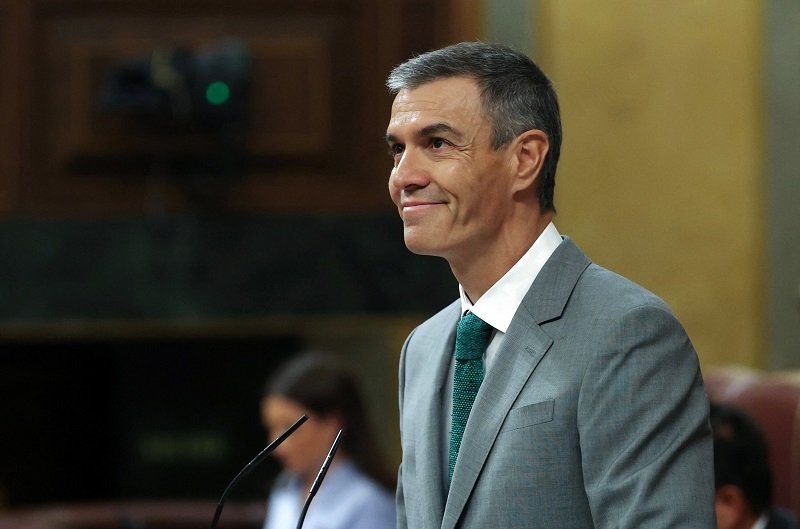
An examination of the Spanish prime minister’s statements on the Moroccan Sahara and the occupied Moroccan cities, what they reveal about the limits of the strategic partnership between Rabat and Madrid, and the increasingly decisive role of the Sahara issue in assessing the positions of European partners.
The interview given by Spanish Prime Minister Pedro Sánchez to the Memorias de Pez podcast, broadcast on Sunday, 8 November 2026, was not simply another occasion to discuss relations between Spain and Morocco. Sánchez chose to address two particularly sensitive issues in the relationship between the two countries: the future of the Moroccan Sahara, on the one hand, and the status of Ceuta and Melilla, on the other. In doing so, he clearly outlined the space within which Madrid intends to develop its partnership with Rabat, while reaffirming the positions it considers matters of national sovereignty.
Sánchez was unequivocal in stating that Spain’s sovereignty over the two cities had never, in his government’s view, been a subject of discussion in bilateral relations with Morocco. At the same time, he acknowledged that managing the border, particularly in Ceuta, becomes considerably more difficult without Moroccan cooperation. The recent migration crisis has also brought back a question that, according to his own account, had not been seriously addressed over the previous forty-five years: how can the two cities become more deeply integrated into the European framework, so that Europeans recognise them not merely as Spanish borders, but as land borders of the European Union on the African continent?
The combination of reaffirming Spain’s position on the two cities while acknowledging the practical necessity of cooperation with Morocco is not incidental. It reflects the way Madrid wants to manage its relationship with Rabat: extensive security, economic and political cooperation, while keeping sovereignty disputes outside the framework of bilateral negotiations recognised by the Spanish government.
Sánchez’s statements on the Moroccan Sahara, however, deserve separate examination. He did not simply repeat the position announced by his government in 2022. He returned to the reasoning behind that decision and rejected the suggestion that Spain’s change of position had resulted from a bargain or political transaction with Morocco.
The Moroccan Sahara: Sánchez defends the 2022 decision and presents it as a strategic choice
On the Moroccan Sahara, Sánchez’s response went beyond a simple reaffirmation of Spain’s position. He recalled that Spain remained, according to his statement, the largest contributor of humanitarian assistance to the refugee camps. He then referred to what he described as a reassessment of international positions after five decades of deadlock, involving countries represented on the United Nations Security Council as well as European states. That reassessment, he argued, had led to the conclusion that autonomy for the Sahara under Moroccan sovereignty could be the most viable option for resolving the dispute.
One particularly notable aspect of his remarks was his refusal to portray Spain’s change of position as a concession to Rabat in exchange for specific benefits. When challenged with the argument that Spain had abandoned a negotiating instrument without receiving a clearly identifiable return, Sánchez responded that there had been neither a bargain nor a trade-off. Rather, he described the decision as a political conviction and a greater commitment by Spain to a region with which it has undeniable historical ties.
This response brings the transformation of Spanish policy in March 2022 back into focus. It was not merely a change in diplomatic wording or a temporary political gesture. Madrid moved from a position that allowed it considerable room for reservation to one that regarded Morocco’s autonomy initiative as a serious, realistic and credible basis for resolving the dispute.
The document governing that change is clearly identifiable. On 18 March 2022, the Spanish government announced the beginning of a new phase in relations with Morocco, based on mutual respect, the fulfilment of commitments, transparency, continuous communication and the avoidance of unilateral actions. The statement also linked the stability of the two countries to their sovereignty, territorial integrity and prosperity.
Sánchez’s official visit to Morocco on 7 April 2022 was followed by a joint declaration in which Spain described the Moroccan autonomy initiative, presented in 2007, as the most serious, realistic and credible basis for resolving the dispute over the Sahara. The declaration linked this position to recognition of the importance of the issue to Morocco and of the Kingdom’s efforts within the United Nations framework.
On 8 June of the same year, Sánchez returned to the Spanish Parliament to defend this policy. He described the Moroccan initiative as the most serious, realistic and credible basis for a solution, while stressing that any settlement should be mutually acceptable and consistent with the United Nations Charter and relevant resolutions. This distinction matters: Spain’s official position, as presented before its legislature, is based on support for the Moroccan initiative as a foundation for a settlement. It does not amount to a declaration that the UN process has ended or that every element of a final solution has already been determined.
Sánchez’s defence of the decision in his November 2026 interview carries an additional significance. More than four years after the change was announced, the Spanish prime minister still finds himself having to explain it to domestic public opinion and respond to those who regard it as an unbalanced concession in relations with Morocco. This indicates that the position has become part of Spain’s political debate, rather than remaining merely a diplomatic decision whose consequences ended with the signing of a joint declaration.
The debate has gradually shifted. It is no longer confined to why Spain changed its position, but increasingly concerns whether that policy can withstand party-political tensions, electoral calculations and pressure from Spanish groups opposed to closer relations with Rabat.
This dimension becomes more significant as Spain approaches the general elections scheduled for 29 November 2026, according to media coverage of the interview. Foreign policy consequently becomes part of the government’s record presented to voters. However, the available information does not establish that Sánchez’s remarks were formulated exclusively for electoral purposes. What can be established is that they were made during a politically sensitive period in Spain, while relations with Morocco remain a subject of domestic debate.
The Royal Speech: the Sahara as the measure of friendship and the effectiveness of partnerships
Sánchez’s current statements acquire a broader meaning when placed alongside the Royal guidance that clearly established the position of the Moroccan Sahara issue within the Kingdom’s foreign policy.
The precise reference is the speech delivered by His Majesty King Mohammed VI, may God assist Him, on 20 August 2022, marking the 69th anniversary of the Revolution of the King and the People, not the speech of 20 August 2021.
In that speech, after reviewing developments in international positions on the Moroccan Sahara and welcoming Spain’s change of position, the Sovereign delivered a clear message to the Kingdom’s traditional and new partners:
“The Sahara issue is the lens through which Morocco views the world. It is the clear and simple criterion by which the sincerity of friendships and the effectiveness of partnerships are measured.”
This statement cannot be separated from the circumstances in which it was made. The Royal Speech had specifically welcomed Spain’s position, describing it as clear and responsible, and emphasised that it had established a new phase in the partnership between the two countries. That phase, the Sovereign stressed, should not be affected by regional circumstances or domestic political developments. The speech also referred to the positions of other European countries and the expansion of international support for the Moroccan autonomy initiative under the Kingdom’s sovereignty.
Invoking this speech when examining Sánchez’s current statements is therefore not simply a matter of recalling a Moroccan political position. It places current developments within the framework established by the Sovereign for assessing the Kingdom’s foreign relations.
Morocco does not measure its relations with partners solely through trade volumes, the level of security cooperation or the frequency of government meetings. It also attaches considerable importance to the clarity of their positions on its territorial integrity and to whether their stated commitments can be translated into consistent policies that remain stable despite changes of government and political circumstances.
From this perspective, Sánchez’s renewed defence of autonomy under Moroccan sovereignty represents continuity with the position welcomed by Morocco in 2022. It confirms that the current Spanish government has not abandoned that policy in the statements of its prime minister.
Journalistic accuracy nevertheless requires a distinction between reaffirming this position and moving towards a new level of political recognition. Sánchez did not announce any new recognition in the interview, nor did he present a diplomatic formula going beyond the joint declaration of 2022. He reiterated that autonomy under Moroccan sovereignty was the most viable option and defended the reasoning behind Spain’s policy shift.
That distinction is important when assessing the significance of his remarks, so that legitimate appreciation of Spain’s position does not lead to attributing statements or commitments to the Spanish prime minister that he did not make.
Occupied Ceuta and Melilla: Madrid seeks a stronger European presence on Africa’s borders
While Sánchez offered a clear defence of his government’s position on the Moroccan Sahara, he left no comparable ambiguity when addressing occupied Ceuta and Melilla.
He stated that Spain’s sovereignty over the two cities had never been a subject of discussion in bilateral exchanges with Morocco, according to his government’s understanding. Madrid therefore does not consider this issue part of the arrangements underpinning relations between the two countries.
This wording deserves attention. It contains no Spanish recognition of Morocco’s claims and offers no indication that Madrid is prepared to include the status of the two cities in future negotiations with Rabat. On the contrary, it reaffirms Spain’s stated red line while seeking to preserve bilateral cooperation in other areas.
Sánchez then turned to a practical issue that reveals the extent of Spain’s reliance on Morocco. He acknowledged that controlling the border in Ceuta becomes much more difficult without the necessary cooperation from the other side of the border, a direct reference to the Kingdom.
This is not simply a matter of technical coordination between border surveillance agencies. For Spain, Morocco is an essential partner in managing irregular migration flows and monitoring the land and maritime routes connecting North Africa with the European space.
Sánchez acknowledged that the migration crisis in Ceuta on 30 and 31 July 2026 remained under investigation, with the Spanish government continuing to examine the matter from a national security perspective. He also indicated that the case was before Spain’s National Court.
He further referred to the departure of a large proportion of the migrants who had entered the city during the crisis. According to the figures presented by the Spanish government, nine out of ten people who entered had left the city, while 15,000 had returned voluntarily since the beginning of August, including 13,000 since 20 August, following an expansion of the reception system. These figures should be understood as data reported by the Spanish authorities, not as an independent assessment or a final finding of the investigation.
More significantly, the Spanish prime minister refused to offer a definitive explanation for the crisis based on speculation. He referred to the possibility of political objectives and what he described as an improper use of a Supreme Court ruling concerning returns at the border. However, he made clear that he did not know which entity might be behind such actions and that the investigation was continuing.
This reservation is important because it prevents the migration crisis from being turned into a direct political accusation against Morocco without publicly established evidence. At the same time, Sánchez’s acknowledgement of the need for Moroccan cooperation confirms that Spanish border security cannot be separated from the nature of its relationship with Rabat.
European integration for the two cities: a project extending beyond statements into institutional and economic arrangements
Sánchez did not limit his remarks to border control. He also spoke about the need to strengthen Ceuta and Melilla’s presence within European institutions, so that Europeans would recognise them as the European Union’s land borders in Africa, rather than simply as two cities belonging to Spain.
He referred to efforts to secure representation for the two cities on the European Committee of the Regions and to discussions about the possibility of integrating them into the European Customs Union. According to Sánchez, this issue has remained unresolved since the beginning of Spain’s democratic period.
These ideas, however, are no longer merely proposals introduced during the interview. On 18 September 2026, the Spanish Ministry of Foreign Affairs announced a package of measures intended to strengthen the two cities’ integration into the European Union. These included efforts to secure permanent representation on the Committee of the Regions, strengthen the presence of Frontex, provide additional political and financial support, and work towards their integration into the Customs Union.
The customs issue also has an existing European legal framework; it is not simply a political discussion. The European Commission explains that Ceuta and Melilla are currently excluded from the European Union’s customs territory, although they benefit from special arrangements concerning exemptions from customs duties on certain commercial transactions, under Spain’s accession arrangements and the relevant European provisions.
This means that any future integration into the Customs Union would not be merely a change in political language or institutional representation. It would have consequences for the economic and commercial status of the two cities, their relationship with European markets and their trade with neighbouring countries.
Morocco is objectively part of this equation because of geography and the scale of economic and social interdependence. It is not, however, a party to the European decision concerning the customs status of the two cities. That decision rests with Spain and the European institutions, while its implications for cross-border trade and regional economic balances warrant close attention.
It is also important not to overlook the fact that Madrid wants to consolidate the European character of the two cities while maintaining the Moroccan cooperation required to secure their borders. These are two objectives that the Spanish government intends to pursue simultaneously, despite the continuing political and historical dispute over the status of the cities.
Relations with Morocco: a strategic partnership that does not eliminate sovereignty disputes
Spanish calculations become clearer when viewed against the period preceding the March 2022 declaration. Relations between the two countries had entered a major diplomatic crisis, linked to Spain’s decision to receive Polisario Front leader Brahim Ghali for medical treatment and the political and border tensions that followed. A process of rebuilding trust subsequently began.
The Spanish declaration of 18 March 2022 sought to establish new rules for managing the relationship through commitments to transparency, continuous communication, respect for agreements and the avoidance of unilateral measures. It also connected cooperation on migration and the restoration of normal movement for people and goods with the stability of bilateral relations.
The recent interview nevertheless reveals that Madrid has not abandoned its traditional understanding of certain sovereignty issues, even as it advocates closer relations with Rabat. Sánchez places Ceuta and Melilla outside the sphere of bilateral discussion as understood by his government, while defending autonomy under Moroccan sovereignty as the most viable solution for the Sahara.
Spain’s position is therefore based on separating the different issues, rather than achieving a comprehensive settlement of all points of disagreement. This requires Moroccan analysis to distinguish the significance of Spain’s policy shift on the Sahara from the continuing dispute over occupied Ceuta and Melilla.
The partnership between the two countries now rests on a range of interests that go beyond conventional government relations: security, migration, trade, investment, energy, maritime connectivity and regional cooperation. Its stability consequently requires clarity of positions, continuity of commitments and the ability to manage disagreements without allowing them to develop into recurring crises.
What should Rabat monitor following Sánchez’s statements?
The significance of the interview does not lie in announcing a new recognition of Moroccan sovereignty over the Sahara, since Spain’s official position had already been defined in the joint declaration of 2022. Rather, it lies in the fact that the Spanish prime minister has once again defended that choice before Spanish public opinion, at a politically sensitive moment ahead of the general elections.
This reaffirmation carries political weight, but it does not remove the need to monitor its institutional and diplomatic consequences. The measure of Spain’s position cannot simply be the number of times a Spanish official declares support for autonomy. What matters is the consistency of that position within Spanish foreign policy, Madrid’s positions in European institutions and the United Nations, and its relations with the parties concerned by the dispute.
The issue of Ceuta and Melilla will constitute another test of the nature of the relationship. Madrid intends to strengthen the cities’ integration into European institutions and the Customs Union, while continuing to rely on Moroccan cooperation to manage their borders. Morocco must address this reality on the basis of its national interests and its geographical and strategic position, without confusing necessary cooperation with any concession on its national positions.
As for the Moroccan Sahara, the Royal Speech of 20 August 2022 remains the clearest political reference for understanding how the Kingdom assesses the positions of its partners. When His Majesty King Mohammed VI, may God assist Him, described the Sahara issue as the lens through which Morocco views the world and the criterion by which the sincerity of friendships and the effectiveness of partnerships are measured, the Sovereign was establishing a principle of foreign policy that goes beyond temporary statements and diplomatic gestures.
In that same speech, the Sovereign specifically referred to Spain, welcoming its clear and responsible position and considering that it had opened a new phase in the partnership between the two countries, one that should not be affected by regional fluctuations or domestic political developments.
Today, more than four years after that change, the Spanish prime minister has once again personally defended his decision. This is a positive development in bilateral relations, but it remains subject to continuous assessment through actual practice, decisions and commitments.
Morocco, which has placed its territorial integrity among the foundations of its foreign policy, cannot assess its partners solely through their public statements. What matters is whether those positions translate into sustained political and institutional consistency, and whether the partnership with Spain is based on mutual respect for national interests rather than on selecting the issues on which each side wishes to cooperate while excluding the others.
Sánchez has renewed his defence of autonomy under Moroccan sovereignty, while also reaffirming Madrid’s position on Ceuta and Melilla. Between these two positions lie the contours of the next phase: a strategic partnership built on genuine shared interests, but still shaped by historical and sovereignty disputes that improved relations have not erased.


