

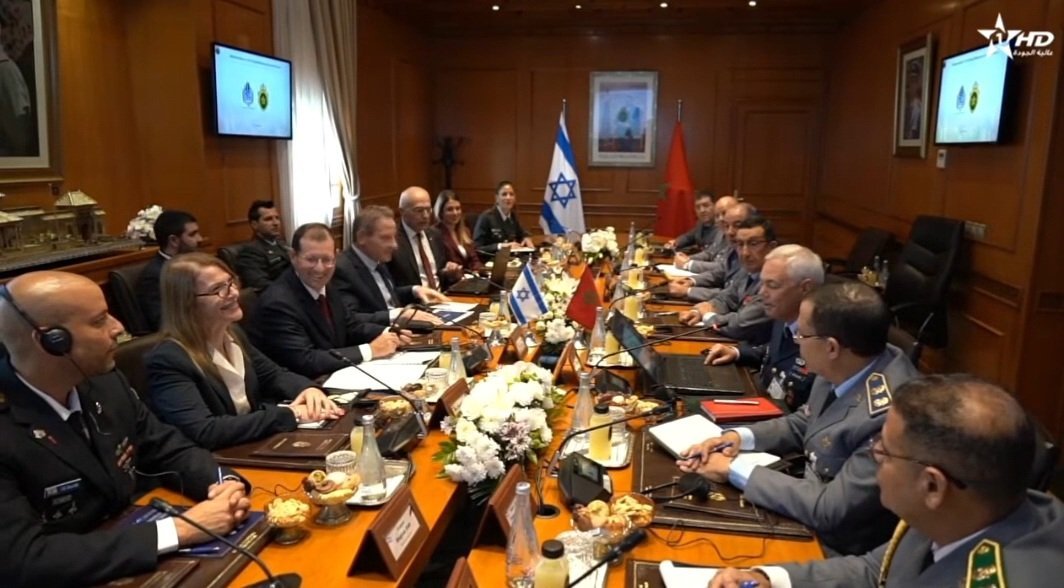
Rabat hosted Amir Baram, Director General of Israel’s Ministry of Defence, on Monday, 9 November 2026, at the head of an official delegation comprising military officials and representatives of the Israeli armed forces. The working visit brought Morocco-Israel defence cooperation into a phase more closely associated with military manufacturing, cybersecurity, the acquisition of equipment and defence technologies. The visit included official meetings with Abdeltif Loudyi, Minister Delegate to the Head of Government in charge of National Defence Administration, and Lieutenant General Mohammed Berrid, Inspector General of the Royal Armed Forces and Commander of the Southern Zone, according to information released by Moroccan media on the basis of a joint statement from the National Defence Administration and the General Command of the Royal Armed Forces.
التعاون العسكري المغربي الإسرائيلي يدخل مرحلة التصنيع الدفاعي.. الرباط توسّع خياراتها لبناء قاعدة صناعية وطنية
Morocco-Israel Military Cooperation Moves Towards Defence Manufacturing: Rabat Expands Its Options for Building a National Industrial Base pic.twitter.com/HY9WWZZHBy
— Diplomatique.ma الدبلوماسية (@diplomatique_ma) November 10, 2026
One of the most significant elements of the discussions was the development of a Moroccan defence industrial base, alongside progress in acquiring military equipment and technologies, expanding cybersecurity cooperation, exchanging expertise and providing training. These issues place the visit within a framework that extends beyond the conventional relationship between a military equipment supplier and an armed institution purchasing that equipment. They open the way to broader industrial and technological cooperation, although the available statements do not specify the details of the projects, their financial commitments or their contractual obligations.
The institutional significance of the visit is also linked to the position held by the Israeli official leading the delegation. Amir Baram serves as Director General of Israel’s Ministry of Defence, an institution that plays a central role in managing defence procurement, military exports and international cooperation in the defence sector. In a statement published on 10 November, the Israeli ministry said that most defence deals with Morocco pass through direct government-to-government agreements led by the ministry. It also referred to the contribution of Israeli companies to establishing an independent Moroccan defence industry through joint ventures and industrial offset agreements.
This formulation deserves close examination. It reveals an approach in which Israeli commercial and industrial interests are explicitly present alongside the military and political dimensions of the relationship. The Israeli ministry itself links the expansion of defence cooperation with partner countries to the growth of its military exports, the strengthening of the Israeli military’s capabilities, support for its defence industry and economy, and the advancement of its foreign policy. Joint industrial projects must therefore also be examined in terms of reciprocal interests, the nature of the technologies being transferred and the amount of industrial value actually generated inside Morocco.
From a cooperation memorandum to a permanent military presence
The institutional foundations of this process date back to the restoration of diplomatic relations between the two countries in December 2020, followed by the signing of a defence cooperation memorandum of understanding in Rabat on 24 November 2021. The agreement was signed during a visit by Benny Gantz, then Israel’s Minister of Defence, with Abdeltif Loudyi.
The memorandum established a framework for cooperation in areas including the exchange of expertise, training, technology transfer and defence manufacturing, in addition to military and security cooperation. It moved relations beyond contacts and coordination towards formal channels between the two defence establishments, enabling the development of cooperation programmes and military contracts through government and institutional arrangements.
Subsequent developments have demonstrated a gradual expansion of this process. The following years saw visits by Israeli military officials to Morocco and the development of cooperation between the Royal Armed Forces and the Israeli military, including joint exercises and exchanges of expertise. The presence of Israeli companies at defence exhibitions in Morocco also became more visible, culminating in Israel’s official participation in the 2026 Marrakech International Air Show, where the Israeli Ministry of Defence presented a national pavilion featuring companies from the defence sector.
Amir Baram’s visit added another institutional dimension to this process through the inauguration of the permanent office of the Israeli military attaché in Rabat, headed by Colonel Sharon Itach, the first permanent Israeli defence attaché accredited to the Kingdom.
A permanent military attaché office differs from periodic visits by official delegations. It provides an ongoing institutional communication channel that can facilitate the monitoring of cooperation programmes, military coordination and exchanges of expertise. However, its establishment alone does not reveal the nature of operational decisions or the level of classified information exchanged, matters that remain governed by the applicable agreements and legal and security arrangements.
Defence manufacturing: what is actually changing inside Morocco?
The emphasis on establishing a defence industrial base comes at a time when Morocco is seeking to expand its production capabilities and technological expertise in military equipment, while reducing exclusive dependence on imports. This approach involves attracting international partners and establishing domestic industrial facilities.
It is supported by an existing legal framework, whose principal elements include Law No. 10.20 on defence and security equipment, weapons and ammunition, enacted in 2020, together with its implementing decree No. 2.21.405, dated 15 July 2021. This framework sets out the conditions governing the manufacture, import, export and trade of defence equipment. Manufacturing activities are subject to administrative authorisation following consultation with the competent national commission.
Article 5 of the law establishes requirements concerning companies’ legal status and capital ownership. It provides that the majority of a company’s capital must be held by Moroccan nationals, while allowing the administration to grant exemptions by decision where considerations relating to defence, security, general policy or economic policy justify them. This provision reflects an attempt to reconcile the protection of national interests with the opening of the sector to foreign investment and partnerships capable of contributing to domestic industrial and technological development.
The objective is not simply to establish factories assembling imported equipment. The definition of manufacturing under Article 4 covers a range of operations, including assembly, shaping, casting and additive manufacturing through three-dimensional printing, as well as maintenance, repair, conversion and modification. This broad definition creates room for different levels of industrial activity, with significant variations in technological value and the degree of local integration.
This distinction becomes essential when assessing any future Moroccan-Israeli industrial projects. The presence of a production facility on Moroccan territory is not, by itself, sufficient evidence of technology transfer in the deeper industrial sense. Such an assessment requires information about the components manufactured locally, the participation of Moroccan engineers and technicians in design and development, the extent of manufacturing and maintenance rights, and the ability to upgrade and modernise equipment without complete dependence on the foreign supplier.
Local manufacturing indicators predate the November visit
Morocco already has defence industrial projects that have reached tangible implementation stages, and this development is not exclusively linked to its partnership with Israel.
On 23 September 2025, Moroccan and Indian authorities announced the inauguration in Berrechid of the TATA Advanced Systems Morocco factory, dedicated to the production of WhAP 8×8 armoured combat vehicles. The project forms part of an investment agreement signed in September 2024 between the parties concerned.
According to information published on the official portal of the Kingdom of Morocco, the project began with a local integration rate of 35%, with the objective of gradually raising it to 50% through investment in training and the integration of national suppliers. The project also provides for the creation of 90 direct jobs and 250 indirect jobs, with the possibility of directing production towards African markets.
This experience demonstrates that the development of Morocco’s defence industry is based on diversifying partners rather than relying on a single technological source. The partnership with India in armoured vehicles represents a different model from cooperation with Israeli companies in weapons systems, military electronics and unmanned aerial vehicles. This diversification gives Morocco greater scope to compare competing offers and negotiate the conditions governing technology transfer and domestic production.
On 8 October 2026, Reuters reported that Kadouri Naour, Managing Director of Moroccan Military Industry, had said the company expected to begin delivering armoured combat turrets to the Royal Armed Forces in March 2027. These turrets are to be installed on 8×8 vehicles assembled in Morocco by India’s Tata, alongside the production of associated ammunition.
The agency also reported that the company operates a facility in the Midparc industrial zone near Casablanca and is establishing a second industrial unit in Sidi Yahya, north of Rabat, dedicated to the production of medium- and large-calibre ammunition.
Reuters also examined the company’s technological links with Israel, noting that sources at the Marrakech exhibition and earlier media reports had referred to close ties with Israeli company Elbit Systems and the use of its technologies. The company, however, presented itself to the agency as a Moroccan defence manufacturer. Its managing director told Reuters that 99% of its employees were Moroccan, including its engineers.
These details provide a more concrete basis for examining the concept of joint manufacturing. Morocco has already begun moving beyond the acquisition of finished military equipment towards the domestic production of components and systems, with support from foreign expertise. However, the proportion of Moroccan employees, important as it may be, is an indicator of local employment and operational activity. It does not, on its own, demonstrate technological ownership or the ability to design, develop and manufacture independently.
Industrial offsets and technology transfer: the real test of the partnership
Israel’s Ministry of Defence has explicitly referred to industrial offset agreements as one of the mechanisms through which Israeli companies contribute to the development of Morocco’s defence industry.
In their various forms, these mechanisms link certain military procurement contracts to industrial, investment or technological commitments in the purchasing country. They may involve establishing production facilities, integrating local companies into supply chains, training national personnel, transferring specific technical operations or developing joint projects.
The actual value of these agreements, however, depends on their terms. There is a difference between a commitment to assemble equipment in a local factory, an obligation to manufacture essential components and the transfer of technical knowledge that enables Moroccan engineers to develop, maintain and upgrade systems. Similarly, the establishment of a joint venture does not automatically demonstrate the transfer of intellectual property or the acquisition of independent manufacturing capabilities.
At present, the official statements published concerning the 9 November visit do not identify the companies expected to participate in new joint projects. Nor do they specify the anticipated investment amounts, Moroccan and foreign ownership shares, implementation schedules or the nature of the technologies involved. The prospect of new contracts in the coming weeks and months remains plausible given the direction of the discussions, but it cannot yet be treated as a confirmed contractual outcome on the basis of the available documentation.
This distinction is particularly important in a sector characterised by high levels of confidentiality, whether in relation to contracts, technical specifications or supply chains. Assessing the actual results will therefore depend on indicators that can be verified later: the opening of production facilities, the delivery of domestically manufactured equipment, increases in national integration rates and the development of maintenance and engineering capabilities within Moroccan companies.
Defence cooperation between strategic calculations and industrial sovereignty
These developments are taking place against broader changes in the global defence industry. Unmanned aerial vehicles, surveillance systems, air defence, electronic warfare and cybersecurity have become essential components of military modernisation. Recent regional and international conflicts have demonstrated the importance of having systems capable of countering low-cost aerial threats, securing communications and data, and reducing dependence on external supply networks.
Morocco has strategic reasons to develop these capabilities, given its geographical position, the extent of its maritime coastlines, its regional environment and the modernisation requirements of the Royal Armed Forces. Building a national defence industry also creates opportunities for engineering research, specialised training, the integration of Moroccan companies into high-value technological industries and potential access to African and international markets, subject to the applicable legal requirements.
The relationship with Israel also carries political and diplomatic dimensions that cannot be separated from the calculations underpinning military cooperation. The Israeli ministry itself acknowledges that defence exports serve as an instrument for supporting its industry and economy while strengthening its international presence. Morocco’s decisions, in turn, remain linked to the Kingdom’s security and strategic interests and to the ability of international partnerships to generate genuine added value for the national economy and industrial base.
The visit confirms the continuation of institutional coordination between the two sides and an expressed intention to expand cooperation towards a defence industrial base, cybersecurity, training and military equipment. Turning that intention into independent production projects will depend on the contractual arrangements, the nature of technology transfer and the extent to which Moroccan expertise and companies are integrated into the different stages of manufacturing and development.
The next phase will be measured by what moves from the negotiating table to production lines, and from general cooperation agreements to specific industrial commitments whose impact can be assessed inside Morocco.


