

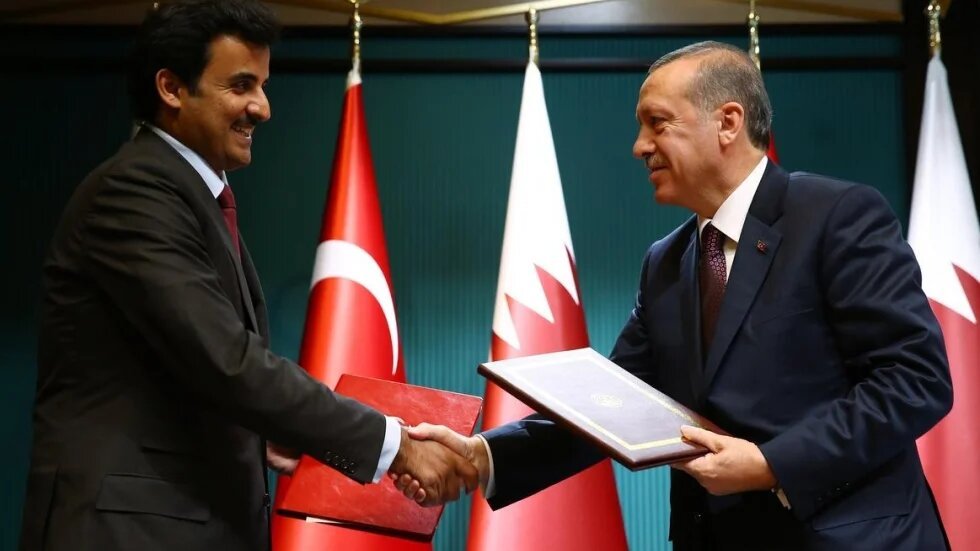
Türkiye and Qatar signed a mutual defence agreement on Friday, 13 November 2026, during a meeting in Istanbul between Turkish President Recep Tayyip Erdoğan and Qatar’s Emir, Sheikh Tamim bin Hamad Al Thani. The signing coincided with the twelfth session of the Türkiye-Qatar Supreme Strategic Committee. The agreement adds a new security and military dimension to a bilateral relationship evolving at a time of persistent regional tensions and a gradual reshaping of defence partnerships across the Gulf and the wider Middle East.
The Turkish Presidency announced the signing. According to statements reported by Reuters, Erdoğan stressed that cooperation with Doha would continue with the aim of preventing a renewed war in the Gulf, creating favourable conditions for dialogue and supporting efforts towards peace. The discussions also addressed the development and diversification of the energy partnership, alongside expanded cooperation in the defence industries.
The term “mutual defence” carries particular significance in international relations. It can extend beyond conventional military cooperation, training and the exchange of expertise to encompass more direct security commitments. However, the Turkish statement, as reported by Reuters, did not disclose the agreement’s detailed provisions, the conditions under which it could be activated or the precise obligations each party would assume if the other faced a threat or attack.
Without the official text, it would therefore be premature to equate this agreement automatically with collective-defence treaties that explicitly stipulate that an armed attack against one member constitutes an attack against the others.
From Military Cooperation to Security Commitments
The military partnership between Ankara and Doha predates the newly announced agreement. On 19 December 2014, the two countries signed a military cooperation agreement covering training, defence industries and the development of relations between their armed forces. Subsequent arrangements established the framework for the presence of Turkish troops on Qatari territory and defined aspects of their missions.
This cooperation contributed to the development of Qatar’s military capabilities through joint exercises, training programmes, the exchange of expertise and military coordination.
The political significance of this partnership became particularly visible during the 2017 blockade of Qatar. At that time, Turkish institutions approved arrangements concerning the deployment of Turkish forces in Qatar, as Doha faced substantial regional pressure. The relationship thus acquired an operational dimension extending beyond diplomatic declarations and economic agreements.
The agreement announced in November 2026 builds on this existing military framework. It also raises a new question concerning the legal and operational nature of the reciprocal commitments. Whether these include military assistance, intelligence-sharing, logistical support or specific coordination mechanisms in the event of a crisis will depend on the provisions eventually made public.
Earlier documents governing the presence of Turkish forces in Qatar help explain the institutional foundations of this cooperation, but they cannot, by themselves, establish the contents of the new agreement.
The Mecca Agreement with Saudi Arabia and Pakistan: A Parallel Development
The signing of the Turkish-Qatari agreement follows another significant development in the network of defence partnerships Ankara has been building.
On 7 August 2026, Türkiye, Saudi Arabia and Pakistan signed the Mecca Mutual Defence Agreement. Its provisions include a commitment to regard an armed attack against one signatory as an attack against the others, with an undertaking to provide assistance using available capabilities.
The Turkish Parliament approved the agreement on 6 November 2026, following its submission to the legislature in October. Its provisions cover defence cooperation, intelligence, military industries and assistance in the event of armed aggression.
The comparison between the two agreements nevertheless requires a clear legal distinction. In the case of the Mecca Agreement, the collective-defence formulation has been explicitly disclosed, and the text has undergone a parliamentary approval process in Türkiye. By contrast, the detailed provisions of the Turkish-Qatari agreement have not yet been made public. The use of the expression “mutual defence” does not, on its own, establish that the two instruments have identical legal scope or obligations.
Through these arrangements, Ankara is expanding its network of security relations with regional powers that possess significant strategic positions and military and economic capabilities. Qatar’s inclusion in this broader network adds another dimension to a partnership already characterised by longstanding political and military cooperation.
The Badr Memorandum: The Industrial Dimension of Defence Cooperation
Approximately three weeks before the Istanbul meeting, on 21 October 2026, Türkiye, Qatar, Pakistan and Indonesia signed a multilateral memorandum of understanding in Doha under the name “Badr”, during a meeting attended by defence officials from the four countries.
The memorandum aims to strengthen cooperation in military production, research and development, technical training, the exchange of expertise and technological capabilities.
The composition of this partnership is particularly significant. Türkiye has an expanding defence-industrial base, Pakistan has considerable experience in military production, Qatar is seeking to broaden its defence capabilities and strategic investments, while Indonesia adds an important Asian dimension to the initiative.
Defence relations among these countries are therefore developing on two complementary levels: strengthening military capabilities through training and coordination, and developing industrial foundations through joint production, research and technology.
The Badr memorandum should nevertheless be distinguished from a collective-defence treaty. It provides a framework for industrial and technological cooperation and does not automatically create an obligation to intervene militarily if one of the participating countries is attacked.
The Supreme Strategic Committee: The Institutional Framework Behind the Partnership
The twelfth session of the Türkiye-Qatar Supreme Strategic Committee gives the new agreement an institutional dimension that extends beyond a single diplomatic meeting.
Established in 2014, the Committee held its first meeting in Doha in 2015. Its sessions have since alternated between the two countries, providing a mechanism to monitor existing agreements, coordinate political, economic and security issues, and identify new areas of cooperation.
According to the Qatar News Agency, previous meetings have resulted in dozens of agreements and memorandums of understanding across various sectors. Qatar’s ambassador to Türkiye, Faisal bin Abdullah Al Hanzab, has also stated that the two countries’ cooperation portfolio exceeds 148 agreements and memorandums covering politics, trade, investment, defence, culture and other fields.
In his remarks, the ambassador highlighted that the current session was taking place at a time when security challenges intersect with energy security, supply chains and economic and technological transformations.
This institutional framework helps explain the widening bilateral agenda. Relations between Ankara and Doha are no longer confined to political coordination. They now encompass investments, economic projects, military cooperation and technology, supported by a regular mechanism for monitoring agreed commitments.
However, the number of signed agreements is an indicator of the breadth of institutional relations, not necessarily of the extent to which projects have been implemented or of their measurable economic and military results.
Gulf Security and the Strategic Calculations of Ankara and Doha
Erdoğan’s statements on preventing a renewed war in the Gulf place the new agreement within a regional equation that extends beyond bilateral relations.
Türkiye and Qatar operate in a region where military tensions are closely connected to maritime security, energy markets and supply chains. Any escalation can affect trade flows, investment and the stability of international markets.
For Qatar, expanding military cooperation with Türkiye is part of a broader policy of diversifying security partnerships and strengthening national defence capabilities. Ankara offers Doha additional opportunities in training, military equipment, defence technology and political coordination.
Türkiye, meanwhile, approaches the partnership as a member of the North Atlantic Treaty Organization, with a substantial military force and an expanding defence-industrial sector. Its closer relationship with Doha forms part of a regional strategy that combines security, economic interests and diplomacy.
The presidential statements on energy add another dimension to the partnership. Diversifying energy cooperation links regional security directly to the economic interests of both countries, particularly given the Gulf’s importance to global gas and energy markets.
Yet stronger military cooperation does not necessarily indicate an intention to move towards confrontation. The officially stated objectives of both sides emphasise dialogue and preventing a renewed escalation, while the precise scope of the new security commitments remains to be clarified.
What Will Determine the Agreement’s Real Scope?
Attention now turns to the official documents that will establish the actual scope of the mutual defence agreement.
The information released by the Turkish Presidency and reported by Reuters confirms that the agreement was signed, but does not yet provide a text from which the obligations of the two parties or the mechanisms for activating them can be clearly established.
Several elements will be decisive: the types of threats covered, whether the agreement is limited to direct military aggression or extends to other security risks, the consultation and decision-making mechanisms, the forms of assistance envisaged, and the constitutional and legislative procedures required for implementation.
These details will be particularly important when compared with the Mecca Agreement, whose text is publicly known and which has received approval from the Turkish Parliament, while the detailed provisions of the new agreement with Qatar remain undisclosed.
The next stage will reveal whether the agreement leads to a more integrated framework for military planning and security coordination or remains a general political and defence arrangement requiring additional implementation protocols.
For now, the established fact is that Türkiye and Qatar have decided to elevate their defence relationship to a new level, while continuing to affirm their commitment to diplomatic efforts aimed at preventing a further escalation of tensions in the Gulf.


