

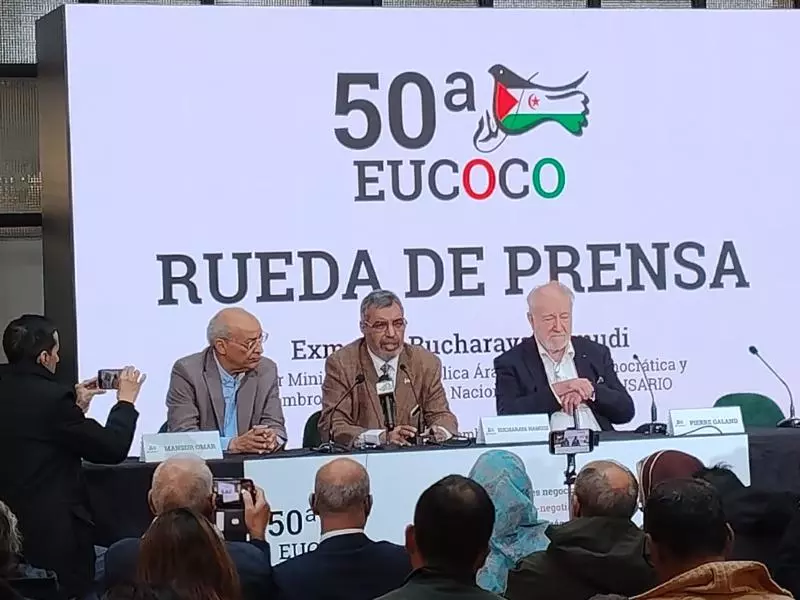
From the Spanish capital, Madrid, the Polisario Front has chosen to return to the language of military threats, raising the tone of its rhetoric to the point of threatening a prolonged war and a war of attrition against Morocco. These statements go beyond the expression of a political position and invoke the prospect of an open military confrontation. Yet the timing and substance of this escalation raise questions about its political motivations and the limits of its ambitions, particularly at a stage when the question of the Moroccan Sahara is undergoing accelerated diplomatic shifts and the separatist thesis is facing growing tests in terms of political legitimacy and its ability to influence the settlement process.
During a press conference in Madrid, Bouchraya Hamoudi Beyoun, a senior figure in the Polisario Front whom the movement presents as the head of its self-proclaimed government, spoke of the Front’s militias being prepared to confront the Royal Armed Forces. He referred in particular to the areas of Bir Lahlou, Tifariti and other locations east of the Moroccan defensive berm, presenting escalation as a possible course of action in the coming period. Between the threat of a prolonged war and the realities shaping the balance of power, a central question emerges: does this rhetoric reflect a genuine shift in the Front’s military calculations, or is it an attempt to revive a political narrative whose diplomatic room for manoeuvre is narrowing?
The significance of these statements lies in their timing, the place from which they were delivered and the messages they sought to convey. Madrid, as the capital of a country historically connected to the Moroccan Sahara issue, has become a platform for political and media messaging that reaches beyond the Front’s supporters, seeking to influence Spanish public opinion and revive its own account of developments on the ground. Claims about Moroccan military reinforcements and the possibility of an operation in the areas mentioned were presented as indicators of an imminent confrontation. However, the statements attributed to Beyoun remain the position of one party to the conflict and do not, in themselves, constitute independent evidence that a Moroccan military operation is imminent.
Madrid: A Platform for Recycling the Language of Confrontation
The choice of Madrid carries political and media significance that warrants closer examination. The Front is seeking to use its presence in Spain to reactivate its external messaging, drawing on the sensitivity of sections of the Spanish political community to the issue and the continued presence of political currents and organizations that support its position. The fact that these statements coincide with activities surrounding the fiftieth conference of the European Coordination of Support and Solidarity with the Sahrawi People, hosted in Madrid on 13 and 14 November 2026, gives the rhetoric a wider framework than that of an isolated press conference.
By referring to Moroccan military reinforcements, Beyoun sought to shift the debate away from political and diplomatic developments and towards the prospect of military confrontation. This shift serves a dual purpose: to portray the Front once again as an actor that retains the capacity to initiate military action, and to raise concerns among European public opinion about the possibility of tensions spreading across the region.
A proper reading of this rhetoric, however, requires a distinction between three levels: what the Front claims about the movements of the Royal Armed Forces; what can be independently verified on the ground; and the political conclusions the Front seeks to draw from those claims. Allegations of Moroccan preparations for a military operation, or of a possible advance towards Bir Lahlou and Tifariti, remain, on the basis of the available information, claims attributed to the separatist official. They should not be converted into established facts about the military situation.
The War-of-Attrition Narrative and the Test of the Balance of Power
One of the most striking aspects of Beyoun’s statements is his move from threatening a limited military confrontation to promoting the prospect of a prolonged war and a war of attrition. He argued that the Front’s past experience would enable it to wage such a campaign, while claiming that Morocco would not be prepared to withstand a drawn-out confrontation.
This outlook brings back a military logic associated with a different period in the history of the conflict, when direct confrontation was one of the principal instruments of the struggle. But invoking past experience does not, by itself, demonstrate that it can be replicated under current conditions. Military calculations change with the nature of weaponry, logistical capabilities, surveillance and reconnaissance systems, and transformations in the regional security environment.
A war of attrition, in military terms, cannot be measured simply by declaring a willingness to wage one. It requires sustainable human and material resources, the capacity to maintain supply lines and movement, the ability to hold positions during engagements, and the readiness to bear the political, economic and human costs of a prolonged conflict. Beyoun’s talk of a long confrontation therefore raises a practical question: what actual capabilities underpin this prospect, and to what extent would the regional actors supporting the Front be prepared to bear the consequences of another escalation?
By contrast, the Royal Armed Forces remain a military institution with an advanced defensive and organizational structure, supported by the resources of the Moroccan state, its institutions and its logistical capabilities. The operation to secure the Guerguerat crossing in November 2020 was a significant milestone in Morocco’s management of developments on the ground. At the time, the Royal Armed Forces intervened to restore the security of civilian and commercial traffic, according to the Moroccan authorities’ statements.
The importance of recalling this episode lies in the different approach it illustrates: a clearly defined intervention aimed at securing the crossing and protecting national interests, rather than being drawn into an open-ended confrontation dictated by the calculations of the other party.
The Security Council: A Precise Reading of Diplomatic Shifts
The statements also call for a return to the United Nations record, which is essential to understanding the context in which the Front is operating. Here, it is important to distinguish Security Council Resolution 2797, adopted on 31 October 2025, from the developments that took place at the Council in October 2026.
Resolution 2797 extended the mandate of the United Nations Mission for the Referendum in Western Sahara (MINURSO) until 31 October 2026. It reaffirmed the Security Council’s support for negotiations on the basis of Morocco’s autonomy initiative, noting that genuine autonomy could constitute the most feasible outcome. This wording represents an important element in the diplomatic process, but it does not mean that the Council described autonomy in that resolution as the only solution. Nor would it be accurate to attribute that wording to a new resolution adopted in October 2026.
The latest development concerns the Security Council meeting held on 30 October 2026, when the Council failed to adopt the United States draft resolution concerning the extension of MINURSO’s mandate after Russia exercised its veto, despite the draft receiving 11 votes in favour and three abstentions. The alternative Russian draft was also not adopted, as it failed to secure the nine votes required. The UN mission consequently entered a new period of uncertainty over the continuation of its mandate and the arrangements governing its future.
These developments show that the diplomatic landscape is considerably more complex than the picture presented by the rhetoric of escalation. Morocco’s autonomy initiative remains firmly present in UN discussions. At the same time, disagreements among major powers over the wording of resolutions and the future of MINURSO demonstrate that the settlement process remains subject to international balances and political negotiations that have yet to reach their conclusion.
For this reason, linking Beyoun’s threats to what he describes as a Moroccan failure at the United Nations requires an assessment that goes beyond the exchange of slogans. The American position in the Security Council, the vote secured by the US draft and its content regarding Morocco’s initiative are all elements that do not support portraying the situation as a clear Moroccan diplomatic setback. At the same time, the failure to adopt the draft requires developments at the United Nations to be addressed objectively, without declaring definitive victories that the international institution has not yet established.
Algeria and Responsibility for the Regional Environment
The relationship between the Polisario Front and Algeria remains central to understanding the continuation and evolution of the conflict. The Front operates within a regional environment in which its political and military calculations are linked to the support it receives from Algeria. Any discussion of a prolonged war therefore extends beyond the Front’s own capabilities and raises the question of regional responsibility for preventing escalation.
The consequences of any potential confrontation would extend beyond the Moroccan Sahara. The region forms part of a Maghreb space already affected by weak coordination and integration, alongside accumulated political and security disputes. Opening another front of tension would also have implications for border security, commercial exchanges, regional stability and efforts to combat cross-border threats across the Sahel-Sahara region.
From this perspective, turning military threats into an instrument of political pressure places all parties before the responsibility of addressing the conflict through a political settlement and avoiding steps that could lead to a confrontation whose wider consequences would be difficult to control.
Between Mobilizing Rhetoric and the Reality of a New Phase
Bouchraya Hamoudi Beyoun’s statements place the value of returning to the language of war at the centre of the debate over the future of the conflict. The Front is attempting to present its readiness for a prolonged confrontation as a means of exerting pressure, at a time when Morocco’s autonomy initiative has become a central feature of international discussions and the region is facing security and geopolitical challenges that require sustainable political solutions.
The real test of any rhetoric invoking war does not lie in the forcefulness of its language, but in its ability to offer a realistic assessment of the costs and consequences of such a conflict, including its impact on populations and regional stability. Wars are not decided through press statements, and promises of a war of attrition are not enough to demonstrate that a party possesses the capacity to wage one or control its outcome.
For Morocco, safeguarding its territorial integrity and protecting its national security remain non-negotiable constants. These responsibilities fall to the state and its institutions, foremost among them the Royal Armed Forces. The diplomatic process, based on defending Morocco’s autonomy initiative and strengthening its presence in international forums, remains complementary to defensive readiness, not a substitute for it.
Ultimately, Beyoun’s remarks in Madrid revive the language of military confrontation at a moment that calls for a precise reading of developments at the United Nations and across the region. Between the threat of a prolonged war and the pursuit of a political settlement, the essential question remains whether the parties concerned are prepared to move from escalation to a political solution—one that safeguards regional security and brings an end to a conflict that has drained the resources of the Maghreb and obstructed the construction of its shared regional space.


