

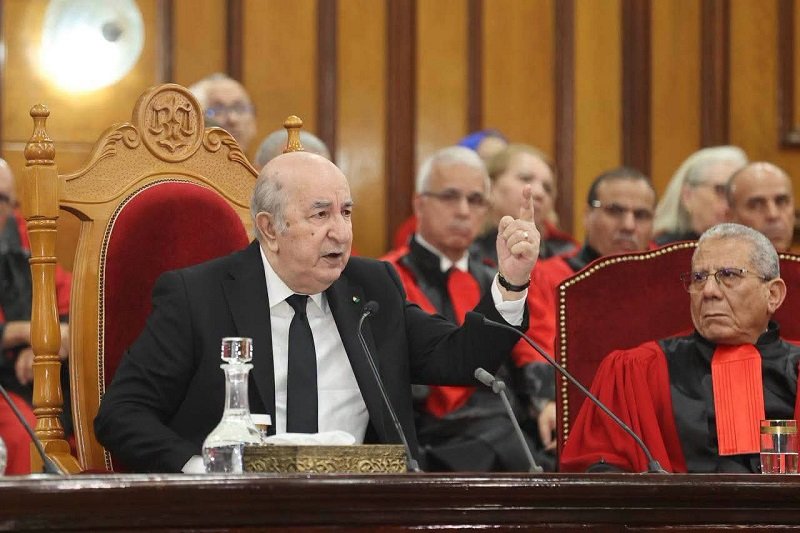
Abdelmadjid Tebboune’s statements have reopened the debate over Algeria’s domestic responsibilities in combating drug trafficking, after the president raised the possibility of targeting production sources beyond the country’s borders. His remarks bring renewed attention to a major judicial case: the seizure of 701 kilograms of cocaine at the port of Oran in 2018, during the investigations into which his son Khaled’s name emerged. Between the Kamel Chikhi case, heard by the Sidi M’hamed Court in 2020, and the psychotropic-drug seizures announced by Algeria’s military authorities in 2025 and 2026, questions of judicial and security oversight are increasingly relevant to a political narrative that places responsibility for the crisis outside the country.
Monday, 16 November 2026
Algerian President Abdelmadjid Tebboune brought drug trafficking back to the centre of Algeria’s political and security debate on Sunday, 15 November 2026, during the opening of the 2026–2027 judicial year at the Supreme Court. His remarks went beyond the familiar language of threats against smuggling networks. He raised the possibility of targeting the sources where these substances are manufactured outside Algeria, invoking what he described as the right to legitimate self-defence.
The official Algerian Press Service reported Tebboune’s statement that the flow of drugs into Algeria had become a “real war against our people and our youth”. He added that the country might be compelled to target the sources of production. Delivered at an official judicial ceremony attended by government and judicial officials, the statement carried implications beyond a routine declaration on organised crime.
Yet the Algerian president did not identify the country or party he had in mind. This omission is central to understanding the statement. Talking about targeting production sources beyond national borders is legally and politically different from announcing a security operation against a trafficking network operating inside the country. Invoking the right to legitimate self-defence also requires establishing the nature of the threat and the facts that could justify such a claim, rather than relying on a general accusation about the flow of drugs.
Morocco remains in the background of the Algerian discourse, but Tebboune’s latest statement did not name it directly. Algerian institutions and media outlets have repeatedly linked part of the cannabis-trafficking activity to Morocco, presenting the western border as one of the routes through which drugs enter the country. At the same time, statements issued by Algeria’s military authorities report repeated seizures of drugs and psychotropic substances in different parts of the country, including operations involving cross-border criminal networks.
Some Algerian media interpretations have sought to connect Tebboune’s remarks to potential sources on the Libyan front, particularly in eastern Libya. That remains a media interpretation, however, since the president did not mention Libya or any other country in his address. The information made public so far does not justify presenting these interpretations as an officially declared position.
From the Port of Oran to the Sidi M’hamed Court
Tebboune’s remarks bring back the cocaine case that erupted in Algeria in May 2018, when the Ministry of National Defence announced on 30 May that 701 kilograms of cocaine had been seized at the port of Oran.
According to the official statement reported by Algerian radio, the shipment was concealed inside a container aboard a commercial vessel flying the Liberian flag. The vessel had come from Brazil, via the Spanish port of Valencia. The container was designated for the transport of frozen red meat. Authorities put the seized quantity at seven quintals and one kilogram, distributed across 603 packages.
The scale of the seizure and the logistical route it exposed quickly turned the operation into a case extending far beyond a single customs and security incident. The investigations brought the name of businessman Kamel Chikhi, known as “El Bouchi”, into the picture, alongside questions about his relationships with officials and influential figures, and allegations involving influence-peddling and improper advantages.
Over the following months, the case branched into several separate judicial proceedings. This distinction is essential when discussing Khaled Tebboune, the son of Algeria’s current president. Khaled Tebboune was arrested and placed in pre-trial detention in June 2018 as part of investigations linked to Kamel Chikhi’s network. However, the judicial proceedings that ultimately led to his trial concerned a case involving property-related powers of attorney and allegedly undue benefits. They did not produce a court ruling establishing his participation in the trafficking of the cocaine shipment itself.
On 26 February 2020, the Sidi M’hamed Court in Algiers acquitted Khaled Tebboune of the charges brought against him in the case involving property-related powers of attorney. In the same case, Kamel Chikhi was sentenced to eight years in prison, alongside other sentences imposed on additional defendants.
Algerian media outlets, including El Khabar and Echorouk Online, reported the details of the rulings at the time. Anadolu Agency also confirmed the acquittal of the president’s son following his period in pre-trial detention.
The judicial outcome requires a clear distinction between the established facts: Khaled Tebboune’s name appeared during the investigations, he was placed in pre-trial detention, and he was subsequently acquitted in the case in which he stood trial. These rulings do not justify presenting him as someone convicted of trafficking the cocaine shipment. Nevertheless, the appearance of the president’s son in a judicial file connected to an influential businessman and a network of relationships with officials remains part of the case’s judicial and political history. It deserves to be recalled when examining official discourse on combating corruption and drug trafficking.
The French newspaper Le Monde revisited the case in an article published on 15 June 2025, seven years after the 701-kilogram seizure. It reported that the trial, which had been scheduled to begin on that date, had once again been postponed. The newspaper described the case as a symbol of dysfunction and internal power struggles within Algeria’s political system, given its judicial and political ramifications and the lengthy course of proceedings.
The persistence of the judicial case years after the seizure raises questions about the effectiveness of the investigations, the establishment of responsibility, and the ability to dismantle networks that benefit from import channels, distribution systems and economic connections. These are questions that concern Algeria’s own state institutions. They cannot be answered merely by announcing a seizure or assigning responsibility to an external source.
Seizure figures put Algeria’s domestic oversight mechanisms to the test
Data released by Algeria’s Ministry of National Defence provide further insight into the scale of operations against psychotropic substances inside the country. On 9 June 2025, the ministry announced the arrest of three people in Batna Province and the seizure of a tanker truck carrying 1,499,550 pregabalin tablets, each dosed at 300 mg, as well as a sum of money.
Earlier, on 29 May 2025, the military authorities had announced the seizure of 1,312,180 pregabalin tablets, also dosed at 300 mg, in the In Amenas region. These operations point to the existence of networks capable of transporting large quantities of psychotropic substances over considerable distances. They also underline the need to trace supply sources, transport routes, storage facilities and distribution channels.
On 11 August 2026, Algeria’s Ministry of National Defence announced the dismantling of two cross-border criminal networks, the arrest of 14 people and the seizure of approximately 1.8 million pregabalin tablets dosed at 300 mg, concealed inside a tanker truck.
These figures come from official military statements and establish the quantities seized in the operations concerned. They do not, however, provide a complete picture of the size of the illicit market, the proportion of networks dismantled compared with those still operating, or the sources of production and financing.
A seizure is evidence of security activity, but it is not, on its own, an adequate measure of the effectiveness of public policy against drug trafficking. An institutional assessment requires additional information: the number of investigations that identify financiers, final judicial rulings, the value of confiscated assets, the extent to which distribution networks have been dismantled, and the results of controls at commercial entry points and border crossings.
This distinction becomes even more important when examining the 2023 report of the United Nations Office on Drugs and Crime, presented in connection with the thirty-first meeting of Heads of National Drug Law Enforcement Agencies in Africa. The report recorded an increase in the quantities of psychotropic substances seized in North Africa between 2022 and 2023. It also referred to seizures of pregabalin and Lyrica in Algeria and Tunisia, noting that most psychotropic substances reaching the two countries were smuggled through Europe or Libya.
These findings present a regional picture more complex than reducing the phenomenon to the borders of a single state. Routes overlap, networks operate across several countries, and the substances involved differ in nature. Some are plant-based drugs, while others are pharmaceutical products diverted into illicit markets.
The report does not provide evidence that Morocco is the source of psychotropic substances entering Algeria. Nor does it establish that all seized substances originate from one country. Its reference to Europe and Libya as important smuggling routes instead highlights the need for regional cooperation, information-sharing and investigations into distribution networks.
Potatoes and cooking oil: A closer examination of market disruptions
Tebboune’s statements coincided with an internal debate in Algeria over the availability of several essential food products, particularly potatoes and cooking oil. During the first week of November 2026, Algerian media outlets reported difficulties in supplying potato markets following a decline in availability and rising prices in several regions.
On 5 November, the Algerian newspaper TSA published a report on the scarcity of potatoes in markets. It referred to stock-release operations in several provinces, including Aïn Defla, Médéa, Boumerdès and Bouira, aimed at increasing supply and limiting price increases. Local media also reported that the price per kilogram had exceeded the reference price set by the authorities in some markets.
These reports must also be examined in their seasonal context. Algeria generally experiences a transition between potato production cycles during October and November. The authorities therefore resort to the regulatory mechanism for widely consumed agricultural products, known as “Syrpalac”, to release stocks held in cold-storage facilities and strengthen market supply. Evidence of disruption in some markets does not necessarily establish a nationwide supply breakdown.
As for cooking oil, concerns about possible shortages in certain areas also circulated during the same period, prompting industrial groups to issue clarifications regarding production and distribution. On 5 November 2026, the Algerian Press Service reported that industrial groups including Agrodive, Cevital, Labelle and Sim had confirmed that production was continuing at a normal pace, that stocks of raw materials and finished products were available, and that distribution operations were ongoing.
These developments reveal tensions in the debate over supply, but they do not justify concluding that there is a nationwide cooking-oil crisis, particularly in light of official statements from industrial companies denying any halt in production or distribution. Distinguishing between a local shortage, a distribution disruption, seasonal scarcity and a general supply crisis remains essential if journalism is to avoid repeating rumours or exaggerating the scope of the facts.
Nevertheless, the coincidence of these issues places the Algerian government before several parallel responsibilities: monitoring markets, ensuring that consumers have access to essential goods, tracking speculation and smuggling networks, and strengthening oversight of pharmaceutical products that may be diverted into illicit psychotropic-drug markets.
Between security responsibility and political discourse
Tebboune’s discourse characterises drugs as a threat to national security. This description reflects the seriousness of the phenomenon for young people and society, but it also opens a debate about the limits of such rhetoric when the focus shifts from combating criminal networks to threatening sources of production beyond national borders.
The effectiveness of a security policy cannot be measured solely by the volume of seized shipments or the number of people arrested. It also depends on institutions’ ability to identify the financial and organisational structures of criminal networks, bring those responsible before the courts, establish the origins and routes of the substances, and prevent networks from being rebuilt after their dismantling.
The 701-kilogram cocaine case illustrates the complexity of this task. It began with the seizure of a major shipment at the port of Oran. The investigations subsequently extended to relationships between businessmen and officials, and the case branched into several judicial proceedings, including the file in which Khaled Tebboune’s name appeared and which ended in his acquittal. These facts form part of the public judicial record, regardless of the political interpretations that may be drawn from them.
As for Morocco, its inclusion in Algerian discourse on drug trafficking does not relieve any party of the responsibility to provide evidence and establish the actual routes used for smuggling. A professional approach to this phenomenon requires security and judicial cooperation, the exchange of information on cross-border networks, and reliance on facts, investigations and court rulings rather than political generalisations.
When a head of state speaks of the possibility of targeting drug-production sources beyond national borders, the nature of the evidence supporting that statement, the identity of the party being addressed and the legal framework for any proposed action become essential elements in understanding its meaning and assessing its implications. Within Algeria, however, oversight of ports, markets and commercial entry points, the fight against corruption and the dismantling of trafficking networks remain direct responsibilities of national institutions.
The cocaine case that emerged in 2018, the Khaled Tebboune file that ended in acquittal, and the seizures of millions of psychotropic tablets are separate facts that should not be conflated into a single accusation. Yet they place Algeria’s domestic institutional record squarely within the debate whenever the fight against drug trafficking moves away from institutional responsibility and towards threats directed beyond the country’s borders.


