

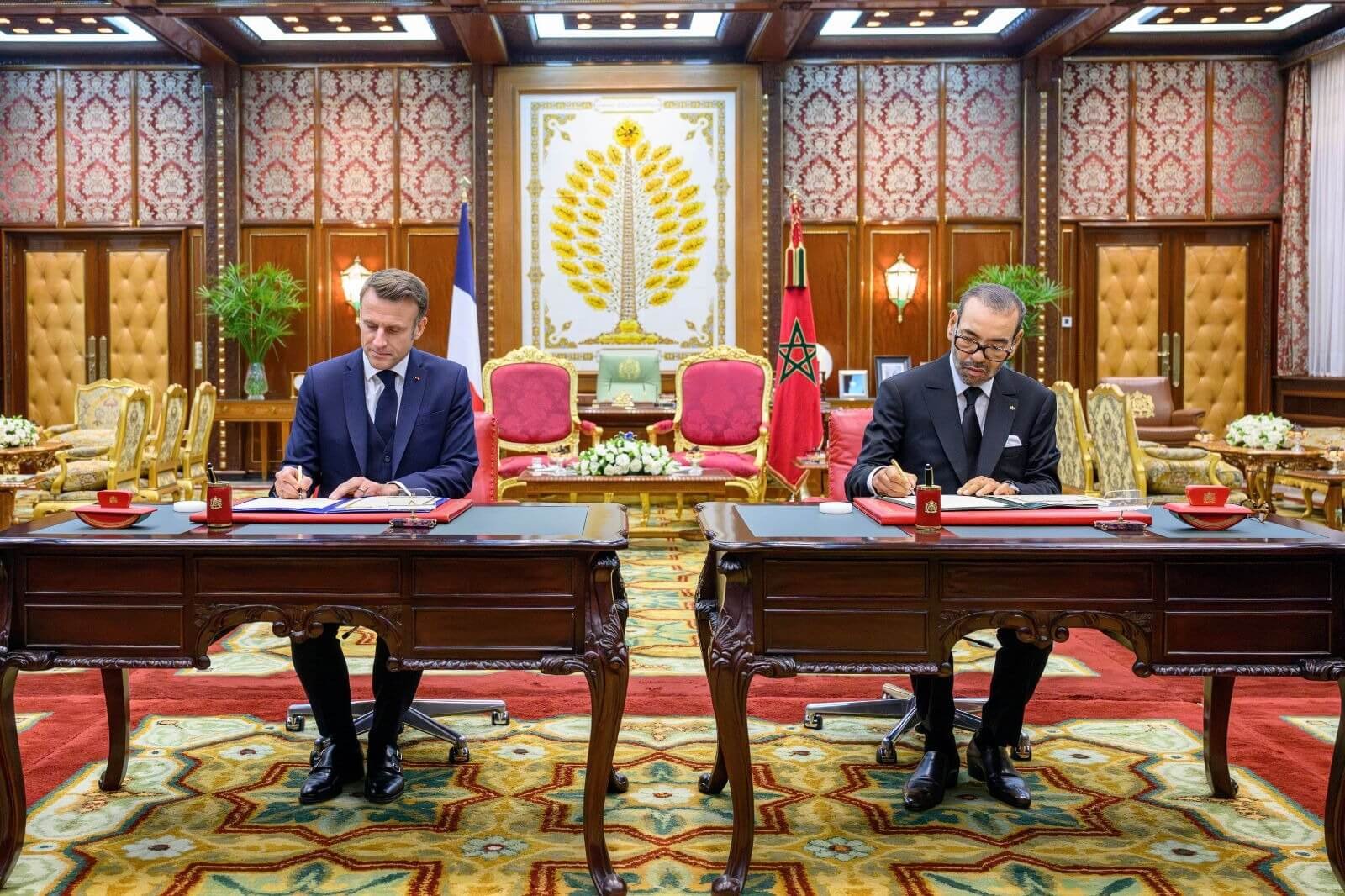
As attention increasingly turns toward King Mohammed VI’s expected state visit to France before the end of 2026, it is becoming evident that this is far more than another diplomatic engagement in the long history of Franco-Moroccan relations. Political and diplomatic circles on both sides of the Mediterranean are now discussing the final stages of a new Treaty of Friendship and Strategic Partnership, one that could fundamentally redefine the relationship between Rabat and Paris for decades to come.
Royal visits to France have always carried symbolic and political significance. Yet this particular visit appears to hold a distinctly historical dimension. Beyond the ceremonial protocol and official statements lies a broader ambition: to close a chapter that began nearly seventy years ago and open a new framework of cooperation adapted to the realities of the twenty-first century.
It is therefore no coincidence that French President Emmanuel Macron has repeatedly referred to the La Celle-Saint-Cloud Agreement and the need to establish a new strategic framework between the two countries. When a head of state revisits a document signed in the mid-1950s, the issue is not nostalgia for the past. Rather, it reflects a recognition that the world which produced that agreement no longer exists, and that the foundations governing Franco-Moroccan relations for generations require a profound reassessment.
To understand the significance of the present moment, one must return to the autumn of 1955. Morocco was then living through one of the most decisive periods in its modern history. Resistance against French colonial rule was intensifying across both urban and rural areas, while the exile of Sultan Mohammed Ben Youssef had transformed the Moroccan question into a major political challenge for France.
Faced with a colonial system that was becoming increasingly unsustainable, French authorities were compelled to seek a new political formula. The negotiations that led to the La Celle-Saint-Cloud Agreement paved the way for the Sultan’s return and prepared the ground for Morocco’s independence. The formula adopted at the time—an “independent state linked to France through permanent ties”—reflected France’s desire to preserve long-term influence while managing the inevitable end of colonial rule.
Nearly seven decades later, the circumstances have changed dramatically. France is no longer the dominant colonial power that once exercised authority across vast areas of Africa. Its traditional influence is increasingly challenged, particularly in the Sahel and West Africa, while new global and regional actors compete for political, economic, and cultural space across the continent.
Morocco, meanwhile, is no longer the newly independent nation focused primarily on consolidating its sovereignty. Over the past decades, the Kingdom has strengthened its institutions, expanded its economy, diversified its international partnerships, and established itself as a significant regional actor. Its growing presence in Africa, political stability, and strategic geographic position have granted Morocco a level of influence unprecedented in its modern history.
Seen from this perspective, the proposed treaty represents far more than the continuation of an old relationship. It reflects the emergence of a new balance. Morocco now negotiates from the position of a confident regional power, while France seeks to adapt its influence to a rapidly changing international environment.
Economics naturally lies at the center of this transformation. Morocco has emerged as a major industrial platform in sectors ranging from automotive manufacturing and aerospace to renewable energy and infrastructure development. For European investors, Morocco increasingly represents not merely a national market but a gateway to Africa and a competitive hub within global supply chains.
The prospect of expanded technological and industrial cooperation further illustrates the changing nature of the partnership. Discussions involving advanced industries and strategic sectors suggest a relationship built not simply on investment flows but on shared long-term interests and mutual strategic calculations.
Yet perhaps the most sensitive dimension remains cultural influence. For decades, the French language has served as one of France’s most effective instruments of influence in Morocco. From Paris’s perspective, preserving the role of French in education, administration, and business extends far beyond linguistic concerns; it concerns maintaining intellectual and cultural influence in one of the most important francophone spaces outside Europe.
Morocco, however, is undergoing its own transformation. Younger generations are increasingly drawn toward English as the dominant language of science, technology, innovation, and global commerce. The real challenge therefore is not choosing between French and English, but constructing a multilingual model capable of enhancing Morocco’s competitiveness in an increasingly interconnected world.
Politically, the stakes extend well beyond bilateral relations. France’s growing support for Morocco’s position on the Sahara issue reflects the Kingdom’s rising strategic importance in matters of regional stability, security cooperation, migration management, and energy partnerships. Discussions concerning colonial archives also indicate a willingness to address unresolved historical issues as part of a broader effort to modernize the relationship.
All of these developments are unfolding against the backdrop of profound international instability. Wars, geopolitical realignments, and shifting global power structures are compelling states to reconsider their alliances and strategic priorities. In such an environment, reliable and enduring partnerships become not merely desirable but essential.
The renewed momentum in Franco-Moroccan relations must therefore be understood within this wider process of global transformation. France recognizes that its future influence can no longer rely upon the mechanisms of the past. Morocco, for its part, continues to diversify its international partnerships while strengthening its longstanding strategic relationships.
The proposed treaty is therefore much more than a diplomatic document. It symbolizes the conclusion of a historical cycle that began with Morocco’s independence and the opening of a new phase built upon a more balanced relationship between two nations profoundly transformed by the changes of the modern world.
Ultimately, the most important question is not what France will give Morocco or what Morocco will offer France. The deeper question is whether, seventy years after independence, both countries are capable of building a relationship freed from the reflexes of history—one founded not on memories of domination, but on partnership, mutual influence, and shared strategic interests. That is where the true historical significance of the forthcoming royal visit to Paris may ultimately be found.


