

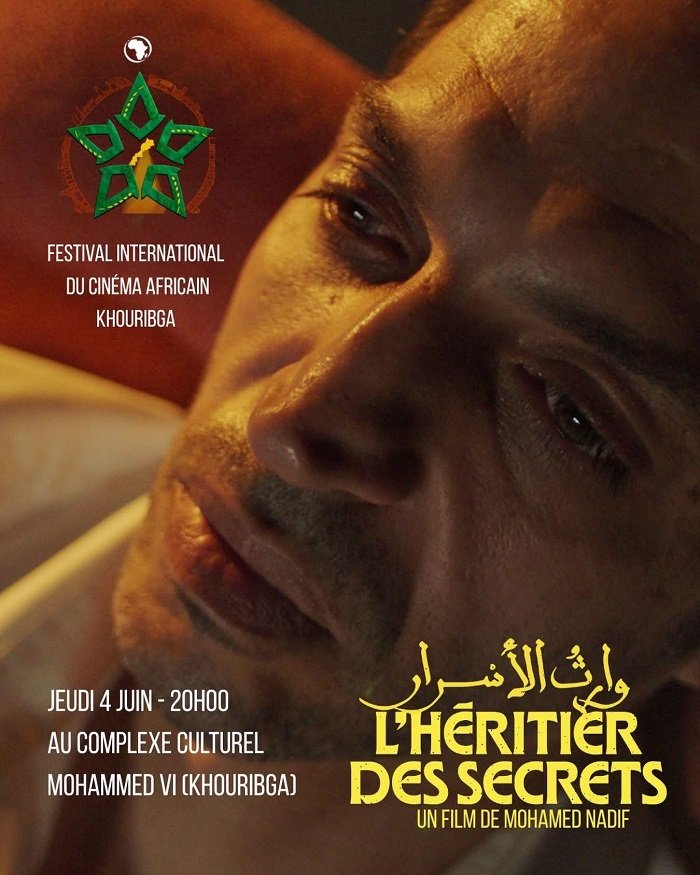
In life, it sometimes takes nothing more than an old letter hidden in a drawer to overturn everything we thought we knew. A buried truth resurfaces, and suddenly the past becomes something different. Memories acquire new meanings, certainties begin to crumble, and silence speaks louder than words. It is from this seemingly simple premise that Moroccan filmmaker Mohamed Nadif builds “Heir to Secrets,” a feature film presented at the Khouribga African Film Festival, before leading audiences into a profound reflection on family, identity, memory, and the weight of hidden truths.
From its opening scenes, the film moves far beyond the boundaries of a conventional family drama. It becomes an exploration of a complex human reality, one rarely addressed in Moroccan cinema with such sensitivity and courage. By choosing to engage with the experiences of transgender individuals and marginalized identities, Nadif avoids sensationalism and controversy for their own sake. Instead, he focuses on the invisible wounds created when personal identity collides with social expectations.
The story follows Farid, whose life is transformed after receiving a letter from Canada revealing that his long-disappeared father had not left the family for another woman, as everyone believed. Behind that disappearance lay a much deeper search: the pursuit of an identity that could not be freely lived within the confines of his original environment.
As the narrative unfolds, it becomes clear that the true subject of the film is not the father’s disappearance itself, but the consequences of that absence for those left behind. A mother trapped between pain and misunderstanding. A son haunted by a childhood shaped by conflict and unanswered questions. And an entire family that built its survival upon an incomplete version of the truth.
Farid’s journey to Canada gradually becomes a journey of self-discovery. In searching for his father, he is also searching for his own past. What he finds is a man who earned respect, friendship, and acceptance while finally living in harmony with himself. More importantly, he discovers the paradox that one person can be rejected in one society and embraced in another, condemned here and celebrated there.
This is where “Heir to Secrets” reaches its greatest social and philosophical depth. The film is not merely about gender identity; it is about society’s capacity to coexist with difference. It questions the boundaries between conformity and freedom, between collective judgment and individual destiny. Above all, it reveals how taboos often generate more suffering than the realities they seek to suppress.
Narratively, Mohamed Nadif demonstrates impressive maturity and control. The movement between past and present enriches the story without disrupting its coherence. Each revelation reshapes the audience’s understanding of previous events, transforming Farid’s personal investigation into a universal exploration of family wounds and inherited pain.
The film’s visual language is equally remarkable. Images do not simply accompany the story; they extend it. The contrast between Moroccan and Canadian spaces functions as more than geographical scenery. It becomes a symbolic dialogue between different visions of identity, belonging, and personal freedom. Cinematographer Kamal Derkaoui’s work stands among the film’s greatest strengths, using light, framing, and movement to create an emotional architecture that elevates every scene.
This visual sophistication is matched by a carefully crafted ensemble performance. The actors inhabit their roles with authenticity and restraint. Younes Bouab delivers what may be one of the strongest performances of his career, giving Farid a psychological depth that carries the audience through every stage of his emotional journey.
The film’s generous production values are evident throughout. From locations and set design to costumes and international settings, every element reflects a clear artistic ambition. Yet the production never feels excessive or self-indulgent; every resource serves the narrative and strengthens its emotional impact.
Ultimately, the greatest achievement of “Heir to Secrets” lies in its ability to transform a sensitive subject into a universal human question. The film does not seek to impose answers. Instead, it invites viewers to observe, listen, and understand before passing judgment. That is perhaps the highest purpose of cinema when it fully embraces its artistic and human responsibilities.
When the credits roll, one impression remains unmistakable: Mohamed Nadif is not simply presenting his third feature film. He is establishing himself as a significant cinematic voice capable of addressing difficult subjects with intelligence, empathy, and aesthetic confidence. Great films do more than tell stories; they compel us to reconsider the world around us. “Heir to Secrets” belongs to that rare category of works whose echoes remain long after the screen goes dark.


