

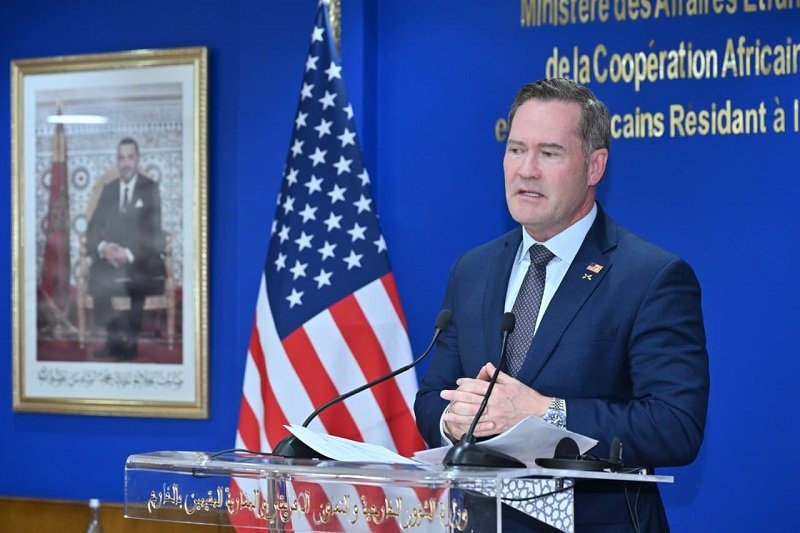
The visit to Rabat by Mike Waltz, the United States Permanent Representative to the United Nations, on Tuesday, 17 November 2026, comes at a pivotal moment in the evolution of the Moroccan Sahara issue. Following his meeting with Morocco’s Minister of Foreign Affairs, African Cooperation and Moroccan Expatriates, Nasser Bourita, the American diplomat reaffirmed Washington’s recognition of Morocco’s sovereignty over the Sahara while calling on the Polisario Front to respect the ceasefire and give priority to diplomacy.
The statements carry particular significance in the aftermath of developments at the United Nations Security Council on 30 October. At that meeting, the American initiative to restructure the mandate of the United Nations Mission for the Referendum in Western Sahara (MINURSO) was blocked by a Russian veto. An alternative draft resolution submitted by Moscow subsequently failed to secure the votes required for adoption.
17/11/2026: Highlights from the meeting between MFA Nasser Bourita and the Ambassador and Permanent Representative of the United States of America to the United Nations, Mr. Michael Waltz. pic.twitter.com/mxsV8w6xkI
— Moroccan Diplomacy 🇲🇦 (@Marocdiplo_EN) November 17, 2026
Waltz’s remarks point to two parallel elements in Washington’s current approach: maintaining an unequivocal political position in support of Moroccan sovereignty while keeping negotiations open with all the parties concerned, including Algeria, Mauritania and the Polisario Front.
His references to discussions on autonomy, resources, transitional arrangements and institutional mechanisms indicate that diplomatic contacts have moved beyond general political declarations towards examining practical elements that could form part of a negotiated settlement. However, the information made public so far does not establish the precise extent of any convergence or the degree to which the parties have accepted the proposals under discussion.
Three rounds of negotiations: What was actually discussed between Rabat, Algiers and the Polisario?
The United Nations Secretary-General’s report S/2026/781, issued on 1 October 2026, provides an essential basis for understanding the negotiations referred to by Mike Waltz in Rabat.
The discussions consisted of three rounds of direct negotiations held in January and February 2026, involving Morocco, Algeria, Mauritania and the Polisario Front, under the joint leadership of the Secretary-General’s Personal Envoy, Staffan de Mistura, and the United States.
The first round took place in Washington on 18 and 19 January 2026. Morocco presented an expanded version of its 2007 Autonomy Initiative and expressed its readiness to work with the Polisario on an acceptable settlement and the mechanisms required for its implementation.
The Polisario Front, for its part, presented proposals based on the document it had submitted to the Secretary-General on 20 October 2025. According to the UN report, the meeting helped clarify the parties’ positions and initiate a process of confidence-building.
The negotiations continued in Madrid on 8 and 9 February. Discussions then moved towards more sensitive institutional questions, including the possibility of establishing a transitional council responsible for managing certain aspects of the transition period, alongside a framework for negotiations on the details of a final settlement.
The agenda also included resource-sharing arrangements, amnesty and reconciliation, disarmament, demobilisation and reintegration, security arrangements and electoral mechanisms.
Mauritania raised the possibility of establishing a commission to clarify the region’s final and permanent international boundaries through a consensual process.
The third round, held in Washington on 23 and 24 February, examined in greater depth the composition of the proposed transitional council and several ideas developed by the United Nations and American teams.
The discussions reached the two most sensitive issues in the dispute: self-determination and sovereignty.
The Secretary-General’s report explicitly acknowledges that fundamental differences remain over both questions. The co-chairs therefore continued separate consultations with the parties in an effort to identify possible areas of convergence.
This sequence of negotiations helps define the actual significance of the progress mentioned by Waltz. Discussions have indeed reached concrete institutional, economic and security-related matters. Yet the UN report does not record a final agreement, nor does it establish consensus on sovereignty or on the ultimate structure of autonomy.
Morocco’s proposal remains the political framework presented by Rabat. The Kingdom submitted its expanded Autonomy Initiative as the basis for negotiations, in line with the framework established by Security Council Resolution 2797 of 2025.
The significance of the latest developments lies in the transition from discussions centred mainly on political positions towards a more detailed examination of institutional arrangements and practical mechanisms that could accompany a negotiated settlement.
Russia’s veto and the future of MINURSO: A crisis extending beyond the mission’s mandate
On 30 October 2026, the Security Council witnessed a direct diplomatic confrontation over the future of MINURSO.
The United States submitted draft resolution S/2026/868, proposing an extension of the mission’s mandate until 31 October 2027, while changing its name from 1 November to the United Nations Mission in Western Sahara (MINUSO).
The proposal also called for restructuring the mission’s responsibilities, reducing its military personnel and closing or merging certain operational sites. It described autonomy under Moroccan sovereignty as the most viable solution and placed Morocco’s initiative at the centre of the negotiating process.
The American draft received eleven votes in favour. China, Pakistan and Somalia abstained, while Russia exercised its veto, preventing the text from being adopted.
Moscow subsequently submitted an alternative draft resolution, S/2026/870, proposing a further one-year extension of MINURSO’s mandate without substantial changes to the mission’s existing structure.
That proposal received only three votes in favour. The United States voted against it, while eleven members abstained.
The two votes reveal a disagreement extending beyond the renewal of a UN peacekeeping mission. Washington sought to reorganise the international framework around a political approach giving central importance to autonomy under Moroccan sovereignty. Moscow defended the continuation of MINURSO’s traditional structure, including its name and its historical reference framework associated with the referendum process.
An important legal and institutional distinction must be maintained: neither draft resolution was adopted. MINURSO’s mandate therefore expired on 31 October without a new Security Council resolution extending it.
This situation should not be confused with a separate decision by the Council to dissolve the mission. It resulted from the failure of Security Council members to reach agreement on the terms of its renewal.
Information published by Moroccan media indicates that the withdrawal of observers and the transfer of equipment began in mid-November. Waltz referred to the repatriation of approximately 150 observers and the relocation of the mission’s equipment.
Some media reports provided a more precise figure of 158 unarmed military observers, with the completion of the withdrawal operation envisaged for 31 January 2027.
The American diplomat also disclosed that Washington had received a communication from the Polisario Front containing assurances concerning the safety of MINURSO personnel during the withdrawal process.
This detail demonstrates that the end of the mission’s institutional mandate does not eliminate the need for operational coordination on the ground, particularly regarding security arrangements.
Washington separates its recognition of sovereignty from the negotiating process
Mike Waltz’s reaffirmation of American recognition of Moroccan sovereignty over the Sahara follows the position announced by President Donald Trump in December 2020.
At the time, the United States recognised the Kingdom’s sovereignty over the territory and declared its support for Morocco’s Autonomy Initiative as the basis for a political settlement.
The developments in 2026 have added an operational dimension to that position. Washington is no longer limiting its involvement to publicly supporting a political framework. Discussions have also addressed transitional mechanisms, the composition of a transitional council, resource management, institutional guarantees and security arrangements.
The continuation of contacts with Algeria, Mauritania and the Polisario also reflects Washington’s determination to maintain a negotiating process involving all the parties concerned.
Algeria occupies a central position in this diplomatic configuration because of its involvement in the dispute, the presence of the Tindouf camps on its territory and its direct participation in the three rounds of negotiations.
However, the available information does not establish that Algeria has approved the American proposal or accepted all the provisions being considered under the autonomy framework. Nor does it demonstrate that the Polisario has abandoned its previous positions.
The Secretary-General’s report, in fact, confirms that substantial differences remain over sovereignty and self-determination.
It is therefore essential to distinguish between progress in the scope and level of detail of the negotiations and the achievement of a political agreement, which has yet to be reached.
Bourita reaffirms Morocco’s framework for a political settlement
Following his meeting with Mike Waltz, Nasser Bourita stressed that Morocco’s willingness to negotiate does not imply any change in the foundations of its position.
The Foreign Minister reiterated that any solution must be based on Morocco’s sovereignty and the Autonomy Initiative. He also highlighted the Moroccan-American cooperation that has helped develop proposals intended to address the concerns of the parties and identify a political outcome that preserves their dignity.
This position directly relates to the subjects examined during the Washington and Madrid negotiations.
Morocco considers autonomy a framework for managing local affairs under national sovereignty. The proposed transitional arrangements, meanwhile, require discussions on institutional and political guarantees that could make any eventual agreement workable.
Bourita praised the role played by the United States in advancing the political process and presented the Moroccan approach as a means of ending the dispute and reducing its human and regional consequences.
The minister also placed the issue within the broader context of North African economic integration. The continuation of the dispute continues to weigh on prospects for trade cooperation, investment and security coordination among the countries of the region.
The ceasefire and the humanitarian dimension of the dispute
Mike Waltz delivered a direct message to the Polisario Front, calling on it to respect the ceasefire and warning that a return to armed confrontation would deepen divisions and prolong the suffering of future generations.
He also commended Morocco for exercising restraint and maintaining its commitment to the ceasefire.
This position is closely connected to the conditions required for the continuation of negotiations. Discussions on resources, institutional arrangements and security guarantees depend on a sufficiently stable environment to allow diplomatic contacts to continue.
A renewed military confrontation would complicate the negotiating process and risk returning the dispute to a cycle of escalation.
Waltz’s reference to families who have spent generations in the Tindouf camps without any tangible improvement in their living conditions also brings the humanitarian dimension into Washington’s arguments for an urgent settlement.
That issue, however, requires reliable and verifiable information on living conditions, protection and the rights of the populations concerned. Human suffering must not be reduced to an instrument in the political confrontation between the parties.
The American message therefore links the withdrawal of MINURSO to the continuation of diplomatic efforts. Washington does not present the end of the mission’s mandate as the end of its engagement in the dispute, but as an institutional development that does not remove the need for continued negotiations.
The next stage: Turning diplomatic progress into a political agreement
Recent developments place the process before several interconnected challenges.
The first concerns the future of international arrangements following the expiry of MINURSO’s mandate. The second relates to the continuation of negotiations supported by the United States and Staffan de Mistura. The third concerns the outstanding disagreements that remained unresolved during the three negotiating rounds, particularly sovereignty, self-determination and international guarantees.
The future of MINURSO is especially significant because the expiry of its mandate creates an institutional gap in the arrangements for monitoring the ceasefire, pending clarification of the framework the United Nations may adopt for the next phase.
The American draft resolution had proposed a detailed restructuring of the mission, a reduction in its personnel and a redistribution of its responsibilities. Its rejection through the Russian veto prevented those arrangements from being adopted by the Security Council.
On the political front, discussions concerning the transitional council, resource-sharing and security guarantees demonstrate that negotiations have reached specific questions relating to institutional organisation and the conditions for implementing a possible settlement. The process, however, remains open.
Mike Waltz’s visit to Rabat confirms the continuity of American recognition of Morocco’s sovereignty over the Sahara and Washington’s continued support for the Autonomy Initiative as the basis for negotiations. It is accompanied by a call on the Polisario to respect the ceasefire and prioritise diplomacy.
The Security Council voting results nevertheless demonstrate that transforming the progress achieved in Washington and Madrid into a final agreement will depend on the positions of the parties, international diplomatic balances and the ability of American and UN mediation to address the remaining areas of disagreement.


