

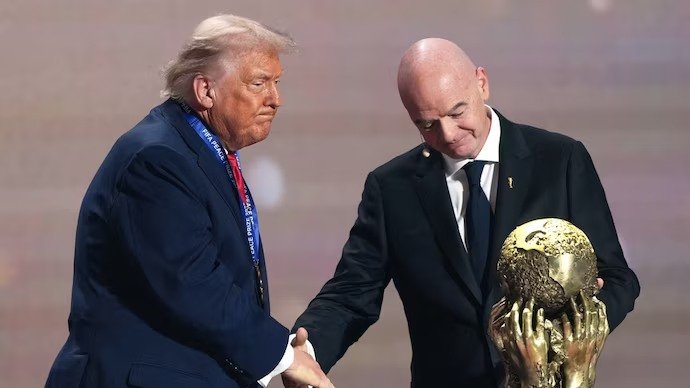
At a moment when sport is increasingly intertwined with politics, and stadiums are turning into an undeclared extension of power struggles, a controversial proposal has emerged from a circle close to Donald Trump: replacing Iran’s national team with Italy in the 2026 World Cup. At first glance, it may appear to be merely an individual opinion, but at its core it reveals deeper shifts affecting the balance of global sport and the limits of its independence.
The story, as reported by the Financial Times, began with a statement from businessman and unofficial envoy Paolo Zampolli, who did not hide that his motivation carries a personal dimension linked to his Italian origins, while at the same time touching broader political stakes. Indeed, bringing Italy—home to a rich footballing history—back into a tournament partly hosted in the United States cannot be separated from efforts to reshape relations between Washington and Rome, particularly under Giorgia Meloni’s government.
However, despite its symbolic weight, the proposal collides with a strict institutional reality. FIFA does not run its competitions according to political desires or diplomatic calculations, but through a precise qualification system based on sporting performance. Its president Gianni Infantino was clear in stating that Iran’s participation is secured and that its qualification was achieved under the established rules, an implicit rejection of any external interference.
On the other hand, the Italian response was swift. Sports and political authorities, led by Sports Minister Andrea Abodi, considered the idea neither realistic nor consistent with the spirit of competition. This position reflects an awareness that participation not grounded in sporting merit can become a symbolic burden rather than an advantage.
What makes this debate go beyond the purely sporting sphere is the broader international context. Iran’s national team, which qualified fairly through Asian qualifiers, does not only represent a football presence, but also a country involved in political tensions with the West. The question therefore becomes deeper: can sporting competitions become tools of pressure or instruments for reshaping international relations? Or are sports institutions truly capable of preserving their independence?
For the average citizen, this debate may seem distant from daily life, but in reality it reflects dynamics that indirectly influence perceptions of justice and fairness in the world. If the rules of a competition as large as the World Cup can be interpreted or politicized, this raises broader questions about the credibility of international institutions, whether sporting or otherwise.
In the end, it is unlikely that Zampolli’s proposal will be implemented, but it has succeeded in exposing the fragility of the boundaries between politics and sport, and in raising an old question in a new form: to what extent can “the game” be protected from power calculations? And is it still possible to convince audiences that what happens on the pitch is decided only by goals, not by deals?


