

It was not simply a piece of cloth being pulled apart before being thrown away. When the Moroccan flag is torn in a Spanish political setting, the image goes far beyond the moment itself. The flag is not merely a detail in a passing scene. It represents a state, a collective memory and a national dignity. That is precisely why the Popular Movement chose a firm tone in its response, with a message that leaves little room for ambiguity: Morocco can disagree with Spain, negotiate with it, and even clash with it over specific interests, but friendship can never become a license to humiliate.
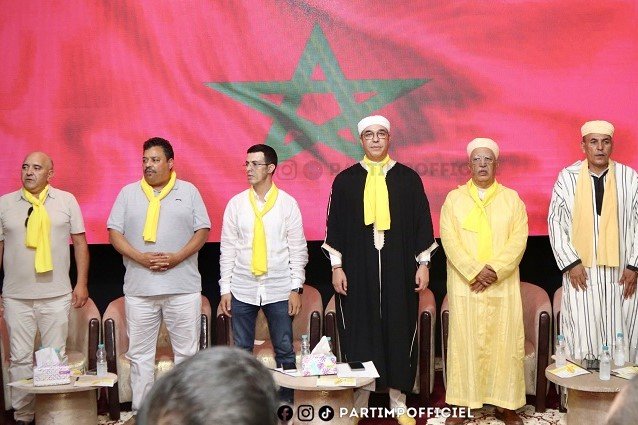
In a statement signed by its Secretary General, Mohamed Ouzzine, the Popular Movement did more than condemn the tearing of the Moroccan flag. It placed the incident within a much broader framework, describing it as an affront to national sovereignty, dignity and the collective memory of Moroccans.
That is where the political significance of the position begins.
The Popular Movement did not treat the incident merely as a provocative act committed by individuals or by a Spanish political current. It described it, in the language of the statement, as reflecting a colonial tendency belonging to the past. That choice of words is not incidental. It invokes a history that remains present in Moroccan-Spanish relations, even when economic and political interests seek to turn the page.
Yet the most striking element lies elsewhere: despite the firmness of the statement, the Popular Movement did not call for a rupture or escalation with Spain.
Quite the opposite.
The party insists that Morocco will continue to uphold friendship, good-neighborly relations and cooperation with Spain. This is arguably one of the statement’s most important messages: Morocco can reject humiliation without rejecting the relationship.
The problem, as presented in the statement, is therefore neither the Spanish people nor Spain as a state. It concerns political behavior that Rabat considers incompatible with the kind of relationship that should exist between the two countries today.
And this is where the statement moves from the flag to something much larger.
When it stresses Morocco’s sovereign right to define the nature of its relations and strategic interests, it clearly invokes the issues that continue to shape Moroccan-Spanish relations: the economy, trade, maritime affairs, strategic interests and fisheries.
The political message that can be read between the lines is direct: Morocco does not manage its foreign relations under pressure from provocation, it does not trade sovereignty for economic interests, and it does not accept a partnership turning into supervision over its decisions.
That dimension becomes particularly significant in the fisheries issue, which has for years remained one of the most sensitive files in relations between Morocco, the European Union and Spain. Morocco’s decisions, the statement insists, must be based on national interests and independent sovereign choices, rather than on the expectations of outside actors.
The statement does not establish a direct link between the flag incident and the fisheries issue. But placing these matters within the same political framework gives the message a scope that goes beyond a symbolic condemnation.
Morocco appears to be saying that the era in which its relations were managed through a logic of reaction is over.
Much has changed in recent years. Spain itself has moved from a period of tension toward a new phase of cooperation with Rabat, particularly after Madrid’s major shift in its position on the issue of Moroccan Sahara. Against that backdrop, the return of certain narratives or behaviors invoking the colonial past may appear, from the Moroccan perspective, increasingly out of place in a relationship that is supposed to have entered a different phase.
This is also where Mohamed Ouzzine’s tone can be understood.
The Secretary General of the Popular Movement did not place friendship in opposition to dignity. Instead, he redefined the terms of the relationship: a genuine partner does not ask Morocco to surrender its sovereignty in order to preserve friendship; good neighborliness does not mean remaining silent in the face of insult; and dialogue can only work when both sides sit at the table as equals.
The statement captures this in one of its strongest formulations: “friendship does not mean giving up dignity, good-neighborliness does not mean accepting insult, and dialogue cannot succeed except on the basis of parity and mutual respect.”
In politics, words are not always just words.
The way they are chosen can sometimes reveal more about the political message than official decisions themselves. And the Popular Movement has chosen here the language of sovereignty, dignity, parity and mutual respect. These are words that go beyond the flag incident and establish what amounts to a broader rule for Moroccan-Spanish relations: cooperation, yes, but without being trapped by the past; friendship, yes, but without surrender; dialogue, yes, but never from a position of weakness.
The image may quickly disappear from Spanish screens. It may be viewed as a limited political gesture. In Morocco, however, national symbols are not treated so lightly.
A flag torn in front of cameras is not simply a passing image. It reaches millions of Moroccans, evokes a long history of struggle for sovereignty and touches a national memory that remains particularly sensitive to anything perceived as contempt for Morocco or an attack on its dignity.
That is why the Popular Movement chose to raise its voice without closing the door.
And perhaps that is the most politically calculated message in the statement: anger does not mean rupture.
Morocco, according to this position, is not looking for another crisis with Spain. But neither does it want a relationship in which it is expected to swallow humiliation in the name of friendship.
Ultimately, the flag may have been the object torn apart in that moment, but the political question left behind is much larger: what kind of relationship does Rabat want with Madrid?
The Popular Movement’s answer is clear: cooperation, yes; shared interests, yes; permanent dialogue, yes. But above all, a sovereign Morocco that decides its own interests and knows where friendship begins and where concessions must stop.
National dignity is not a bargaining chip, sovereignty is not a secondary clause in an agreement, and friendship with Spain cannot come at the expense of respect for Morocco.


